
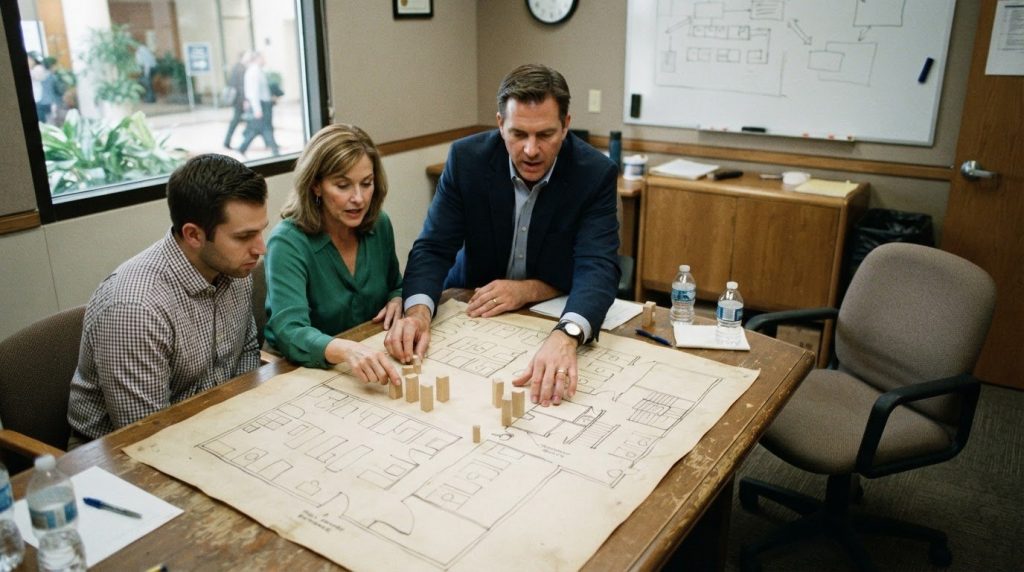
Organizations often test crisis management plans with tabletop exercises once or twice a year, then review the plan annually and after a major organizational change or real incident. To understand how to test your crisis response plan, start with a structured tabletop exercise that walks key participants through their roles and decisions. As the plan and response capability mature, progress to scenario walk-throughs or full-scale simulations.
A test is valuable not because it ends neatly, but because it reveals where decisions, communications, or responsibilities break down. Include situations in which key leaders are unavailable to see how the team maintains continuity. A disciplined post-exercise evaluation turns observations into specific revisions and follow-up actions, rather than leaving lessons in meeting notes. This article explains how to choose an exercise, test roles and communication under pressure, document performance, and turn findings into a stronger plan. It also covers how often to test and update the plan, so readiness remains an active management practice rather than a document review.
Key Takeaways
- Use scenarios that reflect plausible disruptions and test whether response options can adapt when events don’t follow a single script.
- Prepare communication channels with independent backups, and ensure the designated spokesperson handles media inquiries.
- Make initial crisis messages factual: confirm awareness, describe the response underway, share immediate safety steps when relevant, and set expectations for the next update.
- Record exercise findings in sequence, assign follow-up actions, and distribute revised plan details to the people who need them.
How Often Should You Test And Update A Crisis Management Plan?
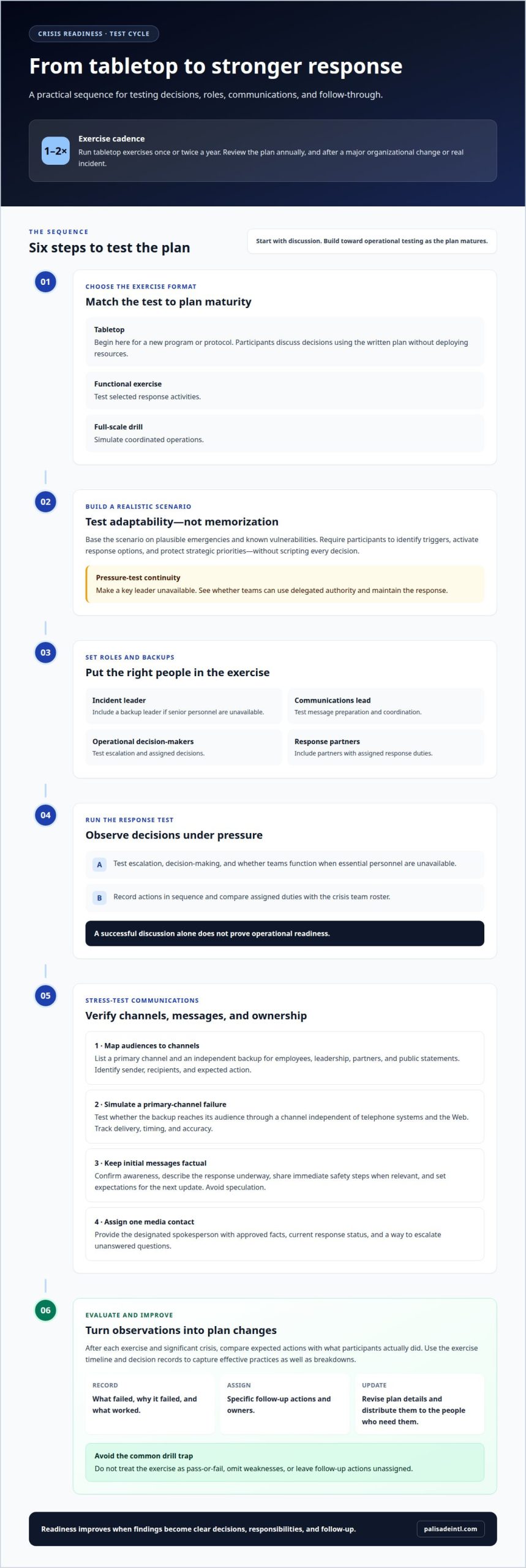
Run crisis management tabletop exercises once or twice a year. Review the plan annually, and after a major organizational change or real incident.
Test the plan in stages, then use the findings to clarify decisions, responsibilities, and support.
Choose a Crisis Exercise Format
- Start with a tabletop exercise when introducing a new program or protocol. Participants work through the written plan and discuss decisions without deploying resources. Then use a functional exercise to test selected response activities, or a full-scale drill to simulate coordinated operations. Choose a format that matches the plan’s maturity and the capabilities being reviewed.
U.S. testing expectations can depend on an organization’s sector and applicable requirements. Identify the rules governing your operations, then document how the exercise tests relevant procedures. Include the incident leader, communications lead, operational decision-makers, and partners with assigned response duties. Name a backup leader to step in if senior personnel are unavailable.
Create Realistic Crisis Scenarios
- Build a scenario around plausible emergencies and known vulnerabilities. Include a disruption that requires participants to identify triggers, activate response options, and protect strategic priorities. Avoid scripting every decision or listing every possible event. For example, test what happens when a key leader cannot be reached and teams must use delegated authority.
For clinical safety planning, distinguish individual support from an organization’s emergency plan. Safety planning can identify distress indicators and steps to take before or during a crisis. Manuals, videos, webinars, and apps can help people access those steps. Screening and assessment can inform an individualized plan, but they do not replace a tested organizational response. Research has found benefits in multiple studies; the VA/DoD guideline found insufficient evidence to recommend for or against such planning for certain patients.
Test the Crisis Response Plan
- Run the exercise with assigned participants, including backups for key roles. Test escalation and decision-making, and see whether teams can function when essential personnel are unavailable. Record actions in sequence and compare assigned duties with the crisis team roster. A successful discussion alone does not prove operational readiness.
Safety planning is distinct from no-harm contracts, which have no research support. Use collaborative, patient-centered safety planning rather than treating a contract as a substitute. After each exercise, record gaps and assign follow-up actions. This tests practical readiness while keeping clinical planning and organizational crisis procedures distinct.
Communication channels and designated spokespersons
Test emergency notifications by simulating a primary-channel failure and activating a backup. Verify that teams receive instructions through channels independent of telephone systems and the Web.
- Map each audience to a primary channel and a backup. For example, list employee notifications, leadership updates, partner coordination, and public statements separately. Identify who sends each message, who receives it, and what action should follow. Then test whether the backup reaches its intended audience when the primary channel is unavailable.
- Prepare messages before an emergency and test them during an exercise. Draft an initial statement that confirms awareness, describes the response underway, gives immediate safety steps when relevant, and sets expectations for the next update. Keep it factual. Avoid speculation that could misdirect employees, partners, or the public.
- Assign one designated media contact to handle media inquiries during the drill. Other team members should not speak for the organization while carrying out separate assigned roles. Test the handoff by providing the spokesperson with approved facts, the current response status, and a way to escalate unanswered questions.
- Simulate a channel outage and track message delivery, timing, and accuracy. For example, disable the exercise’s primary notification route and require the team to use its independent backup. Record who received the alert, who acknowledged it, and whether instructions remained consistent across channels. Test recovery updates as well as initial activation.
Use the results to refine communication strategies, contact lists, and message approval steps in the crisis program. A focused crisis management review can help identify communication vulnerabilities and improve response procedures.
Formal post-test evaluations and plan improvements
Common drill mistakes include treating an exercise as pass-or-fail, omitting weaknesses, and leaving follow-up actions unassigned. Record what failed, why it failed, and which change will address it.
-
Conduct a Formal Post-Test Evaluation
Schedule a documented review after each exercise and significant crisis. Compare expected actions with what participants actually did, using the exercise timeline and decision records. Capture effective practices as well as breakdowns, such as an approval delay that held up an internal alert. Ask participants to explain their decisions rather than simply rate the exercise. Teams across departments, partners, or national operations may have different mental models of the response. Record those differences as findings.
-
Identify Drill Mistakes and Risks
Classify each finding by its operational effect and the process involved. Look for unclear authority, outdated contact details, conflicting instructions, or decisions that stalled when information changed. Avoid declaring an exercise flawless; reviews claiming everything worked may receive greater auditor scrutiny. Separate scenario limitations from genuine response gaps, and note where participants lacked information. For example, a delayed decision may point to an unclear escalation trigger rather than an individual failure.
-
Improve the Crisis Response Plan
Turn each finding into a specific action with an accountable role and a completion point. Replace vague directions such as “notify leadership” with a defined notification sequence and decision authority. Update affected procedures, then redistribute the revised plan to relevant parties. Record why each change was made so later exercises can test whether it worked. Use management reviews to track open actions, recurring issues, and changes that improve readiness across teams.
What are the steps to test a crisis response plan?
A practical way to test your crisis response plan is to start with a staged exercise. Move from written procedures to operational decisions, and keep each test focused on observable actions and documented outcomes.
- Set the exercise objective. Choose a capability to examine, such as escalation, continuity, or cross-region coordination. Define what participants should demonstrate, which plan sections apply, and what evidence observers will record. A focused objective makes it easier to distinguish useful findings from general discussion.
- Choose a scenario that reflects plausible disruptions and relevant vulnerabilities. Include enough detail to engage participants, but avoid scripting every decision. A hypothetical business from another industry can test response processes without relying on familiarity with the organization’s routine operations.
- Choose the exercise scale and participants. Begin with a tabletop discussion for a new protocol, then progress to simulated drills or a full-scale exercise. Include the functions and organizational levels involved in the response. For regional operations, test coordination across locations and allocate sufficient time and resources.
- Prepare a sequence of scenario developments. Introduce changes that require participants to reassess information, adjust response options, and protect strategic priorities. Keep developments controlled and relevant to the objective. Avoid adding complications that test unrelated procedures or distract from the decisions under review.
- Run the exercise and record actions in sequence. Note decisions, assigned duties, information used, and handoffs between teams. Compare actions with the crisis team listing. Identify where participants pause, interpret instructions differently, or cannot access the information they need to proceed.
- Close by turning observations into assigned follow-up actions. Document what worked, what failed, and which plan changes address each gap. Track completion through management review, then use a later exercise to test whether revisions improved performance. Apply these steps whenever you need to test your crisis response plan.
For tailored support assessing organizational exposure and response procedures, explore crisis management support.
Palisade International: Executive Protection
Palisade International provides Executive Protection for leaders whose exposure calls for a considered security posture. When an exercise identifies threats involving senior personnel, workplace violence, or vulnerabilities in protective arrangements, Risk Analysis & Vulnerability Assessments can help clarify risks and inform planning. Workplace Violence Prevention addresses risks that may affect employees and organizational continuity, while Private Investigations can support fact-finding when a specific concern requires examination.
These services complement internal crisis planning; they do not replace the organization’s own response procedures. The appropriate next step depends on the exposure identified, the people at risk, and the operational decisions that remain unresolved. For a confidential discussion about your organization’s security needs, contact Palisade International.
Make Readiness Part of Ongoing Risk Governance
Knowing how to test your crisis response plan is only the beginning. Make readiness part of routine risk governance, with clear ownership for keeping procedures aligned with organizational priorities. As operations, personnel, and exposure change, leaders can use exercise findings to decide where additional expertise may help.
Palisade International provides Executive Protection, Workplace Violence Prevention, and Risk Analysis & Vulnerability Assessments. These services address concerns involving executive safety, workplace threats, or vulnerabilities that need closer assessment. They complement internal planning with focused security capabilities for specific organizational needs.
If your exercise has surfaced unresolved risks or protection requirements, contact Palisade International to discuss a considered next step. Continued attention to readiness can help your organization move forward with greater clarity and purpose.
Frequently Asked Questions
How often should organizations test their crisis response plan?
Organizations often conduct tabletop exercises once or twice a year and review their plan annually. Revisit it after a major organizational change or real incident, since either can alter responsibilities, risks, or operational dependencies. Use the review to decide whether the exercise frequency or format should change, especially when earlier findings remain unresolved or teams have changed.
How do you measure crisis response plan performance and define success criteria?
Define observable criteria before the exercise, tied to its objective. For a decision-authority test, success might mean participants identify who can approve a response when a leader is unavailable. For a notification test, examine whether intended recipients receive accurate instructions through the designated channel. Record evidence and gaps rather than relying on participants’ impressions alone.
What should a crisis response plan exercise evaluation include?
Include the exercise objective, scenario developments, key decisions, communication handoffs, and any departure from written procedures. Capture what participants knew at each decision point and whether that information supported their actions. Include observer notes and participant feedback, then distinguish isolated confusion from a procedural weakness. This record gives reviewers a clearer basis for deciding what needs attention.
How do you document lessons learned and update the crisis response plan after a test?
Create a dated record linking each finding to its evidence, corrective action, and accountable role. For example, if an approval route caused confusion, document the revised authority and where the procedure changed. Track unresolved actions through management review, update the controlled plan version, and distribute it to relevant personnel. A later exercise can test whether the revision addressed the gap.