

Closing an incident is not the same as learning from it. A post-incident security review should reconstruct what happened, identify gaps in detection and containment, and assign corrective actions to accountable owners. NIST CSF 2.0 identifies RS.IM, Improvements, as relevant to turning findings into control and process improvements, while NIST IR 8596 includes a lessons-learned phase relevant to post-incident reviews.
It’s reasonable to focus first on restoring operations and limiting harm. But a clear, structured post-incident security review helps establish which controls worked, where response decisions or information flows fell short, and what needs to change. This article explains how to assess an incident, document practical lessons, and turn findings into trackable actions. It also shows how consistent incident tags can connect related reviews, helping teams recognize recurring patterns without treating each event in isolation.
Key Takeaways
- Translate incident findings into corrective actions with clear owners, priorities, and ways to track completion.
- Reconstruct how detection and containment unfolded to pinpoint where signals, decisions, or handoffs created delays.
- Clarify decision authority and accountability so response roles and follow-through remain visible throughout the review.
- Use consistent incident tags to connect related events and reviews, making recurring patterns easier to identify.
Lessons learned and corrective actions
A lessons-and-actions review turns incident evidence into operational changes that can reduce repeat exposure. A blameless security incident postmortem examines decisions and working conditions without assigning personal fault. It focuses on how systems and processes shaped the outcome.
Lessons from security incidents
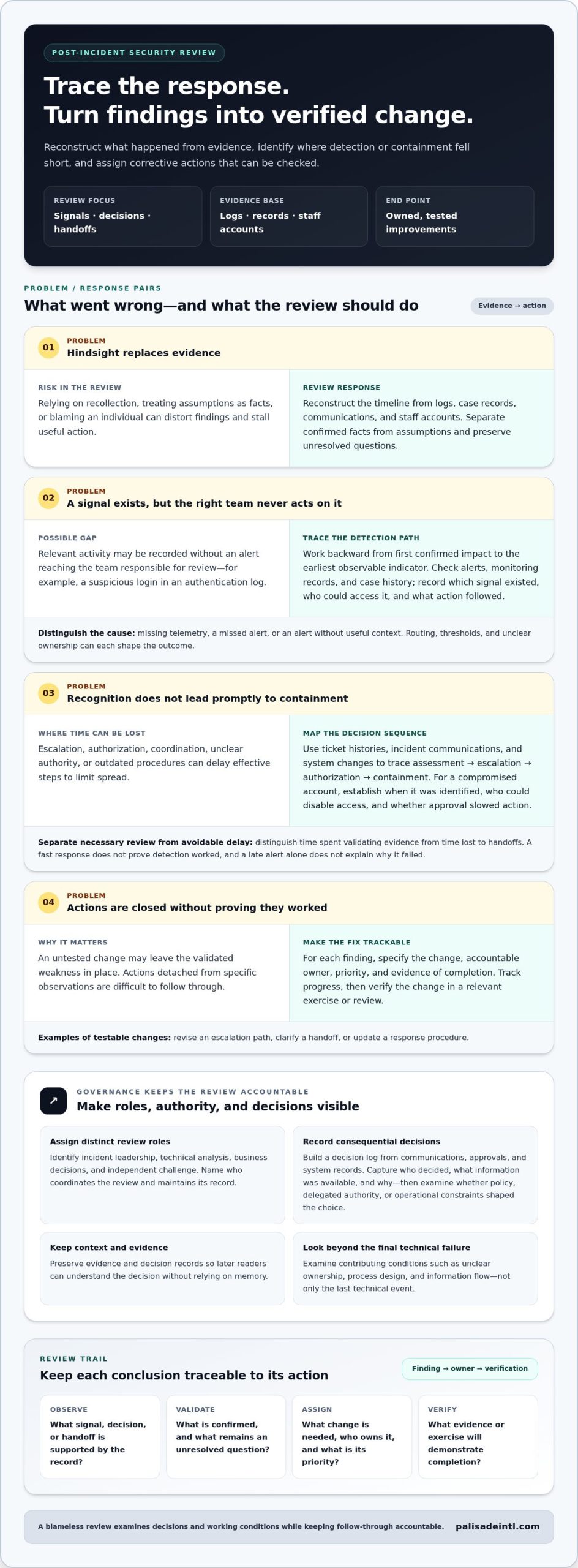
Lessons learned are evidence-based findings about how an incident and the response unfolded. Reconstruct the timeline, compare alerts and decisions with intended procedures, and separate confirmed facts from assumptions. NIST IR 8596 includes a lessons-learned phase relevant to post-incident reviews. NIST CSF 2.0 identifies RS.IM, Improvements, as relevant to turning incident findings into control and process improvements. Validate conclusions against available logs, case records, and staff accounts. Record what helped recognition and what obscured the signal, such as an alert routed to the wrong team.
Corrective action items
Corrective action items are assigned changes that address validated causes or weaknesses. For each finding, specify the change, an accountable owner, a priority, and evidence that will demonstrate completion. DORA requires structured ICT incident management and post-incident improvement for resilience. CIS Controls v8 Control 17 covers learning from incidents and strengthening incident response capability. Translate findings into testable steps: revise an escalation path, clarify a handoff, or update a response procedure. Track progress through completion and verify the change in a relevant exercise or review.
Review mistakes and risks
Review mistakes can distort findings or stall corrective action. Common pitfalls include blaming an individual, relying on recollection instead of records, treating assumptions as facts, and closing actions without testing their effectiveness. A security incident review should look beyond the final technical failure to contributing conditions such as unclear ownership, process design, and information flow. Preserve evidence and decision records, distinguish unresolved questions from findings, and tie actions to specific observations. This supports candid analysis while keeping follow-through accountable.
Detection gaps and containment delays
Detection gaps and containment delays show where incident signals failed to prompt timely action. Reconstruct both paths using alert records, case notes, and decision timestamps rather than relying on memory.
Detection gaps
A detection gap occurs when relevant activity is not identified or escalated using available signals. Trace the incident backward from the first confirmed impact to the earliest observable indicator. Compare that indicator with alerts, monitoring records, and the response team’s case history. For example, a suspicious login may appear in an authentication log without an alert reaching the team responsible for review. The control may have recorded the activity, while routing, thresholds, or unclear ownership prevented investigation. Record which signal existed, who could access it, and what action followed. Distinguish missing telemetry from a missed alert or an alert without useful context. Each cause calls for a different improvement.
Containment delays
A containment delay is the time between recognizing a threat and taking effective steps to limit its spread. Map the sequence from initial assessment through escalation, authorization, and containment. Use ticket histories, incident communications, and system changes to establish when each decision occurred. For a compromised account, determine when responders identified it, who could disable access, and whether approval or coordination slowed action. Examine dependencies as well: a team may have recognized the risk promptly but lacked clear authority or current procedures. Distinguish time spent validating evidence from time lost to avoidable handoffs. That distinction helps avoid corrective actions that weaken necessary review.
Compare the intended response path with the recorded sequence, then identify where detection or containment diverged. Ask whether alert criteria matched the activity, whether the right team received the signal, and whether responders had the access and authority to act. Document each conclusion alongside its supporting record and any unresolved question. A fast response does not prove detection worked: an incident may be contained after substantial exposure. Likewise, a late alert alone does not explain why detection failed. Link each identified gap to a specific improvement, such as revising an escalation route or clarifying containment authority. This creates a traceable basis for action without mistaking symptoms for causes.
Governance and accountability
Incident governance defines who directs, reviews, and approves decisions during and after a security event. In a post-incident security review, assign distinct roles for incident leadership, technical analysis, business decisions, and independent challenge. For example, the incident lead can coordinate the review while a system owner explains access decisions. A senior decision-maker can resolve conflicts across teams. Clear separation helps prevent one person’s assumptions from becoming the accepted account. Document each role and its authority in the review record.
Decision accountability means recording who made consequential choices, what information they had, and why they acted. Build a decision log from incident communications, approvals, and system records. If a manager delayed disabling an account, capture the stated reason and available evidence. Then examine whether policy, delegated authority, or operational constraints shaped the choice. This distinguishes an individual decision from a governance weakness, such as unclear approval authority. Preserve relevant context so later readers can understand the decision without relying on memory.
- Review ownership: Name the person responsible for coordinating the review and maintaining its record.
- Decision rights: Identify who can approve containment, business disruption, and external communication.
- Independent challenge: Ask a reviewer outside the immediate response team to test assumptions and identify conflicts.
- Escalation path: Record how unresolved disagreements reach the appropriate decision-maker.
Governance also determines how sensitive findings are handled and shared. Set access according to each participant’s role, and keep the evidence record separate from broad status updates. A technical finding, for example, may inform leadership without exposing unnecessary personal or investigative details. Define who can approve changes to the final assessment and how corrections are recorded. Close the review by presenting unresolved risks, decisions needing leadership attention, and actions awaiting approval. This gives leaders a clear basis for oversight while preserving an auditable record of how conclusions were reached.
Incident tags and related reviews
Incident tags are consistent labels used to classify events by shared characteristics. A controlled set of tags helps reviewers connect cases without relying on memory or inconsistent descriptions.
Post-incident review timing
Review timing is when a structured examination begins after an incident. Start once immediate response priorities are stable and relevant records are preserved. No single interval works for every event: active containment, evidence volatility, and staff availability all affect readiness. If technical analysis is ongoing, begin with a preliminary review and update findings as evidence develops. In short, begin promptly after stabilization and preservation, then follow up as new facts emerge.
Information and evidence collection
Evidence collection preserves the records needed to reconstruct an incident and assess its impact. Gather incident reports, system and access logs, alert records, relevant communications, response decisions, and timestamps. Record each item’s source, collection time, and relationship to the event. Preserve original records and document any transformations used in analysis. These details help reviewers distinguish evidence recorded at the time from later recollection.
For useful tag design, choose labels that describe observable features rather than conclusions. A case might be tagged by affected asset, entry method, detection source, and business process. Define each label’s meaning, permitted values, and owner in a shared taxonomy. Avoid overlapping labels such as “account issue” and “credential misuse” unless their distinction is clear. Consistent definitions make later comparisons more reliable.
Connect related reviews with shared tags and a brief rationale. Cases tagged with the same detection source, for example, may reveal recurring routing problems, while a shared asset tag may point to repeated exposure. Compare timelines and findings while preserving each event’s context. A matching tag suggests a relationship to investigate, not proof of a common cause. Link the records, note similarities and differences, then decide whether a broader review is warranted.
Use a simple sequence: define tags, apply them during case closure, search for recurring combinations, and record any resulting review. To build a more structured picture of security risks, discuss a tailored security review.
Palisade International: Executive Protection
Palisade International provides Executive Protection for individuals whose security needs extend beyond the findings of an incident review. Consider this support when an event reveals credible concerns about an executive’s exposure, movements, or workplace environment. For organizational risks, Workplace Violence Prevention and Risk Analysis & Vulnerability Assessments can help address related security concerns. Private Investigations may be relevant when unanswered questions require discreet fact-finding. These services address different needs; a review’s findings can help clarify which concerns require attention and what context matters. Share the relevant security objectives and incident context to support a focused discussion while handling sensitive information with care. Contact Palisade International or visit palisadeintl.com to discuss your security needs.
Make the next security decision deliberate
A completed post-incident security review can inform more than a technical correction. Findings may reveal exposure involving people, workplaces, or operational vulnerabilities, providing a basis for broader security decisions. The next step is to distinguish immediate risks from longer-term concerns and determine which call for specialist support.
Palisade International offers Executive Protection, Workplace Violence Prevention, and Risk Analysis & Vulnerability Assessments for distinct security needs. These services may be relevant when findings point to personal exposure, workplace risk, or vulnerabilities that require assessment. Matching support to the specific finding keeps the response focused and proportionate.
Consider what the review has established, what remains unresolved, and which risks extend beyond internal corrective actions. A focused discussion can help define an appropriate path forward. Contact Palisade International to discuss your security needs and take the next step with clarity.
Frequently Asked Questions
What is a post-incident security review?
A post-incident security review is a structured examination of a security event and the organization’s response. It establishes what happened, assesses consequences, and identifies where safeguards or procedures need attention. After unauthorized access to a business account, for example, reviewers may examine how access was obtained and which business functions were affected. The purpose is to support informed decisions, not simply close the incident record.
What are the steps in a post-incident security review?
Conduct the review in stages, from defining its scope to following through on actions. Specify which event, systems, and business functions it covers. Then assemble relevant records, establish a reliable timeline, and assess impact. Analyze contributing conditions, agree on findings, and turn them into actions with clear ownership and completion criteria. A review of a compromised vendor account, for example, might examine the access path and affected internal processes.
Who should participate in a security incident review?
Include people who can explain the affected operations, technology, and decisions. A system administrator can clarify how a service behaved, while a business unit representative can describe operational consequences. Involve privacy, legal, communications, or third-party representatives when the incident touches their responsibilities. A review of a supplier-related event may also benefit from a vendor contact who can clarify relevant service activity. Limit access to sensitive material appropriately.
What should a security incident review report include?
A useful report gives readers enough context to understand the event and make decisions. Include the review’s scope, a concise incident description, affected business functions, and the basis for key conclusions. Separate verified findings from unresolved questions, and note any limitations that shaped the analysis. A post-incident security review report can include an executive impact statement, with supporting logs or diagrams in controlled appendices for technical readers.
How do you identify root causes and corrective actions after a security incident?
Identify root causes by tracing the conditions that allowed an event to occur or continue, rather than stopping at its visible trigger. Ask what made a control ineffective and which organizational or technical conditions contributed. If a shared account enabled access, for example, examine why individual accountability was unavailable. Then choose an action that addresses the underlying condition, such as changing account practices, and define how completion will be assessed.
What legal, regulatory, and reporting requirements apply to security incident reviews in the United States?
Requirements depend on the organization, information involved, affected parties, applicable state or federal rules, and contractual commitments. There is no single reporting timetable or process for every U.S. incident. Identify relevant jurisdictions and data types, preserve decision records, and have qualified legal counsel assess whether notification or regulatory reporting applies. Keep that assessment distinct from the internal review’s operational findings.