

A surveillance report’s most important finding can be misread when separated from the circumstances in which it was gathered. To understand how to read a surveillance report, start with its purpose and scope. Then assess what the documented observations support, what they do not establish, and which next steps are relevant.
It’s natural to focus first on the conclusion, especially when a decision depends on the findings. A sound interpretation also considers the time frame, methods, source material, and any stated limitations. These details help distinguish direct observations from interpretation and keep conclusions proportionate to the evidence.
This guide explains how to assess a report’s intended use, review findings in context, and identify practical follow-up. You’ll learn how to turn relevant observations into a clear decision or further inquiry, without treating a report as proof of more than it records. When findings point to a complex security or investigative concern, careful interpretation can clarify what to do next.
Key Takeaways
- Identify who the report is for and the decision it is meant to inform before weighing its conclusions.
- Separate recorded observations from analysis, and consider whether the evidence supports the interpretation.
- Use recommendations to define a proportionate next step, such as further review or a targeted operational response.
- When findings point to personal-security concerns, consider how executive protection or a risk assessment could address them.
Purpose and scope of surveillance reports
In the United States, privacy and legal considerations depend on jurisdiction, setting, and collection method. A practical approach to how to read a surveillance report starts by identifying these details rather than assuming the same rules apply to every report.
-
Identify the Report’s Purpose and Scope
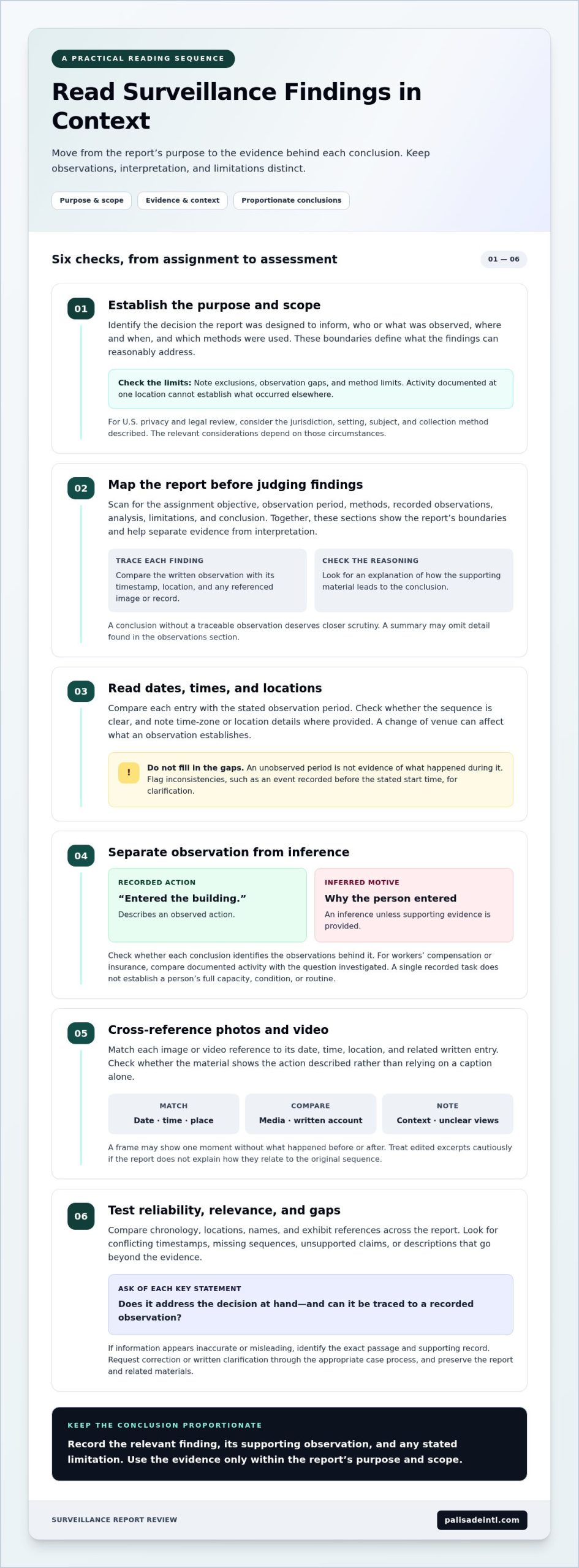
Start by identifying the decision the report was designed to inform. Then check who or what was observed, where and when the observation took place, and which methods were used. These boundaries establish what the findings can reasonably address.
Separate the stated objective from any conclusion that reaches beyond it. A report about activity at one location, for example, cannot establish what occurred elsewhere. Check for exclusions, observation gaps, or method limits. Treat them as boundaries, not minor details. Surveillance also covers different fields. An ECDC weekly report summarized COVID-19 epidemiology in the EU/EEA using data compiled from multiple sources. That public-health purpose differs from an individual investigation. The question of how to read a surveillance report therefore starts with its intended use and defined remit.
For a U.S. privacy and legal review, note the jurisdiction, setting, subject, and collection method described. Don’t treat a report’s legal interpretation as a substitute for the observations supporting it. This keeps your assessment grounded in documented evidence and the assignment’s stated boundaries.
-
Locate Typical Report Sections
Scan the contents or headings before assessing individual findings. Look for the assignment objective, observation period, methods, recorded observations, analysis, limitations, and conclusion. Together, these sections show the report’s boundaries and help you distinguish evidence from interpretation.
Next, trace a finding to its supporting material. Compare the written observation with its timestamp, location, and any referenced image or record. Check whether the analysis explains how that material supports the conclusion. A conclusion without a traceable observation deserves closer scrutiny.
Notice how the report handles gaps. A period without recorded activity doesn’t prove nothing happened; it may reflect the stated scope or method. A summary may also leave out details included in the observations section. Keep relevant context with any excerpt you use to inform a decision.
Finally, note which sections answer your question and which leave uncertainty. Record the relevant finding, its supporting observation, and any stated limitation. This concise review keeps later discussion precise and prevents an inference from being presented as a recorded fact.
Support for interpreting and applying surveillance findings
Interpret each observation in context before deciding what it supports. Use the steps below to assess the report’s chronology, evidence, and relevance.
-
Read Dates, Times, and Locations
Compare each date, time, and location with the report’s stated observation period. Check whether entries follow a clear sequence, and note the time zone or location details where provided. A change of venue can affect what an observation establishes.
Use the recorded chronology to distinguish observed activity from gaps between observations. Don’t treat an unobserved period as evidence of what happened during it. Note inconsistencies, such as an event recorded before the stated start time, for clarification.
-
Separate Observations from Conclusions
Separate direct observations from the investigator’s interpretation. “Entered the building” describes an observed action; a claim about why someone entered is an inference unless supporting evidence is provided. Check whether each conclusion identifies the specific observations behind it.
For a workers’ compensation or insurance report, compare each documented activity with the question the investigation was meant to address. A single recorded task doesn’t establish a person’s full capacity, condition, or routine. Keep conclusions within the evidence and the report’s stated scope.
-
Cross-Reference Photos and Video
Match each image or video reference to its date, time, location, and related written entry. Check whether the visual material shows the action described rather than relying on a caption alone. A frame may document one moment without showing what happened before or after.
Note unclear views, missing context, or differences between the recording and the narrative. Treat edited excerpts cautiously if the report doesn’t explain how they relate to the original sequence. Cross-referencing helps show whether media supports, qualifies, or conflicts with the written account.
-
Check for Gaps, Errors, and Reliability
Compare the chronology, locations, names, and exhibit references across the report. Look for conflicting timestamps, unsupported claims, missing sequences, or descriptions that go beyond the evidence. Then assess relevance: does the material address the decision at hand, and can each key statement be traced to a recorded observation?
If information appears inaccurate or misleading, identify the exact passage and supporting record. Request a correction or written clarification through the appropriate case process, and preserve the report and related materials. For a serious dispute, organize the discrepancies before relying on the findings to make a decision.
Recommendations and follow-up resources
Turn report findings into a proportionate action plan. Use the steps below to assign follow-up, track changes, and maintain a useful record.
- Translate each recommendation into a specific action, a responsible role, and a review point. For example, a camera image report that identifies an obstructed view can prompt repositioning, cleaning, or settings adjustments. Record the finding, response, and completion status together. This links the observation to the operational change instead of leaving the recommendation as a general note.
- Set a reporting cadence that matches the system’s operational needs. Video security system health reports can be scheduled every day, every week, or every month. Choose a cadence that helps the responsible team notice changes in time to act. For camera visibility, schedule image reports at different times of day. Changing light can reveal problems a single viewing time may not show.
- Use a retention audit to compare the intended configuration with recorded performance. A video retention audit report can show configured retention, actual retention, and the difference between them. Note any gap and assign follow-up to the appropriate system owner. If a camera isn’t recording, it has no recorded video to support security purposes. That makes recording status a practical priority when reviewing system health findings.
- Choose follow-up resources according to the report’s subject. For a public-health example, the weekly COVID-19 surveillance summary is available in the COVID-19 country overview. For a camera visibility concern, recurring image reports can help identify equipment needing adjustment to maintain 24/7 coverage. Keep each resource tied to a defined question, such as whether visibility changes by lighting or whether recorded retention matches configuration.
- Close the loop by documenting what changed and what remains unresolved. Link each completed action to the original finding, then note any continuing issue for the next review. A later camera image report, for example, can show whether repositioning improved the view. This creates a clear operational record and helps decision-makers distinguish completed work from outstanding recommendations.
What sections are typically included in a surveillance report?
Report formats differ, but several components help readers follow the assignment, evidence, and analysis. Review each section in sequence to understand how the report supports its conclusions.
- Assignment details: Begin with the objective, subject or location, and requested scope. These details establish what the report addresses. For example, an assignment focused on activity at a named site should not be read as a complete account of someone’s movements elsewhere. Compare the objective with the final conclusion, and flag conclusions that extend beyond the stated assignment.
- Methods and chronology: Find the description of how observations were gathered, followed by dated entries or a timeline. Check the observation period, locations, and sequence of events. A timeline can clarify whether separate entries describe one continuous event or distinct observations. Note any identified break in coverage, and don’t treat the period between entries as documented activity.
- Observations and supporting exhibits: Read the narrative alongside referenced photographs, video, logs, or other records. Match each exhibit label to the related entry, then compare its timestamp and description. For example, a photograph might support a location entry while showing only one moment. Distinguish what the exhibit actually shows from captions or interpretations in the narrative.
- Analysis and findings: Locate the section that interprets observations and states the report’s conclusions. Trace each key finding to a specific entry or exhibit. A report that describes an action and evaluates its significance should make these functions distinguishable. Record which statements are directly documented and which represent analysis, so later decisions rely on the appropriate level of evidence.
- Limitations and next steps: Review any stated constraints, missing context, or recommendations before applying the findings. These details define what the report cannot establish and what additional review could address. If you need to plan a surveillance assignment around clear reporting objectives, discuss your surveillance requirements with an appropriate professional.
Surveillance reports are used in fields such as epidemiology, environmental studies, and national defense. These varied uses underscore why readers should consider the report’s stated assignment and scope when interpreting its findings.
Palisade International LLC: Executive Protection
Palisade International LLC can help when surveillance findings raise concerns about an individual’s security or exposure to risk. Executive Protection is relevant when a person’s movements or circumstances call for a considered protection response. Risk Analysis & Vulnerability Assessments can clarify security concerns, while Workplace Violence Prevention addresses workplace-related risks. Private Investigations may be appropriate when further investigative work is needed to inform a decision.
The right next step depends on the report’s findings and the decision you need to make. Contact Palisade International LLC or visit palisadeintl.com to discuss your concerns.
Put the Findings to Work
A report becomes useful when it informs a deliberate next decision. Keep the documented evidence connected to the question you need to resolve, and don’t let a single observation define a broader security picture. Knowing how to read a surveillance report helps you assess what the findings support; the next step is deciding whether they call for protection, prevention, or a deeper assessment.
Palisade International LLC offers Executive Protection, Workplace Violence Prevention, and Risk Analysis & Vulnerability Assessments to address different security needs. The right direction depends on the concern the findings raise and the decision you need to make. A focused discussion can help you consider a suitable path in light of your circumstances and priorities.
Contact Palisade International LLC to discuss your security concerns and identify a considered next step.
Frequently Asked Questions
What privacy and legal rules apply to surveillance reports in the United States?
Privacy and legal considerations depend on the jurisdiction, setting, and collection method. Review these details rather than assuming one rule applies to every report.
What do common surveillance report abbreviations and terminology mean?
A direct observation records an action; an inference interprets its meaning and requires supporting evidence. An observation gap is a period without recorded activity, and it doesn’t establish what happened during that period.