

The security of your boardroom is no longer a matter of locked doors and non-disclosure agreements. As we move through 2026, the sophistication of covert listening devices and unauthorized data interception has reached a level where traditional security measures often fail to provide adequate protection. You understand that the integrity of your trade secrets and the privacy of your executive communications are the foundation of your competitive advantage. Maintaining that advantage requires a shift from reactive measures to proactive, intelligence-led corporate counter-surveillance strategies.
This strategic guide provides the framework necessary to identify hidden vulnerabilities and secure your most sensitive environments. You’ll learn the methodologies used by elite security professionals to detect and neutralize modern espionage threats before they result in a compromise. We will detail actionable steps for hardening both physical and digital spaces, ensuring that your strategic discussions remain entirely confidential. From technical surveillance counter-measures to advanced risk analysis, we provide the clarity and foresight required to manage global risk with absolute certainty and professional discretion.
Key Takeaways
- Differentiate between surveillance detection and active counter-surveillance to maintain a proactive stance against sophisticated corporate espionage.
- Master the technical methodologies of RF spectrum analysis and non-linear junction detection to identify both active and dormant illicit electronics.
- Implement comprehensive corporate counter-surveillance strategies that mitigate the risk of insider threats and social engineering through disciplined observation.
- Integrate counter-surveillance into your existing risk management framework by establishing precise standard operating procedures for device discovery.
- Leverage the tactical precision of specialists with military or law enforcement backgrounds to ensure the absolute privacy of high-level executive communications.
Defining Corporate Counter-Surveillance in a Sophisticated Threat Landscape
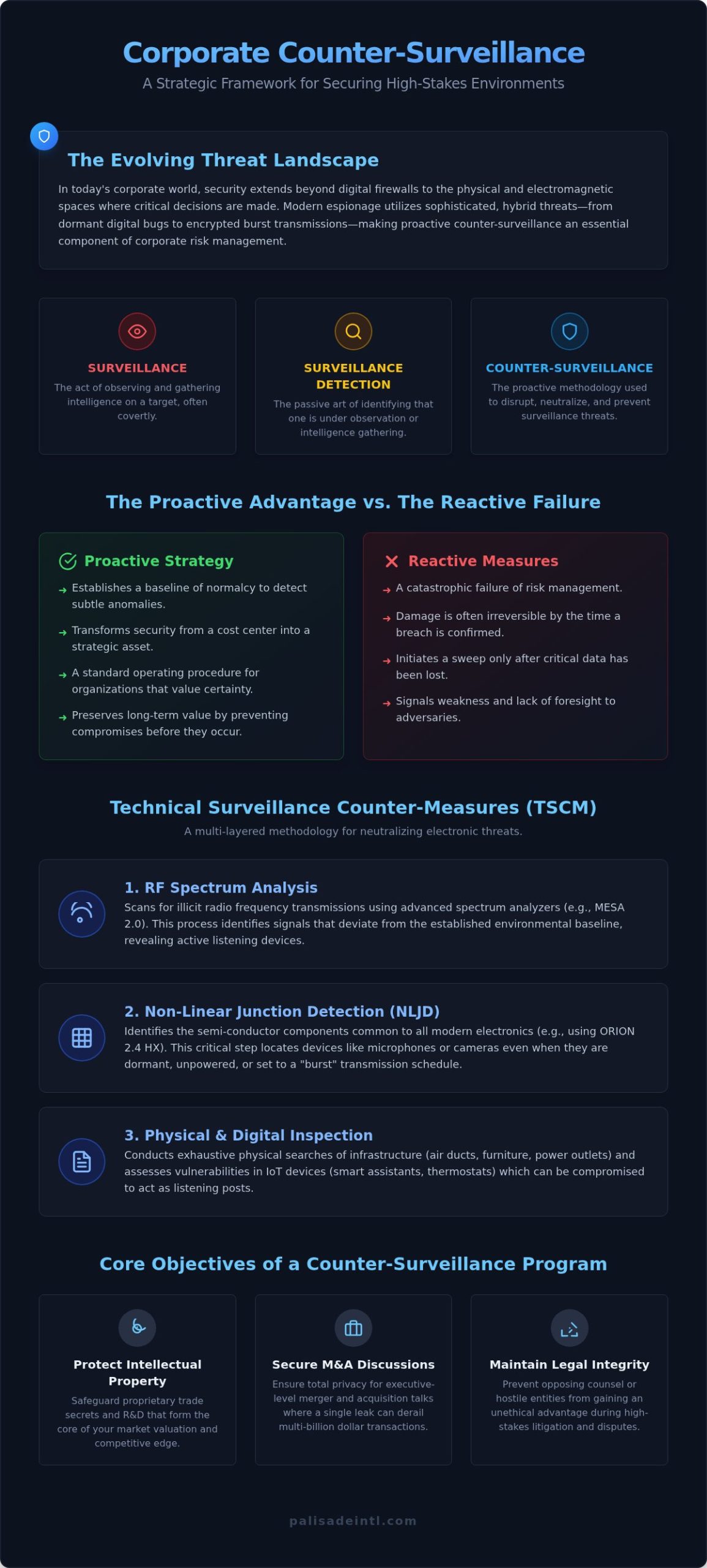
The landscape of information security has shifted from protecting servers to securing the physical and electromagnetic environment of the executive suite. In 2026, corporate espionage has transitioned from simple analog bugs to sophisticated hybrid signals that blend traditional radio frequencies with encrypted digital bursts. Modern corporate counter-surveillance strategies must account for these hybrid threats to maintain total operational security. Effective Countersurveillance measures require a nuanced understanding of the difference between being watched and taking steps to disrupt that observation. While surveillance is the act of gathering intelligence, surveillance detection is the passive art of identifying that gathering. Counter-surveillance represents the proactive methodology used to neutralize these threats before they compromise your operations.
Elite security teams view these efforts as a fundamental component of a broader risk analysis. It isn’t merely about finding a device; it’s about understanding the adversary’s intent and capabilities. The silent professional approach prioritizes absolute discretion. We don’t signal our presence to the opposition. Instead, we work quietly to ensure your environment remains a sanctuary for high-stakes decision-making and strategic planning.
The Strategic Objectives of a Counter-Surveillance Program
A robust program serves several critical functions within the modern enterprise. It protects intellectual property and proprietary trade secrets that form the core of your market valuation. It also ensures the privacy of executive-level mergers and acquisitions discussions, where a single leaked detail can derail a multi-billion dollar transaction. Finally, it maintains the integrity of legal strategy and litigation support, preventing opposing counsel or hostile entities from gaining an unethical advantage during high-stakes disputes. Implementing comprehensive corporate counter-surveillance strategies ensures these pillars of your business remain unshakable.
Proactive vs. Reactive Counter-Surveillance
Waiting for a data leak to occur before initiating a sweep is a catastrophic failure of risk management. By the time a breach is confirmed, the damage is often irreversible. A proactive stance involves establishing a baseline of normalcy within your sensitive corporate environments. This allows specialists to detect even the most subtle anomalies in the electromagnetic spectrum or physical layout. Routine Technical Surveillance Counter-Measures (TSCM) sweeps aren’t an admission of fear; they’re a standard operating procedure for any organization that values strategic certainty. This proactive discipline transforms security from a reactive cost center into a strategic asset that preserves long-term value.
Technical Surveillance Counter-Measures (TSCM): Securing the Boardroom
Professional corporate counter-surveillance strategies rely on more than visual inspections. They require a rigorous, multi-layered approach to Technical Surveillance Counter-Measures (TSCM). At the core of this process is comprehensive Radio Frequency (RF) spectrum analysis using advanced tools like the MESA 2.0 hand-held Spectrum Analyzer. Specialists use this equipment to scan for illicit transmissions, identifying signals that deviate from the established environmental baseline. However, modern threats often remain dormant or operate on a “burst” schedule to evade detection. To counter this, we utilize Non-Linear Junction Detection (NLJD), such as the ORION 2.4 HX. This technology identifies the semi-conductor components of electronic devices, allowing us to locate concealed microphones or cameras even if they’re unpowered or sleeping.
Physical inspection protocols remain equally vital. Our teams conduct exhaustive searches of air ducts, furniture, and telecommunications infrastructure where devices are frequently hidden. In 2026, the “Internet of Things” (IoT) has introduced new vulnerabilities. Smart thermostats and office assistants often possess microphones that can be compromised remotely. While some firms focus on the risks of employee monitoring from a management perspective, we view these connected devices as potential entry points for external espionage. Implementing these corporate counter-surveillance strategies requires a meticulous eye for detail that extends to every connected sensor in the room.
The Limitations of Consumer-Grade Detection Hardware
Relying on “Amazon-bought” bug detectors creates a dangerous and false sense of security. These low-cost tools lack the sensitivity to detect sophisticated spread-spectrum devices or rapid burst transmitters that operate outside standard consumer bands. In the current threat environment, the use of professional-grade spectrum analyzers is the only reliable method for identifying the complex signals used by state-level or high-tier corporate adversaries.
Digital and Computer Forensics in Counter-Surveillance
Threat mitigation must extend to the digital assets that executives carry daily. We integrate computer forensics into our TSCM process to identify malware or spyware on mobile devices and laptops. This is particularly critical for securing remote work environments and home offices, which often lack the perimeter defenses of a corporate headquarters. Our approach ensures that your digital communications are as secure as your physical boardroom. For organizations requiring a comprehensive security audit, professional risk analysis provides the necessary tactical precision to protect your most valuable assets.
Physical and Human-Centric Surveillance Detection Strategies
While technical sweeps identify hardware, the most persistent threats often involve human intelligence and physical observation. Modern corporate counter-surveillance strategies must account for the human element, specifically the insider threat and sophisticated social engineering. An adversary doesn’t always need a bug if they can convince an employee to leave a door ajar or share sensitive credentials. Identifying hostile reconnaissance in the vicinity of a corporate headquarters requires a disciplined eye for anomalies. This includes recognizing unusual patterns in local traffic, identifying “lost” couriers who linger in sensitive areas, or spotting the unauthorized use of drones for aerial photography of secure facilities.
A cornerstone of professional surveillance detection is the Surveillance Detection Route (SDR). This is a planned, methodical sequence of movements designed to confirm if an individual or team is being followed. By navigating through specific “heat points” where a tail would be forced to reveal themselves, security professionals can identify surveillance without alerting the observers to their awareness. Training staff to recognize these signs of unauthorized physical access is not about creating a culture of suspicion, but rather one of collective vigilance and elite professional standards.
Surveillance Detection for Executive Protection
Specialized executive protection teams utilize covert surveillance detection to provide a layer of safety that remains invisible to the public. Unlike overt security guards who act as a visible deterrent, covert counter-surveillance agents operate in the background to identify threats before they reach the principal. This approach is vital for managing high-profile travel and public appearances where a heavy security presence might be counterproductive. By blending into the environment, these specialists can observe the observers, ensuring that corporate counter-surveillance strategies remain effective across global jurisdictions and varied social contexts.
Physical Security Vulnerability Assessments
Securing a facility requires more than installing cameras; it demands a critical audit of access control systems and CCTV blind spots. We employ covert entry testing, a form of “red teaming,” to validate existing security measures by attempting to bypass them using the same tactics an adversary would use. This process often reveals that the most significant vulnerabilities aren’t electronic, but procedural. For the most sensitive briefings, we recommend implementing a “Clean Room” protocol. This involves a designated space that is physically and electronically isolated, where all participants are screened and no external devices are permitted, ensuring that the integrity of the conversation is absolute and beyond the reach of external interference.
Integrating Counter-Surveillance into Corporate Risk Frameworks
Effective corporate counter-surveillance strategies must transition from isolated technical events into a continuous, policy-driven discipline. This integration begins with a comprehensive risk analysis to prioritize high-value assets and sensitive locations. Not every office requires the same level of scrutiny; your strategy should focus resources on areas where mergers, acquisitions, or proprietary research are discussed. By establishing a clear hierarchy of risk, organizations can ensure that their counter-surveillance efforts are both cost-effective and tactically sound. This framework provides the necessary structure to move beyond reactive sweeps and toward a proactive stance of total environmental integrity.
Legal compliance is a critical component of any modern security framework. As of 2026, legislation such as the federal “Stop Spying Bosses Act” and California’s “No Robo Bosses Act” has intensified the scrutiny on workplace monitoring and privacy. Organizations must navigate these regulations carefully to ensure that their defensive measures don’t inadvertently violate wiretapping laws or employee privacy rights. Should a device be discovered, a pre-defined crisis management protocol is essential. The immediate response shouldn’t be to remove the device, which could alert the adversary, but to secure the area and initiate a formal investigation while maintaining absolute discretion. This measured approach preserves evidence and allows for a strategic response to the breach.
Developing a Counter-Surveillance Policy
A formal policy ensures that security measures are applied consistently across the enterprise. This includes establishing a mandatory frequency for TSCM sweeps based on the risk tier of specific departments or executive suites. Integrating security into the human resources process is equally vital. Pre-employment background checks serve as an initial layer of defense against the insider threat, while robust non-disclosure agreements (NDAs) and security awareness training reinforce a culture of confidentiality. These corporate counter-surveillance strategies create a multi-layered shield that protects the organization from both external and internal vulnerabilities.
The Role of the Security Consultant
Engaging a third-party consultant provides a level of objectivity that’s often difficult to achieve internally. These specialists act as a bridge between IT, legal, and physical security departments, ensuring that all defensive measures are synchronized. Internal IT departments, while proficient in network security, often lack the specialized equipment and tactical training required to identify physical anomalies or radio frequency signatures used in sophisticated espionage. A professional consultant brings the military and law enforcement experience necessary to anticipate adversarial tactics. For organizations seeking to harden their defenses against modern threats, engaging an elite strategic security advisory is the most reliable way to ensure long-term operational certainty.
The Palisade Advantage: Strategic Intelligence and Tactical Precision
The efficacy of corporate counter-surveillance strategies depends entirely on the experience of the practitioners executing them. At Palisade International, our team is comprised of individuals with elite military and law enforcement backgrounds, bringing a level of tactical precision that isn’t available in the commercial sector. We operate as the silent professional, maintaining absolute discretion while securing high-stakes environments for a global clientele. Whether we’re operating at a corporate headquarters in Atlanta or securing a remote international site, our approach is always customized to the specific risk profile of the client. We don’t provide off-the-shelf security; we deliver a multi-layered shield that seamlessly integrates TSCM, private investigations, and executive protection.
Our methodology prioritizes the preservation of confidentiality above all else. We understand that for ultra-high-net-worth individuals and corporate entities, a security breach isn’t just a technical failure; it’s a threat to their legacy and market position. By combining broad geographic reach with intimate local knowledge, we ensure that your privacy is protected regardless of where your business takes you. This proactive stance allows us to identify and neutralize threats before they manifest into a crisis, providing you with the peace of mind necessary to focus on your core objectives.
Supporting the Legal Process
When a surveillance device is identified, the technical sweep is only the first phase of the response. We provide specialized litigation support to ensure that any evidence discovered is preserved through rigorous chain of custody protocols. This is critical for turning technical intelligence into actionable legal strategy that can withstand the scrutiny of a courtroom. Our experts are prepared to offer testimony and forensic documentation, providing the legal team with the strategic certainty required to pursue a resolution. This bridge between security and law ensures that your organization can hold hostile entities accountable for their actions while protecting your reputation.
Securing Your Corporate Future
The return on investment for proactive counter-surveillance is measured in the prevention of catastrophic losses. A single leaked strategic plan or proprietary formula can result in multi-million dollar damages and the permanent erosion of market share. Initiating a confidential security audit is a prudent step toward establishing a baseline of total environmental integrity. Our senior advisors work closely with board members and executive leadership to develop a bespoke framework that anticipates volatility rather than simply reacting to it. To secure your most sensitive discussions and ensure operational continuity, consult with our senior advisors for a bespoke security framework.
Securing the Integrity of Your Strategic Vision
Maintaining the absolute integrity of your corporate environment is a continuous commitment to strategic foresight. Effective corporate counter-surveillance strategies require a transition from basic security to a sophisticated, intelligence-led discipline. We’ve detailed how modern threats demand a multi-layered approach that combines advanced TSCM sweeps with rigorous surveillance detection routes and human-centric risk analysis. By integrating these methodologies into your broader risk framework, you ensure that your strategic planning remains entirely confidential.
Palisade International brings over 20 years of expertise in high-stakes risk mitigation to every engagement. Our team of elite specialists, drawn from military and law enforcement backgrounds, operates with the tactical precision and global capability required to protect your interests anywhere in the world. We combine this vast reach with intimate local knowledge to provide a level of security that’s both invisible and absolute. Secure your corporate communications with a professional TSCM audit from Palisade International.
Taking control of your environment is the first step toward long-term operational certainty. With a proactive stance and a trusted partner, you can lead your organization with the confidence that your private discussions remain secure.
Frequently Asked Questions
What is the difference between counter-surveillance and TSCM?
Counter-surveillance is the broad discipline of disrupting observation, while TSCM is the specific technical process of identifying illicit electronics. Counter-surveillance includes physical detection, social engineering awareness, and surveillance detection routes. TSCM involves high-end equipment like spectrum analyzers and non-linear junction detectors. Effective corporate counter-surveillance strategies integrate both technical sweeps and human-centric detection to create a comprehensive defense. TSCM is a specialized tool within the larger counter-surveillance framework.
How often should a corporation conduct a TSCM bug sweep?
Frequency depends on your specific risk profile and the sensitivity of your operations. High-risk environments, such as executive boardrooms or research and development facilities, often require quarterly sweeps or inspections before major strategic announcements. Organizations involved in high-stakes litigation or mergers and acquisitions may conduct sweeps more frequently. Establishing a routine baseline allows specialists to identify subtle anomalies that appear over time, ensuring that your environment remains secure against evolving threats.
Can modern bug sweeps detect devices that are turned off?
Yes, professional-grade equipment can identify electronic components regardless of their power state. Non-linear junction detectors (NLJD) emit a signal that reacts with the semi-conductor junctions found in all modern electronics. This allows specialists to locate dormant bugs, unpowered cameras, or devices that only transmit on a burst schedule. Relying solely on radio frequency (RF) detection is insufficient; a comprehensive sweep must include NLJD technology to ensure that unpowered threats are neutralized.
Is it legal for a company to conduct counter-surveillance on its own premises?
Conducting defensive counter-surveillance on company-owned property is generally legal and often a standard part of a corporate risk management policy. These measures focus on protecting proprietary information and ensuring the privacy of sensitive discussions. Organizations must ensure that their protocols comply with federal wiretapping laws and state-level privacy regulations, such as those in California or Illinois. Implementing professional corporate counter-surveillance strategies requires coordination with legal counsel to ensure that defensive sweeps don’t inadvertently infringe on employee rights.
What are the most common signs that an office is under surveillance?
Physical anomalies are often the first indicator that a space has been compromised. You might notice subtle changes, such as drywall dust on a desk, wall plates that appear slightly crooked, or items in a room that have been moved. Electronic interference in communications or unusual background noise on phone lines can also signal an active bug. Persistent unauthorized individuals lingering near the facility or unusual service vehicles parked nearby are signs of external reconnaissance and potential surveillance.
How long does a professional TSCM sweep typically take for a boardroom?
A thorough inspection of a standard executive boardroom typically requires several hours to complete properly. The duration depends on the complexity of the environment, the density of the electronics, and the volume of physical infrastructure to be inspected. A professional team doesn’t just scan the airwaves; they conduct exhaustive physical searches of furniture, air ducts, and telecommunications wiring. Rushed sweeps often miss sophisticated devices that are designed to blend perfectly into the corporate environment.
Why shouldn’t our internal IT team handle counter-surveillance?
Internal IT teams specialize in network and data security, but they often lack the specialized hardware and tactical training required for physical counter-surveillance. TSCM requires expensive, professional-grade spectrum analyzers and non-linear junction detectors that are outside the standard IT toolkit. Specialists with military or law enforcement backgrounds understand the physical tradecraft used by adversaries. An external audit provides the necessary objectivity and expertise to identify vulnerabilities that an internal team might overlook.
What happens if a listening device is found during a sweep?
Discovery of a device triggers a pre-defined, confidential crisis management protocol. The immediate priority is to maintain absolute discretion to avoid alerting the adversary. The area is secured, and a formal investigation begins to determine the source of the breach. We maintain a strict chain of custody for the device to support potential litigation or law enforcement action. This measured response allows the organization to turn a security failure into a strategic advantage through a controlled legal and investigative process.