

Review a corporate security plan at least once a year and after any material change. Reviewing your corporate security plan on this schedule helps keep controls aligned with current risks, operations, and facilities. It also provides a structured way to protect executive privacy without weakening security across the workplace.
That balance matters. Executives may need discreet, individualized protection, while employees need clear access rules, reporting routes, and emergency procedures. A sound review accounts for both instead of applying identical controls to every person and location.
This guide explains how to assess physical and information security risks, review employee access, test workplace violence reporting and escalation, and evaluate monitoring and audits. It also outlines a practical review schedule and the changes that should prompt an earlier assessment, helping you keep the plan current while protecting confidential information.
Key Takeaways
- Reassess entrances, sensitive areas, and information when operations, staffing, or facilities change, then prioritize the most serious vulnerabilities.
- Review employee, contractor, and visitor permissions against current roles, and include access removal in staff departure procedures.
- Make reporting and escalation routes clear, then use exercises or staff feedback to uncover gaps in response responsibilities.
- Check that monitoring, audits, and response procedures still fit current risks, technology, and operations.
- Schedule a strategy review at least once a year and after a material change, while balancing executive privacy with workplace-wide safeguards.
Assessing entrances, storage, staff areas and sensitive information
In the United States, relevant references include OSHA’s recognized-hazards obligation, NIST Cybersecurity Framework 2.0, and ISO/IEC 27001:2022. According to the National Institute of Standards and Technology, Framework 2.0 organizes cybersecurity work into six functions; according to the International Organization for Standardization, ISO/IEC 27001:2022 defines information security management system requirements.
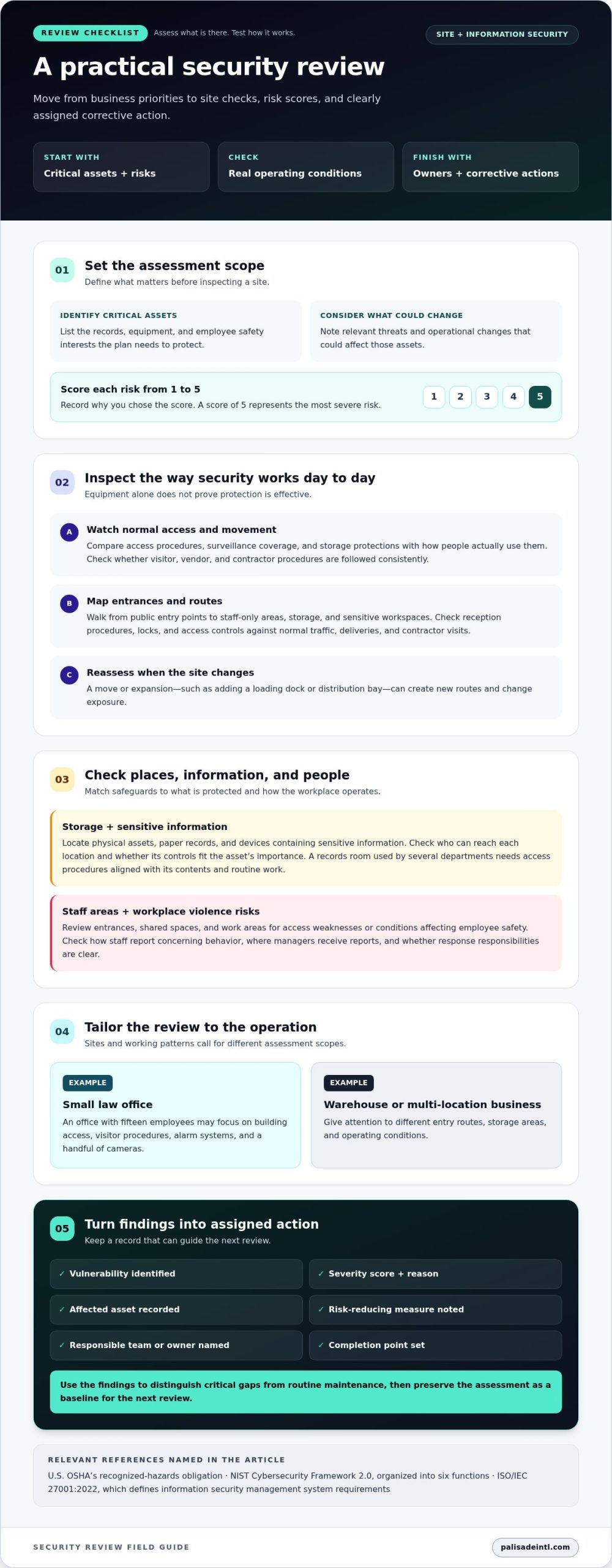
A useful review checklist covers risk objectives, entrances, storage, staff areas, sensitive information, existing security measures, and workplace violence risks.
Define Risk Assessment Objectives
Set the assessment’s objectives before inspecting a site, so the organization can connect identified risks to business priorities. List critical assets, such as confidential records, equipment, and employee safety, then identify the threats and operational changes that could affect them. Score each risk between 1 and 5, with 5 representing the most severe risk, and record the reason for each score.
Assess Existing Security Measures
Inspect security measures under everyday operating conditions, not just during a scheduled walkthrough. Compare access procedures, surveillance coverage, and storage protections with how people actually use them. Check whether visitor, vendor, and contractor procedures are followed consistently. Installed equipment alone does not prove protection is effective. Record gaps, the teams responsible, and the corrective action required.
- Map entrances and movement. Walk the route from public entry points to staff-only areas, storage, and sensitive workspaces. Check whether reception procedures, locks, and access controls match normal traffic, including deliveries and contractor visits. Reassess after a move or expansion, such as adding a loading dock or distribution bay, because new routes can change exposure.
- Inspect storage and sensitive information. Identify where physical assets, paper records, and devices containing sensitive information are kept. Check who can reach each location and whether existing controls fit the asset’s importance. For example, a records room used by several departments needs access procedures aligned with its contents and routine work, rather than assumptions based on its label.
- Review staff areas and violence risks. Examine entrances, shared spaces, and work areas for access weaknesses or conditions that could affect employee safety. Include workplace violence risk assessment in the review: consider how staff report concerning behavior, where managers receive reports, and whether responsibilities remain clear. A Workplace Violence Prevention assessment can help organizations examine these risks and identify practical improvements.
- Customize the assessment to the operation. Tailor the scope to the organization’s sites, working patterns, assets, and exposure. A small law office with fifteen employees may need to examine building access, visitor procedures, alarm systems, and a handful of cameras. A warehouse or multi-location business requires attention to different entry routes, storage areas, and operating conditions.
- Prioritize findings and assign action. Record each vulnerability, its 1-to-5 severity score, the affected asset, and the security measure that could reduce exposure. Use the findings to distinguish critical gaps from routine maintenance. Set an owner and completion point for each action, then preserve the assessment as a baseline for the next review.
Reviewing employee access permissions and removing former employees from access systems
Review access by role, then align training with the permissions employees actually have. A reliable process links personnel changes with access controls, communication, policies, and response plans.
- Compare permissions with current responsibilities. Create a roster of employees, contractors, and managers, then compare each person’s assigned access with current duties. Check physical credentials, restricted areas, shared workspaces, and relevant systems. For example, an employee who changes departments may need different permissions. Record each exception, its business purpose, and who approved it, so access does not persist by default.
- Include access changes in staff transitions. Link hiring, role changes, leave, and departures to a defined access review. When an employee leaves, identify every credential and permission associated with that person, including badges, keys, accounts, and shared access. Assign responsibility for removing or recovering each item, and document completion. Apply the same process to contractors when their engagement ends.
- Test access control in practice. Ask managers to review a current access list and confirm that permissions reflect actual work. Check whether former employees remain on lists, whether shared credentials obscure accountability, and whether temporary permissions have a clear end point. Resolve discrepancies through an approved change process. Keep a record of the decision and the person responsible for updating the system.
- Reinforce policies through regular communication. Use employee security awareness training to explain how to protect credentials, report lost access devices, and respond to suspicious requests. Corporate staff training should occur at least quarterly, with refreshed drills and guidance when security systems or personnel change. Give managers the same core guidance, then clarify their responsibilities for approving access and communicating changes to their teams.
- Use scenario-based exercises. Conduct drills that reflect real responsibilities, such as a lost badge, an unexpected visitor seeking staff access, or a former employee attempting to enter a restricted area. Ask employees to identify the right reporting route and managers to apply the response plan. Record unclear steps and revise the training materials, rather than assuming written policies are understood.
- Connect personnel review with access decisions. For roles involving sensitive assets, align hiring procedures with the organization’s access strategy. Background checks can inform personnel risk assessment, while access should still reflect job duties and documented approvals. Revisit the process when responsibilities change, and make the relevant policy easy for employees and managers to locate.
Reviewing workplace violence reporting and escalation procedures
A corporate security plan documents how an organization protects people, facilities, information, and critical assets. Its checklist should cover written policies, reporting routes, escalation responsibilities, response procedures, and approval authority.
Compare Written Procedures With Daily Practices
Walk through a realistic workplace scenario and compare written instructions with what employees would actually do. Can staff find the reporting route, identify the responsible manager, and follow the response plan? Emergency procedures may go unused for long periods, so test them with tabletop exercises instead of relying on document reviews alone.
Review Reporting Procedures and Policies
Review how employees report threats, who receives each report, and what happens next. A usable policy explains how to raise a concern, how it is recorded and escalated, and which immediate actions help protect people. Ask employees whom they would contact and what they expect to happen after reporting. Their answers can reveal unclear instructions and gaps.
Check Governance and Approval Processes
Link every procedure to an accountable role, an approver, and a decision path. Confirm that current managers know who can authorize protective actions and who communicates updates. If responsibilities have changed, revise the policy before putting it into practice. Clear governance helps prevent conflicting instructions, especially when physical security, surveillance, and employee safety require coordination.
- Map the escalation route. Write the sequence from initial report to management response, including alternate contacts if the usual recipient is unavailable. Specify how urgent concerns move from an employee to the person empowered to act. Check that employees can find the route without searching through unrelated policies.
- Develop procedures around realistic scenarios. Use examples relevant to the workplace, such as a threatening message, escalating conflict, or concerning behavior near an employee area. For each scenario, define the reporting channel, decision owner, communication method, and protective action. Avoid procedures that name a response without assigning responsibility for carrying it out.
- Test communication and coordination. Conduct a tabletop exercise with employees and managers. Present a scenario, then ask participants what they would do, whom they would notify, and what information they would share. Record delays, conflicting directions, and unclear authority. Use those findings to update procedures and implement specific corrective actions.
- Control policy changes. Keep an approved version of each security policy and identify who can authorize revisions. Communicate material changes to affected teams, including new reporting channels or surveillance-related procedures. Confirm that managers can explain the updated action sequence, then retain exercise findings and approvals for the next review.
Continuous monitoring and auditing
Review physical and digital security as operations, technology, and risks evolve. Monitor controls, audit records, examine incidents, and update the response plan as needed.
When reviewing a corporate security plan, assign owners to monitor controls, test how they work, document audit findings, and address gaps. Reassess after incidents, exercises, audits, or operational changes.
Monitor Security Measures
Track whether security measures work during ordinary operations, not only during formal inspections. Check surveillance coverage, access records, alarm responses, and maintenance logs for missed events or unresolved faults. Cameras can provide real-time monitoring and deter potential threats, while alarm systems can alert organizations to breaches instantly. Compare each control’s intended function with observed performance.
Review the Plan and Audit Findings
Consider audit findings alongside incident records, risk assessments, drills, and tabletop exercise results. Identify recurring problems, assign corrective actions, and update procedures when controls no longer suit the site or response responsibilities. An audit should lead to documented findings, accountable owners, and follow-up, not a report disconnected from daily operations.
- Set monitoring responsibilities. Name the team or role responsible for each measure, such as reviewing access logs, testing alarms, and recording equipment faults. Define how staff report a failed control and who receives that report. A clear assignment prevents an unresolved issue from moving between departments without action.
- Review physical and technical performance. Inspect entrances, restricted areas, surveillance coverage, and relevant system records. Confirm that cameras cover operationally important locations and that alarm notifications reach the people responsible for response. Record blind spots, outages, and delays. Do not treat the presence of equipment as proof that it performs its intended function.
- Connect incidents to corrective action. After an incident or near miss, document what occurred, which security measures applied, and where the response succeeded or stalled. Compare the event with the written plan and exercise records. Assign actions to named owners, then track whether each change was implemented and whether it addresses the identified gap.
- Audit policies and compliance workflows. Schedule audits of security measures and policies to identify gaps and check whether internal procedures are followed. Review applicable requirements as part of normal workflows, since laws and regulations can change. Update the plan when standards, facilities, technology, or operations change, and retain evidence of decisions and completed actions.
- Use findings to refine the response plan. Bring monitoring records, audit results, drills, and assessments into one review. Prioritize issues that affect safety, critical assets, or response coordination. Revise the relevant procedures, communicate changes to affected teams, and check implementation during the next audit. This creates a traceable cycle from observation to action.
Corporate security plan review schedules
Set a recurring review date and define the events that trigger an earlier assessment. Review the corporate security strategy at least once a year and after any material change.
- Set the annual review date. Place the strategy review on the organization’s operating calendar, with a named owner and required participants. Choose a point when relevant records, operational updates, and audit findings can be examined together. Treat the annual review as a scheduled governance activity, not an optional task postponed until an incident exposes a gap.
- Define material-change triggers. List changes that could affect exposure, responsibilities, or protective measures. Examples include moving premises, adding a loading dock, expanding into another location, changing operating hours, or introducing new technology. Assign a role to notify the security lead when such a change is approved, so review begins before new conditions become routine.
- Include incident-driven reviews. Add incidents and near misses to the schedule as immediate review triggers. Examine whether existing procedures supported the response, whether responsibilities were clear, and whether the event exposed an unaddressed risk. Record lessons and assign follow-up actions. Waiting for the annual meeting can leave a known weakness in place during changing operations.
- Use exercises and audits as schedule inputs. Bring findings from drills, tabletop exercises, audits, and risk assessments into the next review. If an exercise reveals confusion about escalation, schedule a focused review of response responsibilities. If an audit identifies a control gap, track its correction and test the change. These inputs make the security strategy responsive to operational evidence.
- Coordinate review with personnel changes. Review timing should account for changes in personnel, leadership, and decision authority. A new manager may alter approval routes or reporting responsibilities, while staff turnover can affect how policies are understood. Update the plan and communicate relevant revisions so employees and managers know which procedures remain current.
- Maintain a decision record. For each review, document the date, participants, changes examined, decisions made, and actions assigned. Record why a control remains suitable or needs revision. This creates a clear comparison between review cycles and helps the next assessment identify unresolved actions rather than reopening settled questions without context.
- Match review depth to the trigger. A material facility change may require a site-focused assessment, while a new reporting structure may call for policy and approval updates. Keep the annual review broad, then scope additional reviews to the specific change. This approach keeps the schedule practical while ensuring relevant risks receive timely attention.
For a tailored assessment schedule tied to changing facilities, personnel, and risks, request a risk analysis and vulnerability assessment.
Palisade International: Executive Protection
Palisade International LLC provides Executive Protection for organizations managing individualized risks to senior leaders while maintaining workplace-wide security. If a review identifies exposure related to leadership movements, sensitive operations, or employee safety, align protective planning with the organization’s broader risk picture.
Risk Analysis & Vulnerability Assessments can help identify gaps across facilities and operations. Workplace Violence Prevention addresses employee safety, reporting, and response planning. Private Investigations can support organizations examining specific security concerns. These services can complement an internal review, but clear policies, accountable decisions, and regular plan updates remain essential.
To discuss executive protection or a corporate security concern, contact Palisade International LLC.
Turn Review Findings Into a Clear Next Move
A review is most valuable when decision-makers can act on its findings without compromising executive confidentiality or leaving workplace responsibilities unclear. Use the results of reviewing your corporate security plan to decide where internal ownership is sufficient and where a focused external perspective could help guide the next step.
Palisade International provides Executive Protection for organizations managing individualized risks to senior leaders, as well as Workplace Violence Prevention and Risk Analysis & Vulnerability Assessments. These services address distinct concerns while keeping wider security priorities in view. The right next step depends on the exposure identified and the outcome leadership needs.
If you’re ready to discuss a security concern or assess possible next steps, contact Palisade International. A deliberate conversation can help you move forward with greater clarity and control.
Frequently Asked Questions
How do you balance executive privacy with workplace-wide security protocols?
Set a common security baseline for all staff, then limit executive details to people with a defined need to know. Keep building entry, emergency reporting, and workplace conduct consistent, while sharing itineraries, protection arrangements, and sensitive movements only through restricted channels. Reception staff, for example, can follow the same visitor protocol without seeing an executive’s travel schedule. Review who can access each detail, and remove access when responsibilities change.
What Is a Program Review and Assessment?
A security program review assesses whether an organization’s strategy, resources, and controls address its current risks. It may combine onsite observations, stakeholder interviews, and operational data to identify strengths and priorities for improvement. Interviews, for instance, may show that a department follows an informal process that differs from written policy. The assessment can connect that finding to governance, staff responsibilities, and practical recommendations.
What’s the biggest mistake companies make with security?
A consequential mistake is assuming a written plan proves employees can carry it out. Procedures can drift from daily operations after leadership changes, a new worksite opens, or staff develop informal workarounds. For example, a policy may list a reporting contact who has changed roles. Test whether employees can find the current instructions, identify the responsible person, and take the appropriate next step.
How often should a corporate security plan be reviewed and updated?
Review the corporate security strategy at least once a year and after any material change. Review sooner after an incident, a significant operational shift, or an exercise that reveals unclear responsibilities. A move, new site, or change in leadership can alter who faces risk and who authorizes action. Record each review date, decision, and assigned follow-up.
What security risks and threats should a corporate security plan address?
Consider risks to people, facilities, information, and operations. These may include workplace violence, unauthorized physical access, cyber attacks, and breaches involving third parties. Assess how risks intersect: a compromised vendor account, for example, could expose sensitive information even when building access is controlled. Account for site conditions and operational disruptions, then prioritize threats by their potential impact and the people or assets exposed.
How should a company assess the effectiveness of its security controls?
Assess controls by comparing their intended purpose with observed performance and documented evidence. For example, compare access approvals with current permissions, then check whether staff follow the related entry process. Review incident records, maintenance logs, and audit findings for recurring failures or delays. Each control should have a clear owner, expected outcome, and corrective process. Track whether actions resolve identified problems, rather than simply closing reports.
How do companies test security plans with audits, tabletop exercises, and drills?
Use audits to examine records and control performance, tabletop exercises to discuss decisions, and drills to practise actions. A tabletop exercise might present a report of threatening behavior and ask participants who receives it, who escalates it, and what information is shared. A drill can test whether staff can find and follow the relevant procedure. Document confusion, delays, and proposed changes, then assign each corrective action to an owner.
What are common gaps found during corporate security plan reviews?
Reviews often reveal differences between written rules and daily practice. Examples include an active credential assigned to a former employee, contractor access that remains after work ends, or a reporting route that names an unavailable manager. Other gaps may include unclear approval authority, surveillance that misses a relevant area, or incident records without assigned follow-up. Look for links between weaknesses, since several small omissions can complicate a coordinated response.