

Investigative findings are not automatically admissible evidence in New York litigation; they must meet the applicable legal standards. Courts may examine investigative methods, witness reliability, chain of custody, and procedural issues. Presenting investigation findings to legal counsel does not determine what a court will accept. In serious-misconduct matters, counsel also assesses legal exposure and how the investigation’s purpose and handling affect confidentiality.
A well-documented investigation can strengthen an organization’s understanding of its position, but documentation and admissibility are separate questions. How findings are gathered, recorded, and shared can affect their usefulness to counsel and the protections that may apply.
This article explains how attorney-client privilege, work-product protection, representation, and investigative purpose shape the presentation of findings. It also explains why counsel’s early involvement matters when allegations may involve senior personnel, potential criminal exposure, or board review, and how an evidence-focused report can support legal analysis without treating investigative conclusions as a court’s determination.
Key Takeaways
- Set reporting lines, scope, resources, and update intervals before evidence gathering begins so counsel can oversee the investigation’s direction.
- Clarify at the start of each employee interview that counsel represents the organization and that the organization controls any privilege.
- Distinguish fact-finding for legal advice from business or compliance review, and align the report’s purpose and content accordingly.
- When allegations involve potential criminal exposure, senior personnel, or board review, involve counsel early and preserve relevant evidence.
Attorney-client privilege and work product doctrine in U.S. investigations
Privilege depends on the investigation’s purpose, counsel’s direction, and how findings are shared. A confidential label alone does not protect material from disclosure.
Privilege and Confidentiality Rules
Attorney-client privilege protects qualifying confidential communications made to obtain or provide legal advice. Work-product protection concerns material prepared because of anticipated litigation. Self-evaluative privilege may protect some internal assessments, but its availability varies. These protections shape what counsel can receive confidentially and what others may later examine.
In corporate interviews, explain that the organization, not the employee, controls the privilege. Under District of Columbia Rule 1.6, interview communications are protected for the corporation’s benefit. A report should identify the allegations, investigative efforts, background facts, findings, relevant policies or laws, and remedial measures. These distinctions help counsel assess the evidence without treating confidentiality as a guarantee of protection.
Protecting Privilege and Avoiding Waiver
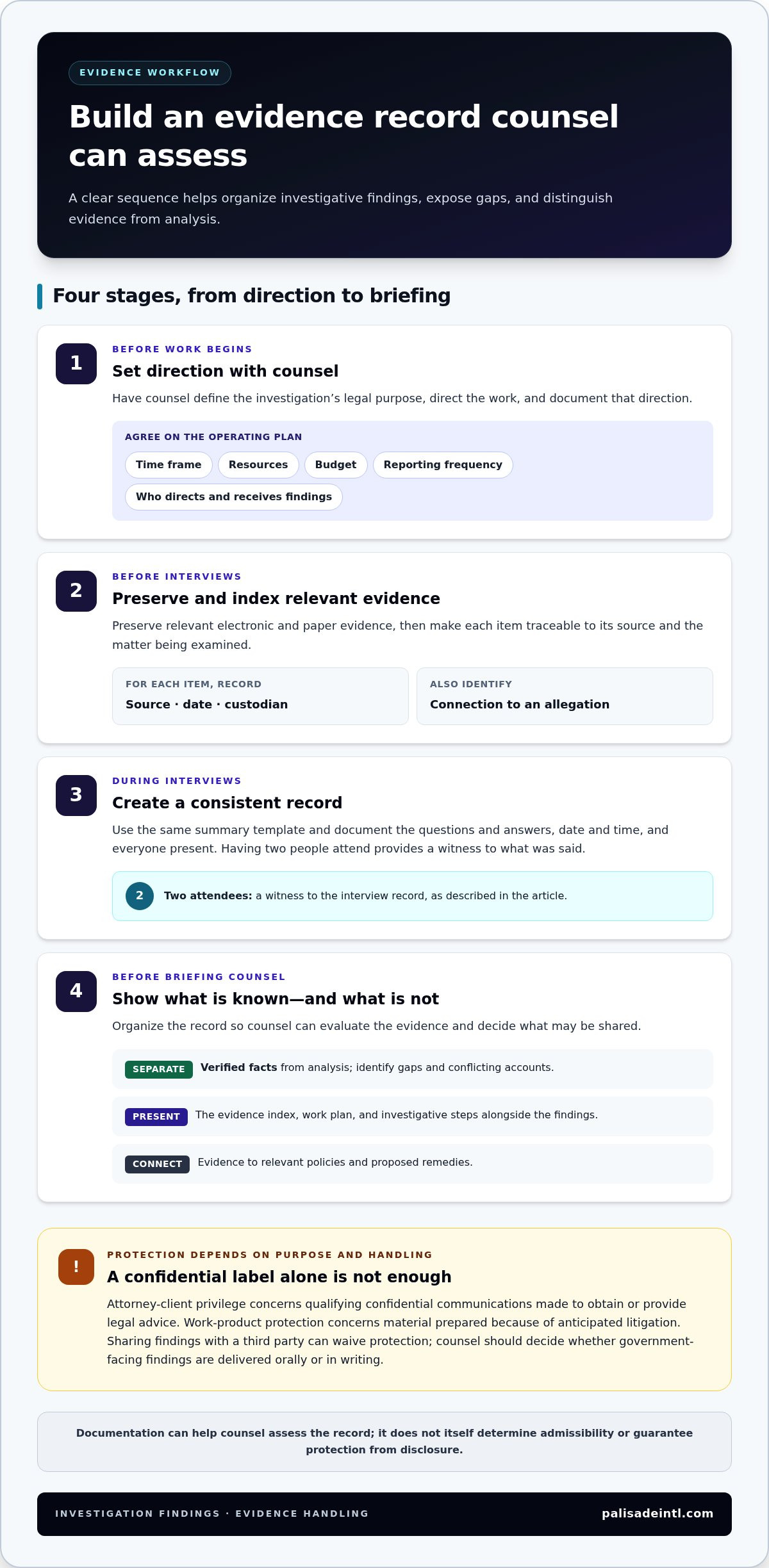
To preserve potential protections, have counsel define the investigation’s legal purpose, direct the work, and document that direction. Before work begins, agree on the expected time frame, resources, budget, reporting frequency, and who will direct the team and receive findings. Outside experts should work at a lawyer’s direction when their work supports legal advice.
Sharing findings with a third party can waive protection. In Pacific Pictures Corp. v. United States District Court, 679 F.3d 1121, the Ninth Circuit held that disclosure of privileged communications generally destroys privilege. A confidentiality agreement may not prevent waiver. Counsel should decide whether government-facing findings are delivered orally or in writing. If clients are jointly represented, Rule 1.7 requires conflict analysis and informed consent where applicable; actual adversity may require ending the joint representation.
Evidence Preservation and Counsel Briefings
Before interviews, preserve relevant electronic and paper evidence, then index each item by source, date, custodian, and connection to an allegation. Record the questions and answers, date and time, and everyone present; use a consistent summary template. Having two people attend each interview provides a witness to what was said.
Before briefing counsel, organize the evidence index, identify gaps and conflicting accounts, and separate verified facts from analysis. Present the work plan and investigative steps alongside the findings, then explain how the evidence relates to relevant policies and proposed remedies. This structure helps counsel evaluate the record and decide what can be shared without assuming that disclosure to the government preserves privilege.
Clarifying who the lawyer represents during a corporate investigation
At the start of each employee interview, counsel should give an “Upjohn” warning: the lawyer represents the corporation, and the corporation controls the privilege. Under District of Columbia Rule 1.13, a lawyer retained by a corporation represents the entity, not employees merely because the lawyer interviews them. This distinction matters when the organization’s interests may diverge from a witness’s interests.
Explain the lawyer’s role in plain terms before asking substantive questions. If the employee could become a subject of a criminal inquiry, clarify that the organization may decide whether to disclose interview information. A witness who needs personal legal advice should understand that corporate counsel does not provide it. District of Columbia Rule 4.3(b) requires a lawyer dealing with an unrepresented person to clarify the lawyer’s role when that person misunderstands it.
Representation conflicts require separate analysis. District of Columbia Rule 1.7 applies when a lawyer represents both the corporation and a constituent; appropriate disclosure and consent may be required. If actual adversity makes joint representation untenable, consent to continued representation must follow disclosure of the consequences and limits. Rule 1.9 may restrict the lawyer from continuing for either client after a conflict ends the joint representation. Federal Rule of Criminal Procedure 44(c)(2) addresses potential conflicts in multiple representation.
Check employment agreements and collective agreements for clauses that provide representation rights during an internal investigation. In Canada, a unionized employee’s right may depend on the collective agreement, as in TELUS Communications Inc., 2009 CIRB 482. For a government resolution, counsel handling negotiations may be separate from counsel who directed fact-finding, helping preserve the findings’ objectivity. A structured investigative fact-finding process can help organize information for counsel’s assessment, while leaving legal advice and representation decisions to the attorney.
Assessing whether an investigation concerns legal advice or business advice
The investigation’s purpose shapes how counsel reviews its findings and communications. Separate factual work from legal analysis to keep the corporate record clear.
Label each point as an allegation, an established fact, or an inference. For example, “the employee approved the payment” is a factual claim only if supported by records or testimony. “The approval breached policy” is an assessment that requires comparison with the applicable policy. This distinction helps counsel determine what the evidence establishes and what remains interpretation.
An internal investigation may gather facts for legal advice, business decisions, or both. Counsel should decide at the outset whether investigators will draw legal conclusions, then reassess the scope as evidence develops. A report prepared by counsel to provide legal advice reflects a defined legal assignment more clearly than a general operational review. Purpose alone, however, does not make every communication privileged.
Compliance review serves a distinct function. The Federal Sentencing Guidelines for Organizations are identified as guidance for an effective compliance program. Findings about employee conduct can help assess whether controls addressed the relevant risk, while counsel considers the legal implications and appropriate action.
Findings Before Filing Suit
Before filing suit, assess whether the investigation addressed the facts required for the claim. Confirm that relevant witnesses were interviewed, evidence was preserved, and the record supports each material allegation. Counsel can distinguish evidentiary support from assumptions and identify unresolved issues that may affect the decision to proceed. Investigative conclusions do not, by themselves, establish legal liability.
Statements, Credibility, and Evidence Gaps
Summarize each witness’s account separately from the investigator’s credibility assessment. Attribute statements, note corroborating or conflicting evidence, and explain the basis for any assessment, such as inconsistencies with a dated communication. Do not treat demeanor alone as proof. Identify missing records, witnesses who were not interviewed, and unanswered questions, then explain how each gap relates to a disputed issue. This gives counsel a clear view of the record’s limits.
Legal counsel during serious-misconduct investigations
Potential criminal exposure, the seniority of employees under review, and possible board oversight can shape counsel’s role. These factors help determine whether outside counsel should direct the investigation and how the organization should manage reporting lines. A special committee, in-house counsel, or selected management members may receive findings, but the work plan should specify who directs the team and who receives its reports.
Set communication protocols before interviews begin. For a large internal investigation, provide the legal team with daily updates on investigative progress, emerging risks, and decisions requiring counsel’s attention. Preserve relevant electronic and hard-copy evidence, and place a hold on record destruction. These steps help counsel assess the developing record while investigative work continues.
Interview planning also requires care. The legal team should decide whether one or two people will attend each interview and whether an employee facing serious allegations should have the opportunity to bring legal counsel. Advise a potential subject of a parallel government investigation of the right to consult counsel before cooperating, along with the consequences of declining to cooperate with the organization’s inquiry. This distinction helps each individual understand the separate interests involved.
At the reporting stage, in-house counsel can present final findings orally or in writing. The format should reflect the audience, purpose, and disclosure risks. Counsel handling a government resolution may be better placed to negotiate separately, preserving the fact-finding team’s objectivity and the findings’ credibility. Investigative conclusions inform decisions; they do not determine legal liability or guilt.
For serious allegations that also raise security concerns, discuss discreet investigative support as part of a coordinated response. Clear roles, controlled reporting, and evidence preservation help parties develop a record counsel can assess with precision.
Palisade International: Executive Protection
Palisade International provides Executive Protection for individuals facing elevated security concerns, including situations where serious misconduct may create personal or workplace risk. Its Workplace Violence Prevention and Risk Analysis & Vulnerability Assessments help organizations assess exposure and plan risk-reduction measures. Private Investigations support fact-finding when an organization needs information gathered and documented for counsel’s review. These services complement legal advice; they do not replace counsel’s assessment of privilege, evidence, or legal strategy.
Consider engaging Palisade International when an investigation raises security concerns alongside the need for a careful factual record. The appropriate support depends on the situation and the organization’s objectives. For a discreet discussion of your security or investigative needs, contact Palisade International or visit palisadeintl.com.
Align the Next Decision With the Risks Ahead
The next step is to turn a carefully managed investigation into decisions that address legal exposure and operational risk. Keep counsel responsible for legal advice and disclosure decisions, while assigning clear ownership of security measures, employee communications, and the organizational response. This separation helps leaders act on findings without confusing investigative conclusions with a legal determination.
When findings point to personal security concerns, workplace threats, or broader vulnerabilities, Palisade International offers Executive Protection, Workplace Violence Prevention, and Risk Analysis & Vulnerability Assessments. These services can support a coordinated response alongside counsel’s legal strategy. The value of presenting investigation findings to legal counsel lies not only in the report, but also in the disciplined decisions that follow.
For a confidential discussion about security and risk-management needs, contact Palisade International. A deliberate next step can help your organization move forward with greater clarity and control.
Frequently Asked Questions
How Does Investigative Evidence Become Admissible in Court?
Evidence is usable in court only when it satisfies the legal standards that apply to the proceeding. In New York, investigative findings are not automatically admissible; parties may need to establish reliability, proper handling, and a clear connection to disputed issues. For example, a dated message may support a timeline, but its origin and integrity may still be examined. Courts assess the evidence, not simply the investigator’s conclusion.
What Investigative Procedures Might Be Challenged in Court?
Parties may challenge how investigators searched, interviewed witnesses, retained documents, or disclosed findings. A dispute might concern whether an employee had a meaningful opportunity to respond in an interview or whether records were preserved in their original condition. Timing, notice, and chain of custody can also matter. Keep procedural records showing what investigators did, when they did it, and how they handled the resulting evidence.
What Standards Do Courts Apply to Investigative Reports?
Courts assess investigative conduct in light of the legal claim and type of proceeding; a report’s conclusions do not bind the court. Administrative or regulatory matters may involve a reasonableness assessment, while criminal or civil fraud disputes apply stricter scrutiny to reliability and procedural compliance. A court may examine the methods behind a conclusion, its supporting evidence, and whether material information was disclosed rather than accepting the report at face value.
How should investigation findings be organized for legal counsel?
When presenting investigation findings to legal counsel, prepare a decision-focused packet that lets counsel trace each material assertion to its source. Use a concise chronology with dates, event descriptions, and document identifiers, then attach the referenced records in matching order. Flag issues that require a legal decision, such as whether to pursue further interviews or preserve additional data. Keep sensitive legal analysis separate from general operational updates.
What legal risks arise from sharing investigation findings or interview notes?
Sharing protected findings or notes with an outside party may waive privilege or work-product protection, potentially affecting parallel civil or criminal proceedings. Disclosure to the government can raise particular concerns, and a confidentiality agreement may not preserve privilege against other parties. Before sharing, assess the recipient, purpose, contents, and any joint-defense agreement, which may restrict disclosure choices. Treat interview notes as sensitive records, not routine meeting summaries.
What is the best format for an executive summary of investigation findings?
Open with a brief, decision-oriented summary stating the investigation’s purpose, scope, principal findings, and immediate issues requiring leadership attention. Separate established facts from allegations and unresolved questions, and direct readers to supporting records rather than embedding every detail. A short table can map each finding to its evidence and operational significance. Clearly attribute legal conclusions and recommendations to counsel when counsel provides them.