

In high-stakes litigation, the most compelling discovery is entirely worthless if the methodology behind its acquisition cannot withstand the clinical scrutiny of a courtroom. You understand that legal battles are often won or lost on technicalities rather than the facts themselves. The growing complexity of digital forensics and evolving forensic science standards, such as the 2026 ANSI/NIST biometric updates, makes the margin for error narrower than ever. It’s natural to feel concerned that a minor oversight in professional evidence collection might compromise an entire strategy or lead to a costly dismissal.
This guide provides the strategic framework required to master the rigorous standards of professional evidence collection, ensuring every finding remains admissible and impactful. We’ll examine the critical nuances of the chain of custody, the implications of new state-level AI regulations, and the precise protocols that transform raw data into a decisive legal advantage. By aligning your investigative efforts with elite military and law enforcement precision, you can secure the certainty your clients demand in volatile environments.
Key Takeaways
- Establish a rigorous foundation by distinguishing between physical, digital, and testimonial evidence to ensure all gathered data meets the high threshold of legal verification.
- Implement advanced protocols for digital evidence collection, utilizing cryptographic hashing and original data preservation to secure virtual findings against technical challenges.
- Maintain an unbreakable chain of custody through meticulous chronological documentation, eliminating the procedural gaps that often lead to evidence suppression.
- Leverage specialized investigative techniques, such as covert surveillance and asset searches, to uncover strategic advantages in high-stakes corporate and legal environments.
- Integrate the investigator’s role as an expert witness to provide the authoritative testimony necessary to validate complex findings during litigation.
The Fundamentals of Evidence Collection in Modern Litigation
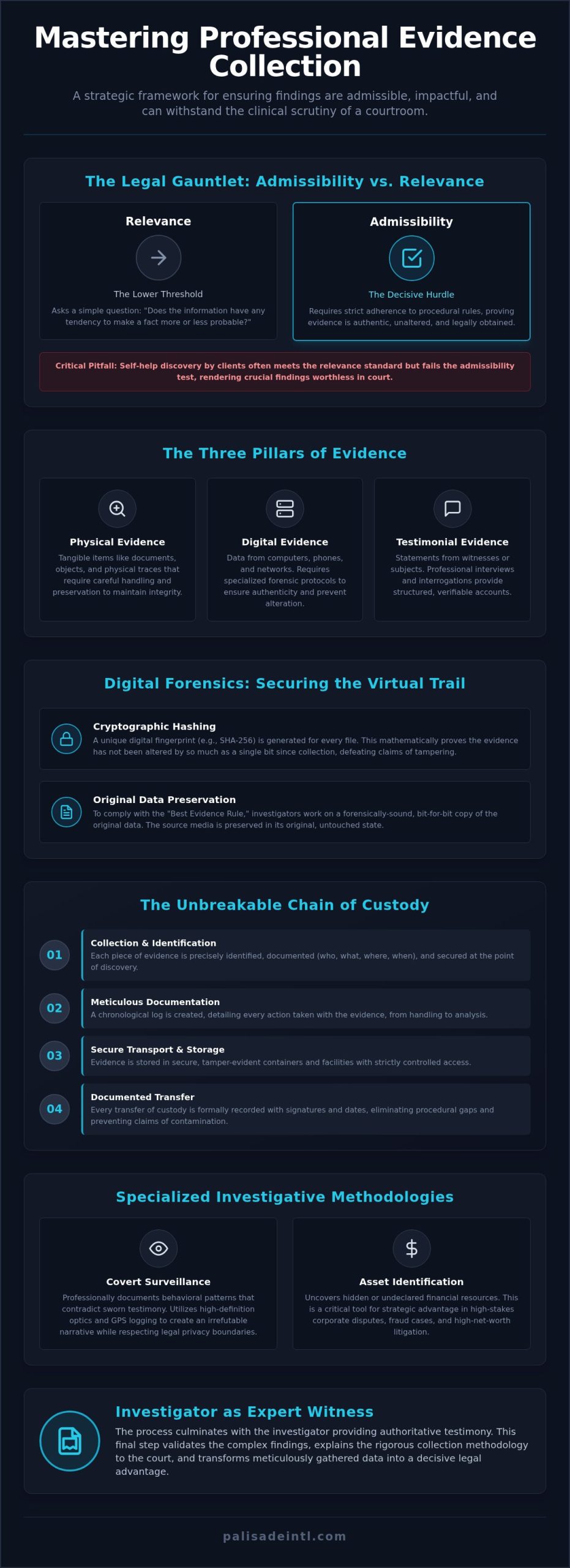
Evidence collection is the systematic gathering of information intended for formal legal verification. It transforms raw observations and disparate data into a structured format suitable for judicial review. In high-stakes litigation, this process distinguishes between physical items, digital records, and testimonial accounts. While a client might personally discover a relevant document, professional intervention ensures that the discovery survives the transition from the field to the witness stand. Professional investigators prioritize the Unbreakable Chain of Custody, which documents every hand that touches a piece of evidence to prevent claims of tampering or contamination.
Courts distinguish sharply between relevance and admissibility. Relevance merely asks if the information has any tendency to make a fact more or less probable. Admissibility, however, is a significantly higher threshold that requires adherence to strict procedural rules. Self-help discovery by clients often fails this test because it lacks the technical precision required to prove the evidence hasn’t been altered. By utilizing a professional for evidence collection, legal teams ensure that their most impactful findings aren’t discarded on a technicality during the preliminary stages of a case.
The Legal Threshold: Why Admissibility Matters
The “Best Evidence Rule” remains a cornerstone of modern litigation, requiring the original version of a document or recording to prove its contents. While digital copies are frequently accepted, the forensic integrity of those files must be beyond reproach. Private investigators operate under different constraints than public law enforcement regarding the Fourth Amendment; they aren’t government agents, yet evidence gathered through illegal means like trespass can still face suppression. In Georgia civil law, admissible evidence is defined as any relevant information that is not otherwise excluded by a specific statutory or constitutional rule.
The Role of the Silent Professional in Discovery
A private investigator Atlanta firms rely on acts as a bridge between suspicion and proven fact. This role demands absolute neutrality and objectivity. If an investigative report appears biased, its utility in court evaporates. By maintaining a sober, intelligence-led approach, the investigator provides a foundation of reliability that allows counsel to build a more aggressive legal strategy. Skilled evidence collection prioritizes foresight, identifying potential challenges to integrity before they are raised by opposing counsel. This proactive stance ensures that the evidence remains a powerful asset rather than a liability.
Specialized Methodologies for Private Sector Investigations
Private sector investigations diverge sharply from the standardized procedures of public law enforcement. While police departments focus on criminal prosecution, private investigators prioritize civil admissibility and the specific strategic needs of corporate or high-net-worth clients. Effective evidence collection in this environment requires a multi-layered approach that combines traditional observation with advanced technical verification. This methodology ensures that every finding is not just discovered, but also preserved in a manner that survives the clinical scrutiny of opposing counsel during discovery.
Surveillance as a Tool for Truth
Covert observation serves as the primary method for documenting behavioral patterns that contradict sworn testimony or public claims. Professionals transform raw visual data into court-ready video evidence by adhering to strict protocols that respect privacy laws while securing critical behavioral data. In high-stakes litigation, the transition from suspicion to documented fact depends on the investigator’s ability to remain undetected. Those requiring these specialized surveillance services in Georgia benefit from a methodology that anticipates defense challenges regarding the expectation of privacy. By utilizing high-definition optics and GPS logging, investigators create a comprehensive narrative of a subject’s activities that is difficult to refute.
Asset Identification and Risk Mitigation
Identifying hidden wealth requires a sophisticated blend of database intelligence and physical verification. In cases of corporate fraud or high-net-worth divorce, linking findings to a broader risk analysis allows for the effective deployment of asset protection strategies. This process isn’t merely about finding accounts; it’s about establishing a provable trail of ownership and control. Professionals use background checks and asset searches to uncover real estate holdings, shell companies, and offshore interests that have been intentionally obscured. This level of evidence collection provides the leverage necessary for favorable settlements or successful judgments.
Strategic witness interviews and statements provide the testimonial framework that supports physical findings. Investigators act as neutral observers, securing sworn statements that stabilize the narrative before formal depositions occur. Additionally, Technical Surveillance Counter-Measures (TSCM) act as a vital defensive layer. By identifying illicit monitoring devices or unauthorized transmissions, professionals protect the integrity of the legal team’s internal strategy. Even as physical methodologies evolve, the interplay with virtual spheres remains critical. Understanding the foundations of Digital Forensics: Securing Evidence ensures that surveillance logs and recovered documents are handled with the same forensic precision as digital files. If your case involves complex corporate interests, consulting with an expert in litigation support ensures your strategy rests on a foundation of verified fact.
Digital Forensics: Securing Evidence in a Virtual Environment
Computer forensics represents the technical pinnacle of modern evidence collection, moving beyond physical discovery into the scientific extraction and analysis of data from electronic systems. It involves the rigorous identification, preservation, and documentation of digital information to ensure its absolute integrity in a court of law. Unlike traditional methods, digital investigations require specialized hardware and software to interact with volatile data without altering its state. This discipline allows for the recovery of deleted emails, encrypted communications, and hidden system logs that often contain the “smoking gun” in complex litigation.
Cryptographic hashing serves as the digital seal for every piece of evidence gathered. By generating a unique alphanumeric string for a file or drive, investigators can prove that the data presented in court is an identical match to the original discovery. Any attempt by a non-expert to “browse” through a device risks spoliation, which is the legal term for the destruction or alteration of evidence. Simply turning on a laptop or opening a file changes access dates and system logs, potentially rendering the findings inadmissible and damaging the credibility of the entire case.
The Anatomy of a Digital Investigation
A forensic investigation begins with “imaging,” a process that creates a bit-for-bit clone of the storage medium. This allows analysts to work on a perfect replica while the original remains untouched in a secure environment. Metadata, often referred to as “data about data,” provides the invisible context necessary to prove intent or authorship by revealing when a document was created, who edited it, and the geolocation of its origin. A simple copy of a file is not forensic evidence because it lacks the underlying system metadata and unallocated space data required for legal verification.
Mobile and Cloud Forensics in 2026
The landscape of evidence collection has shifted heavily toward mobile devices and cloud environments, where encrypted messaging apps present significant hurdles for standard discovery. Modern forensic tools allow for the extraction of ephemeral data from platforms that users believe are private or self-deleting. In cases of corporate espionage or workplace violence, securing cloud-based logs provides a trail of unauthorized access that physical hardware might not reveal. These virtual threats often coincide with physical surveillance risks. Integrating digital discovery with a TSCM guide ensures that a legal team’s strategy is protected from both data breaches and illicit physical monitoring. By maintaining this dual-pronged vigilance, investigators provide the strategic certainty required for high-stakes litigation.
Establishing an Unbreakable Chain of Custody
The chain of custody serves as the chronological documentation of every person who handled a piece of evidence from the moment of its acquisition. In the context of professional evidence collection, this record isn’t merely a log; it is the legal spine that supports the entire case. A single undocumented transfer or an unverified storage period creates a gap that opposing counsel will exploit to demand suppression. To prevent this, every interaction must answer five critical questions: who handled the item, what specific actions were taken, when did the transfer occur, where was it secured, and how was it moved? Physical media, such as hard drives or surveillance tapes, requires climate-controlled, limited-access storage and tamper-evident packaging to ensure its original state remains pristine.
Secure transport is equally vital. When moving sensitive materials, investigators utilize GPS-tracked couriers or hand-delivery protocols to maintain constant visual or digital oversight. This level of evidence collection discipline ensures that the transition from the field to the secure repository is as scrutinized as the discovery itself. By treating every item as if it were the deciding factor in a multi-million dollar judgment, the investigator provides the peace of mind that legal teams require when preparing for trial.
The Documentation Trail
Contemporary standards require more than just a signature on a bag. Investigators maintain detailed field notes that are written at the time of discovery to ensure absolute accuracy. The use of specialized tracking software and tamper-evident seals provides a digital and physical audit trail that is difficult to challenge. When the chain of custody survives an aggressive cross-examination, it’s because the documentation is so meticulous that it leaves no room for doubt regarding the item’s integrity. These records provide a transparent history that validates the evidence’s authenticity before the court.
Personnel Integrity and Background
The background of the investigator provides the silent weight that anchors the chain of custody. Experts with military or law enforcement backgrounds bring an ingrained culture of procedural discipline that translates directly into courtroom credibility. They understand the gravity of handling sensitive materials and the repercussions of even a minor procedural error. An investigator’s reputation for precision impacts how much weight a judge or jury gives to the findings. This high level of litigation support ensures that the evidence isn’t just present, but persuasive. If you require a partner who prioritizes absolute procedural integrity, you should consult with a professional investigator to secure your discovery process.
Leveraging Expert Evidence Collection for Strategic Litigation Support
Strategic evidence collection serves as more than a discovery tool; it is the catalyst for the entire litigation narrative. By providing a clear, forensic view of the facts, investigators allow legal counsel to anticipate opposing arguments and refine their positioning before entering the courtroom. A particularly powerful yet often overlooked aspect of this process is the documentation of “negative evidence.” Proving that a specific event did not occur, or that a subject was not present at a critical location, can be just as decisive as uncovering a hidden asset. This defensive layer of intelligence provides the certainty required to dismantle unfounded claims during high-stakes disputes.
The value of professional evidence collection lies in its ability to transform raw data into a strategic advantage. When an investigation is conducted with the foresight of a seasoned professional, the resulting reports do more than just list facts; they provide a roadmap for cross-examination and settlement negotiations. This proactive approach ensures that your legal team is never surprised by the discovery process, maintaining control over the environment even as new variables emerge.
From Fact-Finding to Expert Testimony
The transition from fact-finding to the witness stand requires a deep understanding of judicial standards. In Georgia, the distinction between a fact witness and an expert witness is critical. While a fact witness testifies only to what they directly observed, an expert witness provides specialized analysis and opinions based on their professional background. Investigators with military and law enforcement experience are uniquely positioned to serve in this capacity, as they possess the technical vocabulary and composure necessary to present complex digital or surveillance data to a jury. For high-profile individuals, these findings are often integrated into a broader executive protection framework, ensuring that legal discovery and personal security operate in tandem to mitigate multi-dimensional risks.
Choosing a Partner for Legal Integrity
Selecting an investigative partner requires a rigorous evaluation of both their technical capabilities and their discretion. A firm must demonstrate a global operational reach while maintaining intimate, ground-level knowledge of local jurisdictions. Palisade International, founded in 2003, offers this dual perspective through a team of specialists who prioritize intelligence-led solutions over generic, off-the-shelf services. The integrity of your evidence collection process depends on the silent professional who remains several steps ahead of potential challenges. If you require absolute strategic certainty and a partner who understands the intricacies of complex legal environments, contact us for a confidential consultation to discuss your specific requirements.
Securing the Future of Your Legal Strategy
Mastering the intricacies of judicial discovery requires more than just finding facts; it demands a forensic mindset that anticipates the clinical scrutiny of the courtroom. Precision is paramount. By prioritizing an unbreakable chain of custody and leveraging advanced digital forensics, you ensure every discovery serves as a pillar for your litigation strategy. The transition from suspicion to admissible proof is a journey that requires absolute integrity. You’ve seen how technical standards and personnel credibility determine the weight of your findings.
Palisade International provides the strategic certainty required for such high-stakes environments. Founded by former law enforcement professionals, our firm brings 20+ years of high-stakes litigation support to every engagement. We maintain a specialized computer forensics laboratory to extract and preserve virtual data with surgical accuracy. Secure your legal strategy with professional evidence collection from Palisade International. You can move forward with the confidence that your evidence is not only powerful but unassailable.
Frequently Asked Questions
What makes evidence gathered by a private investigator admissible in court?
Admissibility depends on the investigator’s strict adherence to legal standards, including the Best Evidence Rule and avoiding illegal acts like trespass. Since private investigators aren’t government agents, they don’t require warrants, but they must respect statutory privacy laws. Professional evidence collection ensures that data is authenticated and the method of acquisition is beyond reproach. This involves meticulous documentation of the source to ensure no tampering occurred during the process.
Can a private investigator collect digital evidence without a warrant?
Yes, private investigators can collect digital evidence without a warrant because they are private citizens, not government agents bound by the Fourth Amendment. However, they must obtain the data through legal means, such as owner consent or public access. They cannot hack into secure systems or bypass encryption through illegal methods. The focus remains on securing data that is legally accessible to the client or available through authorized forensic extraction.
What is a chain of custody, and why is it critical for my case?
A chain of custody is the meticulous, chronological log of every person who has handled a piece of evidence from discovery to the courtroom. It’s critical because it proves the item’s integrity and prevents claims of tampering or contamination. Without a documented trail, the court cannot verify that the evidence presented is the same item originally collected. This procedural discipline is the foundation of reliable litigation support in high-stakes environments.
How does computer forensics differ from standard IT data recovery?
Standard IT recovery focuses on restoring lost files for business continuity, often ignoring the metadata or system logs. Computer forensics is a scientific process designed specifically for judicial review. It uses bit-for-bit imaging and cryptographic hashing to preserve the original state of the device. This ensures that the evidence remains admissible while uncovering hidden data, deleted communications, and unauthorized access patterns that standard recovery methods frequently miss.
What happens if the chain of custody is broken during an investigation?
A broken chain of custody often leads to the suppression of evidence, rendering it unusable in trial. If a gap exists in the documentation, opposing counsel can argue that the item was altered, contaminated, or replaced. This compromise can devastate a legal strategy and lead to the dismissal of key claims. Maintaining a pristine log is essential to ensure that your findings survive the clinical scrutiny of discovery and cross-examination.
Are surveillance videos always admissible in Georgia courts?
Surveillance videos are not automatically admissible; they must be authenticated and gathered without violating the subject’s reasonable expectation of privacy. In Georgia, investigators must ensure that recordings are made in public spaces or with proper authorization. The video must also be clear, unedited, and supported by the testimony of the investigator who captured it. Professional evidence collection protocols ensure these visual records meet all statutory requirements for civil litigation.
How do you ensure discretion when collecting evidence in sensitive corporate matters?
Discretion is maintained through a silent professional approach that prioritizes covert operations and extreme confidentiality. Investigators use low-profile surveillance techniques and secure communication channels to gather intelligence without alerting the target or disrupting business operations. This elite level of vigilance protects the brand’s reputation while securing the facts. Every engagement is customized to the specific environment, ensuring that privacy remains a central pillar of the investigative process.
Can Palisade International provide expert witness testimony for my trial?
Yes, our specialists provide authoritative expert witness testimony to validate complex investigative findings. Our team consists of experts with military and law enforcement backgrounds who possess the professional composure required for the witness stand. They translate technical data, such as computer forensics or surveillance logs, into clear testimony for a jury. This capability ensures that the evidence we collect is not just presented, but effectively defended under rigorous cross-examination.