

In high-stakes litigation, the difference between a decisive victory and a catastrophic dismissal often resides in a single, overlooked string of metadata. You recognize that the transition from discovery to admissibility is fraught with risk, particularly when digital evidence analysis must account for data dispersed across encrypted messaging, cloud platforms, and complex IoT ecosystems. The fear of evidence spoliation is a rational response to an environment where standard IT protocols often fall short of forensic requirements.
This article provides the strategic framework necessary to master these complexities, ensuring your electronic data remains unassailable under the most rigorous judicial scrutiny. We’ll examine the technical precision required for a defensible forensic timeline and the critical role of certified expertise in providing expert witness testimony. By the end of this discussion, you’ll possess a clear understanding of how to bridge the gap between volatile binary data and a composed, authoritative narrative for the courtroom.
Key Takeaways
- Understand why professional digital evidence analysis is the essential foundation for transforming volatile electronic data into legally defensible evidence.
- Learn the critical phases of the forensic lifecycle, including why bit-for-bit imaging is required to preserve metadata integrity during data acquisition.
- Identify high-value data sources across mobile devices and cloud platforms that often provide the decisive evidence needed for complex litigation.
- Recognize the operational differences between standard IT protocols and forensic standards to prevent inadvertent evidence spoliation by internal staff.
- Discover how integrating computer forensics with broader litigation support strategies provides a comprehensive layer of security and strategic certainty.
The Strategic Role of Digital Evidence Analysis in Modern Litigation
Modern litigation is no longer won solely through oral testimony or paper trails. It’s decided in the silent archives of servers, the encrypted caches of mobile devices, and the metadata of cloud storage. Digital evidence analysis is the scientific preservation, identification, and interpretation of electronic data for use in legal proceedings. It transforms raw binary code into a defensible narrative that can withstand the highest levels of judicial scrutiny. For corporate executives and legal teams, this process is the centerpiece of risk management; it provides the clarity needed to navigate complex disputes with absolute strategic certainty.
There is a fundamental distinction between simple data recovery and forensic-grade analysis. Simple recovery is a utilitarian process designed to find a missing file or restore a crashed system. In contrast, forensic analysis is an evidentiary discipline. It focuses on the “digital fingerprint,” documenting not just what a file contains, but who accessed it, when it was modified, and whether it was intentionally manipulated. This level of detail is vital in high-stakes litigation where the authenticity of a document is as important as its content. A comprehensive Digital forensics overview reveals that the discipline relies on maintaining a strict chain of custody to ensure every bit of data remains unassailable from the moment of acquisition.
The Forensics Bridge: From Binary to Narrative
Forensic experts act as translators. They move between the technical world of hex code and the practical world of the courtroom. Success in this field requires more than just technical proficiency; it demands the ability to contextualize data within a broader investigation. Whether identifying a pattern of intellectual property theft or verifying the timeline of a corporate merger, the analysis must be clear and logical. Digital evidence is the modern foundation of litigation support. By integrating forensic findings with other investigative tools, such as private investigations or executive protection strategies, legal teams gain a multi-layered understanding of the threats they face.
The High Stakes of Electronic Discovery
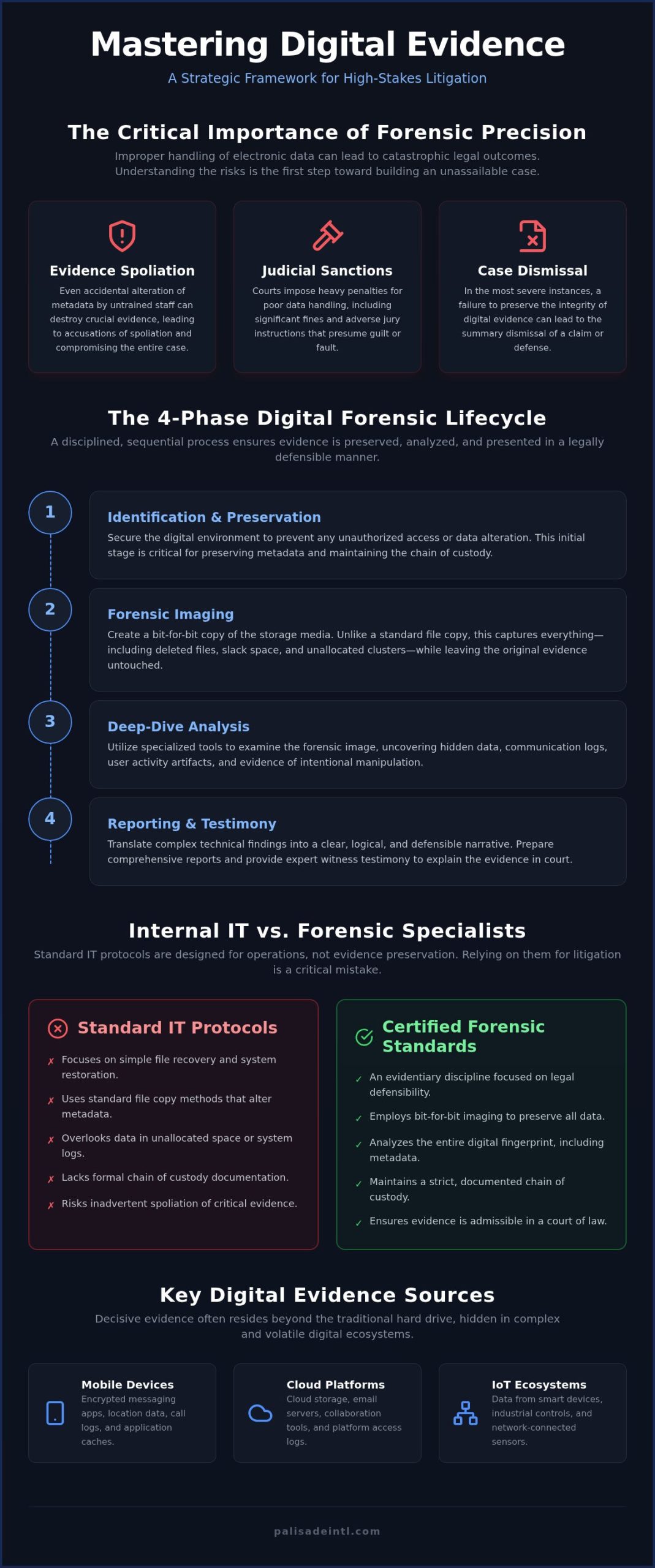
The consequences of improper data handling are severe. Spoliation of evidence, even if accidental, often leads to heavy judicial sanctions, adverse jury instructions, or the summary dismissal of a case. “Good enough” data recovery protocols fail because they don’t account for the volatility of metadata. Every time a file is opened by an untrained staffer, its “last accessed” date changes, potentially destroying the very evidence needed to prove a timeline. Professional analysis prioritizes the integrity of the original environment. Our team, drawing on extensive military and law enforcement backgrounds, approaches every engagement with the discipline required to ensure that evidence is not just recovered, but admitted.
The Forensic Lifecycle: From Data Acquisition to Admissible Insight
Success in high-stakes litigation requires a disciplined adherence to a four-phase forensic lifecycle. The process begins with the precise identification and preservation of the digital environment. This initial stage is critical; any unauthorized access or improper handling can lead to the irrevocable loss of metadata. Once the environment is secured, analysts move to forensic imaging. This involves creating a bit-for-bit copy of the storage medium, capturing every sector, including slack space and unallocated clusters where deleted data often resides. Unlike standard file copies, this method ensures the original remains untouched and pristine.
The third phase involves deep-dive analysis using specialized protocols to extract meaningful intelligence from the forensic image. Experts look beyond the visible file structure to uncover hidden patterns, communication logs, and artifacts of user activity. Finally, the lifecycle concludes with reporting and expert witness preparation. The resulting documents don’t just list findings; they provide a clear, logical narrative that explains the “how” and “why” behind the digital traces. This structured approach ensures that the digital evidence analysis remains unassailable when presented in a court of law.
Maintaining an Unbroken Chain of Custody
Legal defensibility rests entirely on the chain of custody. Every hand-off of digital media must be meticulously documented to prove that the evidence remained secure and unaltered throughout the investigation. Cryptographic hashing serves as the digital seal for this process. By generating a unique mathematical value for both the original data and the forensic copy, analysts can prove to the court that the two are identical. Whether conducting Georgia-based or global investigations, our team adheres to these stringent protocols to maintain absolute integrity. For organizations facing high-stakes disputes, securing professional computer forensics services ensures that every byte is captured without compromise.
Non-Destructive Data Acquisition
The process of collecting and analyzing digital evidence requires specialized hardware known as write-blockers. These devices physically prevent any data from being written back to the original source during the imaging process, maintaining the integrity of the evidence. This is especially vital when dealing with volatile memory (RAM). RAM contains temporary data, such as running processes and network connections, that disappears once a device is powered down. Capturing this “live” data before it’s lost is often the key to meeting the Daubert standard for scientific evidence. By prioritizing non-destructive methods, forensic specialists provide a level of strategic certainty that standard IT departments simply cannot replicate.
Beyond the Hard Drive: Identifying High-Value Digital Sources
The scope of digital evidence analysis now extends far beyond traditional desktop computers. High-value data is increasingly recovered from a constellation of sources, including encrypted mobile applications, remote cloud storage, and Internet of Things (IoT) devices. These “silent witnesses” often provide the critical context needed to prove intent in high-stakes litigation. For instance, wearables and smart office systems record granular activity logs that can verify a person’s presence or physical state at a specific moment. Metadata analysis of file creation and access logs can reveal whether a document was accessed with authorization or surreptitiously duplicated during a corporate dispute. Adhering to a standardized digital evidence examination guide ensures that these diverse data points are collected with the procedural rigor required for courtroom admissibility.
The Mobile Frontier: SMS, Signal, and Encrypted Apps
Modern encryption presents significant hurdles in digital evidence recovery. While apps like Signal and WhatsApp protect data in transit, forensic specialists can often recover “ghost” data from application caches or unallocated space on the device itself. This includes deleted SMS messages, location history, and time-stamped communication logs. Integrating this mobile intelligence into a broader private investigator Atlanta workflow allows legal teams to build a comprehensive narrative of an individual’s actions and movements. It’s a method that transforms fragmented digital traces into a cohesive, intelligence-driven strategy that standard discovery processes frequently miss.
Corporate Infrastructure and Server Forensics
Corporate server forensics offers a deep-dive look into internal operations. Analyzing email headers and server logs is essential for identifying unauthorized access or potential corporate espionage. This technical scrutiny often aligns with technical surveillance counter-measures (TSCM) to ensure that both digital and physical environments are secure. When a breach occurs, the forensic analysis must be exhaustive. It identifies not only the point of entry but also the specific data exfiltrated. For boutique law firms and global corporations, this level of technical oversight provides the security and tactical planning necessary to mitigate risk and protect high-value assets. These sources don’t just provide data; they provide certainty in an increasingly volatile digital landscape.
Why Internal IT Teams Cannot Replace Forensic Specialists
Internal IT departments focus on operational continuity and system performance. Their primary objective is to keep systems running, which often involves patching vulnerabilities or restoring services as quickly as possible. This “IT Bias” is fundamentally at odds with the rigorous requirements of digital evidence analysis. Forensic specialists don’t fix problems; they document them with surgical precision. While an IT manager might possess deep technical knowledge, they rarely have the specialized forensic certification or the military-grade discipline needed to maintain a bit-for-bit record that survives aggressive cross-examination. Relying on internal staff for high-stakes litigation support often introduces a level of subjectivity that opposing counsel will exploit to undermine your case.
Spoliation Risks and Judicial Sanctions
The legal pitfalls of using untrained staff are catastrophic. Simply opening a folder to “search” for relevant files can alter up to 30% of a drive’s metadata. These microscopic changes to “last accessed” or “modified” timestamps constitute spoliation of evidence. Courts have historically issued severe sanctions, including adverse inference instructions or the complete dismissal of a case, when data handling protocols fail to meet forensic standards. The financial burden of engaging external experts is negligible when compared to the potential loss of a multi-million dollar verdict due to a tainted chain of custody. Professional forensics ensures that the evidence remains unassailable, providing the strategic certainty that high-level litigants require.
The Credibility of the Independent Investigator
Third-party objectivity provides a critical layer of protection for corporate boards and legal teams. Internal employees are inherently vulnerable to claims of bias or conflict of interest, especially if the investigation involves colleagues or executive leadership. Our team maintains the “silent professional” stance, delivering findings that are rooted in objective data rather than internal politics. By leveraging sophisticated risk analysis early in the process, we help organizations preempt digital threats before they escalate into full-scale litigation. If you require absolute certainty and a defensible forensic foundation for your next case, contact Palisade International to ensure your digital evidence stands up to the most intense judicial scrutiny.
Integrating Digital Forensics into a Comprehensive Litigation Strategy
The integration of digital evidence analysis into a broader litigation and security strategy represents the pinnacle of tactical planning. It’s not enough to simply react to a breach or a discovery request; elite organizations use forensic insights to inform their overall risk posture. For instance, data recovered during an internal audit can provide early warnings for workplace violence prevention or reveal vulnerabilities in corporate assets before they’re exploited. This proactive stance ensures that digital evidence analysis serves as a continuous feedback loop for threat mitigation, preventing legal teams and executives from being caught off guard by sudden volatility. Palisade International, founded in 2003, combines a global operational reach with specialized local knowledge from our Georgia headquarters to deliver these multi-layered solutions. Our team, comprised of professionals with military and law enforcement backgrounds, understands that forensics is often the first line of defense in a complex litigation environment.
Tactical Forensics for High-Net-Worth Individuals
High-net-worth individuals face unique risks where a digital breach can lead to significant reputational damage or physical security threats. In these cases, discrete investigations are paramount. We integrate forensic findings with executive protection protocols to create a comprehensive shield around our clients. By identifying risks before they reach the public record, we maintain the absolute secrecy that defines our brand identity. Privacy remains the cornerstone of every engagement, ensuring that sensitive personal data is handled with extreme discretion and technical precision. This customized approach allows us to mitigate threats quietly, protecting assets without the need for outward flashiness.
Next Steps: Securing Your Digital Evidence
The “Golden Hour” of data preservation begins the moment a threat is identified. Any delay increases the risk of automatic system overwrites or accidental spoliation by untrained staff. When you engage a forensic team, immediate action is taken to secure the digital environment. To prepare for a consultation, have a clear list of the devices involved, the suspected timeline of events, and any known administrative credentials. This information allows your investigator to begin the acquisition process with surgical efficiency, ensuring no metadata is altered. If you’re facing a high-stakes legal challenge or require a partner who values confidentiality above all else, Contact Palisade International for professional litigation support and computer forensics to secure your strategic advantage.
Securing Your Strategic Advantage in a Digital Environment
The shift toward sophisticated digital evidence analysis reflects the increasing complexity of the global legal landscape. Mastering the forensic bridge ensures that your electronic evidence remains unassailable, providing the clarity and strategic certainty required for high-stakes litigation. By prioritizing non-destructive acquisition and maintaining an unbroken chain of custody, you protect your organization from the catastrophic risks of evidence spoliation and judicial sanctions. These protocols don’t just preserve data; they preserve your credibility before the court.
Palisade International, founded in 2003, brings decades of collective law enforcement experience to every engagement. We provide comprehensive litigation support and expert witness capabilities that translate fragmented technical data into a decisive, courtroom-ready narrative. Our team acts as a vigilant guardian, ensuring your interests are protected with absolute discretion and technical precision across every digital frontier. You don’t have to navigate these technical hurdles alone when elite expertise is available to safeguard your reputation.
Secure your litigation strategy with professional digital forensics from Palisade International.
With the right forensic partner, you can transform volatile binary data into your most powerful asset for success.
Frequently Asked Questions
What is the difference between data recovery and digital evidence analysis?
Data recovery focuses on the restoration of lost or damaged files to functional use, whereas digital evidence analysis prioritizes the evidentiary integrity and context of the data. While a recovery specialist simply wants to find a specific file, a forensic analyst documents the “digital fingerprint” to prove who accessed it and when. This process involves maintaining a strict chain of custody and using write-protected environments to ensure findings are admissible in high-stakes litigation.
How long does a typical computer forensics investigation take?
The duration of a computer forensics investigation depends on the volume of data and the complexity of the encryption involved. A standard imaging process might take several hours, but the deep-dive analysis and report generation usually require several business days or weeks. High-priority cases involving multiple cloud platforms and mobile devices naturally demand a more extensive timeline to ensure every byte of information is verified and contextualized correctly within the forensic timeline.
Is digital evidence analysis admissible in all Georgia courts?
Digital evidence analysis is admissible in Georgia courts provided the methods used meet the specific legal standards for scientific evidence, such as the Daubert standard. Our team adheres to these rigorous protocols to ensure every finding stands up to judicial scrutiny. Because Georgia evidence laws are precise, we maintain a disciplined approach to data acquisition that prioritizes the authenticity of the metadata and the integrity of the original source for every engagement.
Can deleted messages be recovered from an encrypted phone?
Deleted messages can often be recovered from an encrypted phone by analyzing application caches and unallocated storage space where traces of data reside. Even when messages are deleted from the user interface, the underlying database may not purge the information immediately. Success depends on how much the device has been used since the deletion, as new data can eventually overwrite these “ghost” artifacts in the memory, making immediate preservation a critical priority.
What is a “forensic image” and why is it necessary?
A forensic image is a bit-for-bit, sector-by-sector duplicate of a storage medium that captures everything, including hidden files and slack space. This process is necessary because it allows analysts to examine a perfect copy without ever touching or altering the original evidence. By generating a unique cryptographic hash for both the original and the image, we can prove to the court that the data remains identical and untainted throughout the entire investigative process.
How much does professional digital evidence analysis cost?
The cost of professional digital evidence analysis is determined by the scope of the investigation, the number of devices involved, and the complexity of the data environment. Fees are typically structured as hourly professional rates or project-based engagements for comprehensive technical audits and litigation support. Because every engagement is highly customized, we evaluate the specific risks and technical requirements of your case to provide a sophisticated, multi-layered solution that ensures absolute strategic certainty.
What happens if our internal IT team has already touched the device?
If an internal IT team has already accessed the device, the integrity of the metadata has likely been compromised, but forensic recovery is still possible. Our specialists will document the current state of the hardware and attempt to differentiate between original user activity and the changes introduced by IT staff. It’s critical to stop all internal interaction immediately to prevent further spoliation and to allow for a defensible forensic narrative to be established.
Do you provide expert witness testimony for digital forensic cases?
Yes, Palisade International provides comprehensive expert witness testimony as a core component of our litigation support services. Our team members, many with military or law enforcement backgrounds, possess the composed authority required to explain complex technical findings to a jury. We don’t just deliver raw data; we provide a clear, unassailable narrative that bridges the gap between technical binary code and the specific legal requirements of the courtroom environment.