
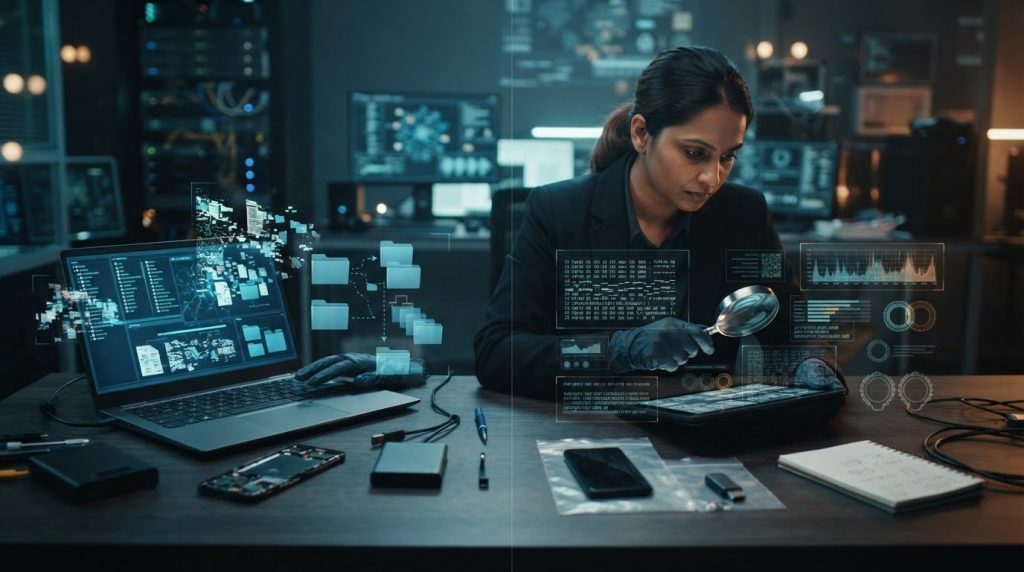
The files you need may be recoverable, but retrieving them alone may not explain what happened. That distinction sits at the heart of digital forensics vs data recovery: one aims to retrieve information, while the other examines digital evidence in response to investigative questions. Choosing the right objective matters when a device or its contents may be relevant to a dispute or inquiry.
It’s understandable to be unsure where to begin, or to worry that handling a device could affect information that needs to be preserved. This guide explains how retrieval differs from forensic examination, when each objective may fit, and why recovered files aren’t the same as documented investigative findings.
You’ll also learn what details can help define a focused examination, including the device involved, the information of concern, and whether the matter has an investigative or legal context. Palisade International LLC provides computer and cellphone forensics as part of its private investigation services, with a discreet approach to evidence collection and analysis.
Key Takeaways
- Start with your objective: retrieving missing information calls for a different approach than investigating activity or context.
- In digital forensics vs data recovery, the distinction is not only what information is found, but how it is examined and documented.
- Digital evidence can extend beyond files to relevant metadata and other device records that help address a specific investigative question.
- Clarify the matter, device, and information of concern to help define a focused forensic examination.
- Palisade International provides computer and cellphone forensics within its private investigation services, using licensed investigators and current investigative technology.
Digital Forensics vs. Data Recovery: Two Different Objectives
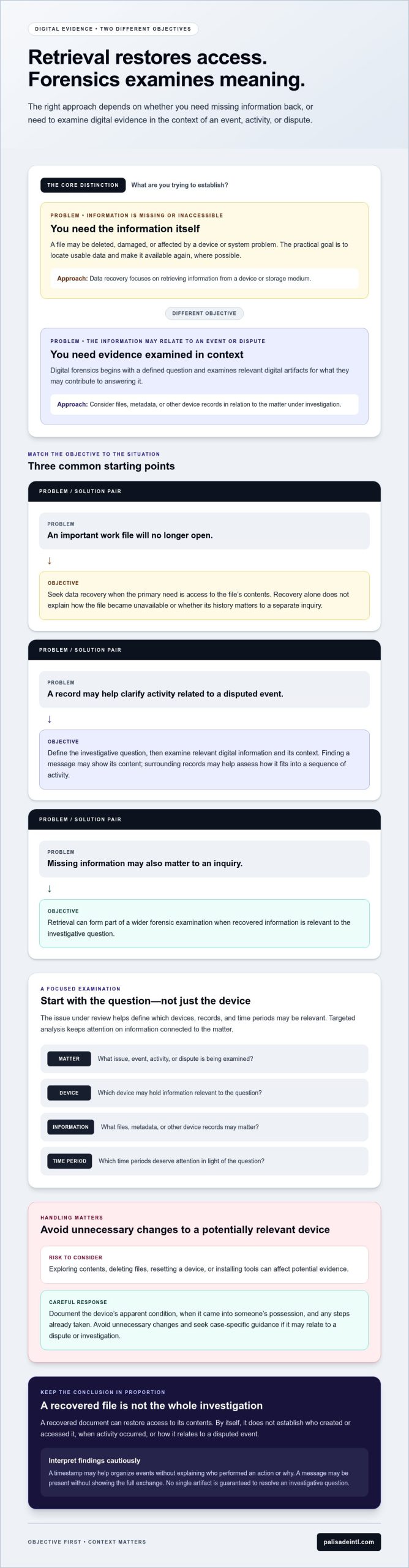
A device may contain missing information, records relevant to a disputed event, or both. The right objective depends on what you need to establish. In digital forensics vs data recovery, the distinction is not simply whether files are found. It is whether the task ends with retrieval or continues into examining evidence and its relevance to an investigative question.
Data recovery seeks information; digital forensics examines digital evidence to understand what it may show in context. A recovered document may restore access to its contents. It does not, by itself, establish who created or accessed it, when activity occurred, or how it relates to a disputed event. Those questions call for analysis beyond retrieval.
What data recovery is designed to accomplish
Data recovery focuses on retrieving information a user needs from a device or storage medium. Files may be inaccessible because they were deleted, damaged, or affected by a device or system problem. The practical goal is to locate usable data and make it available again, where possible.
For example, someone who can no longer open an important work file may need access to its contents. Retrieval is the central objective in that situation. Even if the file is recovered, that result alone doesn’t explain how it became unavailable or whether its history matters to a separate inquiry.
What digital forensics adds to an investigation
Digital forensics starts with a defined question, then examines relevant digital artifacts for what they may contribute to answering it. Depending on the matter, those artifacts could include files, metadata, or other device records. The focus is not only locating information, but considering its context and significance in relation to the issue under investigation.
For instance, finding a message may reveal its content. Examining relevant surrounding records may help an investigator assess how it fits into a sequence of activity. The interpretation depends on the evidence available and the question being examined; a single artifact should not be treated as proof of more than it can support. The broader field is outlined in What is Digital Forensics?.
This distinction can help clarify the initial objective:
- Retrieval: You need access to particular missing or inaccessible information.
- Investigation: You need to examine digital information for context related to an event, activity, or dispute.
- Both: Missing information may matter to an inquiry, so retrieval can form part of a wider forensic examination.
Computer and cellphone forensics are part of Palisade International’s private investigation services. Its licensed investigators maintain required education and skills and use the latest technology for investigations. The examination is tailored to the matter, with discretion guiding the handling of sensitive information.
How Digital Forensics Examines Evidence Beyond File Retrieval
A forensic examination is guided by a defined question, not simply by the presence of a device or file. Before interpreting digital information, an investigator needs to understand the issue under review, what is already known, and what the examination is intended to clarify. That focus helps distinguish potentially relevant material from data with no clear connection to the matter.
From investigative question to relevant digital artifacts
The question helps shape the scope: which devices may hold relevant information, what types of records may matter, and which time periods deserve attention. In a disputed communication, for example, the inquiry might concern whether related records exist and how they fit with other available information. In a suspected unauthorized-access matter, relevant device records may help establish a sequence of activity.
Potential artifacts can include files, metadata, or other device records. Their value depends on the question and surrounding context. A timestamp may help organize events, but may not explain who performed an action or why. A message may be present without showing the full exchange. Not every device contains relevant material, and no single artifact is guaranteed to resolve an investigative question.
This is a central distinction in digital forensics vs data recovery: examination considers what digital information may mean in relation to a matter, rather than treating discovery of a file as the complete result. The scope should remain focused. Examining more information is not automatically more useful; targeted analysis keeps attention on records that bear on the question.
Why preservation, documentation, and context matter
How a device is handled can affect potential evidence. Before exploring its contents, deleting files, resetting it, or installing tools, document its condition and the circumstances in which it was found or received. If it may relate to a dispute or investigation, avoid unnecessary changes and seek case-specific guidance on handling it. Early care can help preserve useful context for later examination.
Documentation can capture practical details such as the device’s apparent condition, when it came into someone’s possession, and any steps already taken. These details don’t determine what the evidence means, but they can help an investigator understand how it reached its current state and interpret findings cautiously.
A recovered file is an item of information; an interpreted finding is an assessment of that information’s relevance and context. The two aren’t interchangeable. Technical examination may identify records, patterns, or timing, but it does not by itself establish a person’s intent or conduct. Those conclusions require careful interpretation of the available material and the broader facts.
When digital records may inform a wider inquiry, Palisade International provides computer and cellphone forensics as part of a discreet, client-specific private investigation. Defining the question and documenting what has already happened can help establish a focused starting point.
Digital Forensics vs. Data Recovery: Compare the Goal, Process, and Output
A useful comparison starts with the question the work must answer. If a document has disappeared, the immediate concern may be whether its contents can be retrieved. If it relates to a disputed event, the concern may extend to how it fits with other digital information. These objectives can overlap, but one process should not automatically stand in for the other.
Compare the questions each discipline is meant to answer
Recovery asks whether needed information can be retrieved from a relevant source. For example, can an inaccessible file be restored for the user to consult? Forensics asks what relevant digital information may indicate in the context of an investigation. If that same file is connected to a disputed communication, the inquiry may examine its relationship to other records or activity. Neither question guarantees a particular finding.
| Discipline | Primary goal | Central question | Process focus | Typical output |
|---|---|---|---|---|
| Data recovery | Retrieve usable information | Can the needed information be accessed? | Locate and restore files or data where possible | Recovered information, if retrieval succeeds |
| Digital forensics | Examine information relevant to an investigation | What may the digital records indicate about activity, context, or sequence? | Assess relevant artifacts and their relationship to the investigative question | Findings or analysis shaped by the scope of the examination |
Compare process priorities and expected outputs
Recovery prioritizes access to usable information. Its practical value is often measured by whether the required files or data can be made available. Forensic work prioritizes examination and analysis: which records matter, how they relate to the question, and what their limits are. Its output may include documented findings, but scope and deliverables depend on the specific matter.
A matter can require both objectives. A file might first need to be located or retrieved, then assessed as part of a broader inquiry. Retrieval alone doesn’t establish the file’s history or significance, and forensic analysis cannot be assumed to restore every inaccessible item. The sequence and scope depend on the investigative need, available material, and condition of the relevant source.
Legal use also requires care. A technical result should not be treated as automatically admissible or decisive; its evidentiary significance depends on the matter and applicable requirements. The comparison in digital forensics vs data recovery is a practical starting point, not a substitute for case-specific assessment. Define the intended outcome first: access to information, analysis of activity or context, or a coordinated approach addressing both.
Choose the Right Approach for Your Digital Evidence Problem
Start with the outcome you need, not with a particular tool or assumption about what the device contains. In digital forensics vs data recovery, the key decision is whether you need information back for use, need to understand digital activity in context, or need to address both objectives.
- Define the immediate objective. If a missing or inaccessible file is the problem and you need its contents for ordinary use, retrieval may be the priority. If the concern is what happened, when activity occurred, or how digital records relate to a disputed event, an investigative examination may be more appropriate.
- Consider whether the information has investigative significance. A deleted file may be a practical inconvenience, or it may relate to suspected misconduct, a disputed communication, or another inquiry. If you need context rather than access alone, describe the question that needs examination.
- Record the known circumstances. Note the device type, the issue observed, the relevant timeline, what has already happened to the device, and any immediate concerns. Separate what you know from what you suspect. This gives an investigator a clearer starting point without treating assumptions as established facts.
- Limit unnecessary device use if evidence may matter. Avoid exploring, changing, or attempting repeated fixes on a device that may be relevant to an inquiry. Its condition and prior handling can inform an assessment; unnecessary activity may complicate the picture.
- Allow for overlapping needs. Some matters call for retrieval and investigative analysis, but neither objective automatically replaces the other. The appropriate scope depends on the information needed, known circumstances, and the question the work is intended to address.
When the immediate problem is inaccessible or missing information
If the goal is to regain access to a file needed for routine work, recovery may be the primary concern. The source’s condition and circumstances surrounding the loss affect what may be retrievable, so retrieval should never be assumed. Even if information is recovered, that result alone doesn’t establish who acted, why the file became unavailable, or whether it relates to a separate event.
When the matter calls for investigative examination
Disputed activity, suspected misconduct, or a need to understand digital context can point toward forensic examination. Describe the specific issue, relevant people or devices, known timeline, and records you believe may matter, while distinguishing documented facts from unanswered questions. If the issue is connected to a legal matter, litigation support for legal professionals may form part of the broader context.
For a discreet, case-specific discussion about computer or cellphone evidence, discuss your digital forensics needs with Palisade International.
How Palisade International Approaches Computer and Cellphone Forensics
Digital evidence can matter as part of a wider inquiry, not only as a collection of files on a device. Palisade International provides computer and cellphone forensics within its private investigation services, including evidence collection and forensic analysis. The investigative question helps determine what information is relevant and how the examination fits the circumstances of the matter.
This distinction is central to digital forensics vs data recovery. A retrieval task focuses on making information available; a forensic examination considers digital material in relation to an investigative objective. The appropriate scope depends on the case, the devices involved, and the questions that need attention. No particular recovery, finding, or legal outcome is guaranteed.
Forensic technology within private investigations
Computer and cellphone examinations can contribute to a broader private investigation when digital records may help clarify an event or issue. Palisade International’s licensed investigators maintain required education and skills and use the latest technology for investigations. The investigative context guides the analysis: the same device record may have different relevance depending on the matter, and not every artifact will answer the question under review.
For readers considering investigative support in Atlanta, a private investigator Atlanta strategic guide can provide related context on private investigations. Digital forensic work remains case-specific, with attention directed toward the matter and available information rather than assumptions about what a device will reveal.
Prepare for a discreet initial discussion
A concise summary can help establish a focused starting point. Consider preparing:
- The issue or event you need examined, separating known facts from concerns or assumptions.
- The relevant computer, cellphone, or other device, if known.
- A general timeline, including when the issue arose and any handling or changes already made.
- Any immediate concern about privacy, a dispute, or the device’s continued use.
Share only information relevant to framing the matter. If a device may contain evidence, avoid unnecessary use or changes while you determine the appropriate next step. Palisade International approaches engagements discreetly and tailors the investigative scope to the circumstances, available information, and questions that require examination. A discussion can establish a focused starting point for computer or cellphone forensics.
Discuss a computer or cellphone forensics matter
Set a Clear Direction for Your Next Step
The most useful next move is to turn uncertainty into a focused question: what decision or understanding do you need the digital information to support? That question can keep the work aligned with the matter, particularly when the distinction between digital forensics vs data recovery has practical consequences for how a device is handled and examined.
Palisade International provides computer and cellphone forensics as part of its private investigation work. Its licensed investigators maintain required education and skills and use the latest technology for investigations. The scope is shaped around the specific circumstances, without assumptions about what the evidence will establish.
Prepare a concise account of the issue, the relevant device, the known timeline, and any immediate concerns. A discreet, case-specific discussion can help define an investigative direction without presuming a particular result.
Discuss a computer or cellphone forensics matter. A clear starting question can help bring order to a complex situation.
Frequently Asked Questions
Is digital forensics the same as data recovery?
No. Digital forensics and data recovery address different objectives. In digital forensics vs data recovery, think of the difference as access versus investigation: recovery seeks usable information, while forensics examines relevant digital material in relation to a defined inquiry. If you need a missing spreadsheet for routine work, access may be the priority. If the spreadsheet relates to a disputed event, its surrounding context may also matter.
Can data recovery determine who deleted or changed a file?
Not on its own. Recovering a file may restore its contents without establishing who deleted or changed it. Relevant records or metadata could provide clues, but their meaning depends on the source, what information remains, and the broader circumstances. If attribution matters, frame it as an investigative question rather than assuming retrieval will identify a person. Findings should be interpreted cautiously and in context.
Can digital forensics examine both computers and cellphones?
Yes. Digital forensic examination can involve computers and cellphones, depending on the question and the material relevant to the matter. For example, an inquiry about a disputed exchange might concern information on a phone, a computer, or both. Palisade International provides computer and cellphone forensics within its private investigation services. The relevant devices and scope depend on the circumstances, rather than on a fixed checklist of devices.
What should I do with a device that may contain relevant digital evidence?
Limit unnecessary use and avoid resetting the device, deleting information, or trying repeated fixes. Record its current condition, where it is, who has handled it, and any steps already taken. Note the issue and approximate timeline while details are clear. If the device is part of a legal or workplace matter, coordinate with the appropriate decision-makers before making changes that could affect information or access.
Can deleted files always be recovered?
No. Recovery cannot be assumed. Whether deleted information remains available depends on factors such as the device’s condition and what happened after deletion. Continued use or damage may affect what can be retrieved, and some files may be incomplete or unavailable. Avoid treating a recovery attempt as a guaranteed solution, especially if the information may relate to an investigation. The device and circumstances require an individual assessment.
Does a recovered file automatically count as evidence in court?
No. Finding or retrieving a file does not automatically establish its legal significance or mean a court will accept it. Its relevance may depend on the facts of the matter, how it was obtained and handled, and applicable requirements. A recovered document can be one piece of information, but its contents alone may not establish authorship, timing, or surrounding circumstances. Legal questions should be addressed with qualified legal counsel.
Can a matter require both data recovery and digital forensics?
Yes. A matter may involve both if information is inaccessible and may also help clarify an event. For example, a missing project document could be needed for business continuity while also being relevant to a dispute about changes to that document. Identify the retrieval objective and investigative question separately, so restoring access isn’t mistaken for explaining the file’s history or significance.