
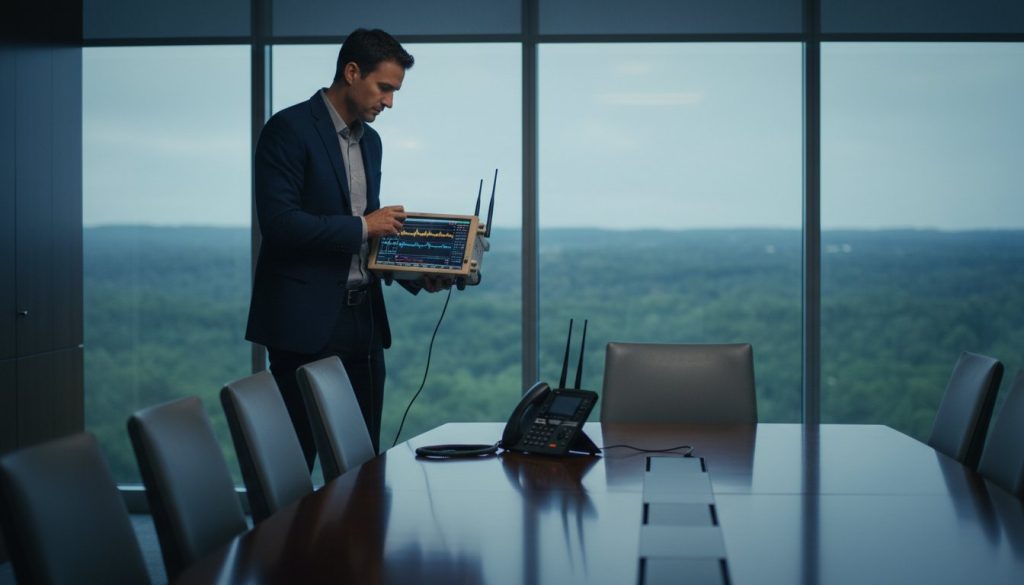
Hiring an unvetted hobbyist to secure a confidential boardroom is a greater strategic liability than the surveillance device itself. You likely recognize that the disparity in professional bug sweep cost reflects a fundamental difference between a cursory visual inspection and a comprehensive, intelligence-led sweep. With the 2025 Allianz Risk Barometer identifying technical intercepts as a primary driver of global volatility, relying on “spy shop” gadgets provides a false sense of safety that compromises your long-term interests. The illusion of security is a profound failure that often costs more than the initial investment in professional protection.
This guide clarifies the nuanced variables that determine TSCM pricing and provides a framework to distinguish between amateur enthusiasts and elite technical practitioners. We’ll examine the essential equipment benchmarks, the necessity of bespoke mitigation strategies, and how to verify a provider’s operational excellence. By understanding these technical requirements, you’ll gain the clarity needed to secure your environment and ensure the absolute restoration of your privacy. This strategic overview ensures you aren’t just buying a service, but investing in a definitive solution for your organizational security.
Key Takeaways
- Understand why the professional bug sweep cost is a direct reflection of risk mitigation and the specialized technical expertise required to counter sophisticated modern surveillance.
- Learn to distinguish between inadequate “spy shop” sweeps and elite TSCM services by evaluating equipment standards and the necessity of continuous operational training.
- Identify the strategic differences between residential privacy protection and the multi-layered countermeasures required to neutralize corporate industrial espionage and insider threats.
- Discover the essential vetting criteria for providers, ensuring your security partner utilizes government-grade detection technology to identify even the most discreet, high-level bugs.
- Gain insight into how bespoke, intelligence-led solutions offer a proactive defense and absolute strategic certainty for high-net-worth individuals and corporate entities.
Defining the Value of Privacy: What Determines Professional Bug Sweep Cost?
Professional bug sweep cost isn’t a standard line-item expense. It’s a strategic allocation of capital toward asset protection and risk management. When high-stakes negotiations or sensitive executive communications are at risk, the price of a sweep reflects the sophistication of the threats being mitigated. You aren’t paying for a technician to walk through a room with a handheld wand. You’re investing in a comprehensive security posture designed to identify vulnerabilities that consumer-grade tools simply cannot see.
Privacy isn’t accidental. It’s engineered. In a corporate or high-net-worth environment, the presence of a single illicit listening device can lead to the total compromise of intellectual property or personal safety. Therefore, the cost is a direct reflection of the intensity of the search and the level of certainty required by the client. It’s the difference between a cursory glance and a forensic audit of your private space.
The Difference Between TSCM and a Basic ‘Sweep’
True Technical Surveillance Counter-Measures (TSCM) is an intelligence-led discipline. It’s fundamentally different from a basic sweep performed by an amateur using retail-grade gadgets. A $500 ‘bug detector’ bought from an online retailer lacks the sensitivity to find modern, low-probability-of-intercept (LPI) transmitters or dormant devices that only activate at specific times. Professionals don’t rely on toys. They utilize laboratory-grade equipment like Non-Linear Junction Detectors (NLJD) and spectrum analyzers that often cost more than $30,000 per unit.
These tools require expert operators to function effectively. Most elite TSCM teams consist of personnel with deep backgrounds in military intelligence or specialized law enforcement. Their expertise allows them to distinguish between the background electronic noise of a modern office and the subtle signature of a sophisticated eavesdropping device. When you evaluate professional bug sweep cost, you’re primarily paying for this high-level technical proficiency and the peace of mind it provides.
The High Cost of Privacy Breaches
The financial impact of a breach often dwarfs the professional bug sweep cost by a significant margin. According to the 2023 Cost of a Data Breach Report by IBM, the average global cost of a data breach reached $4.45 million. In corporate espionage scenarios where trade secrets, merger details, or acquisition strategies are stolen, the damage to market position is frequently irreparable. A single compromised meeting can result in the loss of millions in projected revenue or the failure of a sensitive legal strategy.
Framing the sweep as a fraction of the potential loss is the standard approach for 85% of global security directors. Utilizing technical surveillance counter-measures provides the litigation support and operational certainty required in high-stakes environments. It’s a proactive defense mechanism. By identifying threats before they manifest as a crisis, organizations protect their most valuable intangible assets. Discretion and foresight are the hallmarks of a secure operation, ensuring that your private data remains exactly that.
The Technical Variables: Equipment and Operational Excellence
The investment required to field a tier-one Technical Surveillance Countermeasures (TSCM) team is substantial. Most reputable firms utilize a suite of specialized equipment that exceeds $150,000 in total value. This capital expenditure ensures that the professional bug sweep cost reflects the ability to detect threats that consumer-grade tools simply cannot see. Beyond the hardware, pricing accounts for the 80 to 120 hours of annual training required for specialists to remain proficient against 2026-era surveillance innovations. Every facility presents a unique RF (Radio Frequency) profile; therefore, a bespoke approach is the only way to guarantee the integrity of a secure space.
The Role of Advanced Instrumentation
Professional teams rely on Spectrum Analyzers, such as the REI OSCOR, to conduct real-time analysis of the local radio environment. These devices scan up to 24 GHz in seconds, identifying illicit transmissions that hide within legitimate signal traffic. While a spectrum analyzer finds active signals, a Non-Linear Junction Detector (NLJD) is necessary to find dormant or “off” electronics by detecting the semi-conductor junctions present in all modern surveillance circuitry. Thermal imaging cameras are critical for identifying the minute heat signatures generated by hidden lenses or internal power supplies concealed within walls and furniture.
Expertise and Personnel Costs
A single-operator sweep is often insufficient for high-stakes environments. Industry standards dictate a team of two or more specialists to maintain physical security while simultaneously monitoring signal fluctuations. This division of labor ensures thoroughness and prevents the oversight of sophisticated “burst” transmitters. The “silent professional” ethos defines these operations, where discretion and operational security (OPSEC) are prioritized to ensure the sweep itself does not alert a potential adversary.
Integrating the tactical mindset of a private investigator atlanta professional adds a layer of intelligence-led scrutiny to the technical process. This expertise allows the team to look beyond the hardware and analyze the “how” and “why” of a potential breach. The professional bug sweep cost is an investment in this multi-layered defense strategy.
- RF Noise and Electronic Density: High-density urban environments require more labor hours to filter through hundreds of legitimate Wi-Fi and Bluetooth signals.
- Physical Complexity: Server rooms, executive boardrooms, and private aircraft each demand specific protocols and specialized probes.
- Bespoke Methodology: Every sweep is tailored to the client’s specific threat model, ensuring that resources are allocated where the risk is highest.
Operational excellence is not a static achievement but a continuous pursuit. For organizations requiring absolute certainty, a consultation on strategic threat mitigation can provide the necessary foresight to protect sensitive information before a breach occurs.

Residential vs. Corporate TSCM: Comparing Investment Scales
Differentiating between residential and corporate technical surveillance countermeasures is essential for understanding how a professional bug sweep cost is calculated. Residential engagements focus on the sanctity of the home and the protection of personal privacy. These sweeps often address specific threats like stalking, domestic litigation, or the protection of high-net-worth families. In contrast, corporate TSCM is a strategic tool designed to thwart industrial espionage, secure boardrooms, and mitigate insider threats. The investment scale reflects these differing objectives; a residence requires intimate, detail-oriented inspection of personal spaces, while a corporate environment demands a high-level, intelligence-led approach to secure sensitive business data.
The primary cost driver in any engagement is the scale of the environment. However, scale isn’t measured by square footage alone. A 10,000-square-foot warehouse might be less complex to sweep than a 500-square-foot executive boardroom packed with advanced telecommunications equipment. Providers typically utilize two pricing structures: flat-fee project engagements for defined scopes or hourly rates for complex, evolving investigations. Flat fees provide budget certainty, but they require a comprehensive initial assessment to ensure no technical vulnerabilities are overlooked.
Residential TSCM Pricing Frameworks
Executive residences in the Atlanta and Roswell areas present unique challenges that influence the professional bug sweep cost. These properties often feature integrated smart home systems and expansive Wi-Fi networks that extend to guest houses or outdoor living spaces. A bespoke residential sweep includes more than just walls and ceilings; it involves auditing the digital perimeter and scanning high-value vehicles for GPS trackers or cellular transmitters. Flat rates for large estates can be misleading. Without a preliminary risk analysis, a generic quote might ignore the complexity of a home’s specific Internet of Things (IoT) ecosystem. Effective mitigation requires a tailored plan that accounts for every potential point of ingress an adversary might exploit.
Corporate and Industrial Sweep Costs
Corporate security directors prioritize efficiency and discretion. Instead of sweeping an entire office floor, which can be cost-prohibitive and unnecessary, elite providers focus on “Sensitive Compartmented Information” areas. These high-value zones include executive offices, legal departments, and research laboratories. Concentrating resources here ensures maximum protection for the firm’s most critical assets. Timing also plays a significant role in corporate pricing. Deployments often occur after-hours or during weekends to prevent operational downtime and maintain the “silent professional” profile. This scheduling avoids alerting potential insiders to the sweep’s presence. Before initiating a sweep, firms should engage in a formal risk analysis to identify where their vulnerabilities lie. This strategic framework ensures that the TSCM budget is allocated to the areas of highest risk, providing a superior return on security investment.
Avoiding the ‘Spy Shop’ Trap: How to Vet TSCM Providers
The market for surveillance countermeasures is saturated with low-cost providers who rely on consumer-grade hardware found in retail “spy shops.” While the initial professional bug sweep cost from these hobbyists might seem attractive, their lack of sophisticated training leaves clients vulnerable to government-grade or high-end corporate espionage tools. These budget operators often miss passive bugs, burst transmitters, or devices embedded within complex infrastructure. True Technical Surveillance Countermeasures (TSCM) require an intelligence-led approach that goes beyond simple frequency scanning.
Vetting a provider involves a rigorous assessment of their background and technical capabilities. Elite firms typically consist of former intelligence officers or specialized military technicians who understand the offensive strategies used by modern adversaries. You should demand a specific equipment list before signing any contract. A provider’s inability to produce a detailed inventory of their spectrum analyzers, non-linear junction detectors, and thermal imaging tools is an immediate indicator of technical inadequacy.
Critical Questions for Potential Providers
Engage in a direct technical dialogue to separate high-level professionals from ill-equipped amateurs. Use these specific queries to gauge their operational excellence:
- “What is the total value of the equipment you’re bringing to my site?” A professional TSCM team often deploys hardware valued in excess of $200,000. If a provider arrives with only a few thousand dollars worth of handheld “wands,” they won’t find sophisticated threats.
- “How do you handle ‘burst’ transmitters or devices that only activate intermittently?” Modern bugs don’t always transmit a constant signal. Identifying these requires high-speed spectrum analysis and long-term monitoring capabilities that basic detectors simply don’t possess.
- “Do you offer a 100% guarantee that the room is clean?” Any provider promising a “100% guarantee” is a red flag. In the security industry, we recognize that threats evolve. A professional promises a rigorous, intelligence-led process and the highest probability of detection, not an impossible absolute.
The Importance of Post-Sweep Reporting
The value of a professional bug sweep cost is often found in the documentation delivered after the physical inspection. A verbal “all clear” is insufficient for corporate compliance or high-net-worth risk management. A bespoke report serves as a technical baseline for your environment, documenting the RF spectrum as it existed during the sweep. This report should include detailed spectrum logs, physical inspection findings, and high-resolution thermal imagery of suspicious heat signatures.
These comprehensive documents are essential for litigation support if a device is discovered. When a firm finds illicit surveillance equipment, they must maintain a strict chain of custody to ensure the evidence is admissible in court or during internal investigations. A professional TSCM firm acts as a strategic partner, assisting law enforcement by providing the technical data needed to trace the origin of a threat. This level of detail ensures that your organization is prepared for the legal and operational aftermath of a security breach.
Bespoke TSCM Solutions from Palisade International
Palisade International delivers intelligence-led TSCM services tailored for the unique requirements of Georgia’s elite. Our methodology merges technical precision with a sophisticated understanding of global risk management. We prioritize absolute discretion. This ensures our operational footprint remains invisible to adversaries. From securing corporate headquarters in Roswell to protecting executive residences across international borders, our team provides unparalleled certainty in an era of persistent surveillance. While the professional bug sweep cost reflects the complexity of the task, the investment secures the integrity of your most sensitive data. We’ve managed security protocols for clients across 15 different countries, adapting to local threat landscapes with surgical precision.
Our Strategic Approach to Bug Sweeps
Our multi-layered methodology exceeds standard industry protocols to provide a comprehensive security umbrella. We utilize spectrum analyzers capable of detecting signals up to 24 GHz, ensuring that even the most modern, low-probability-of-intercept devices are identified. Our process includes:
- Physical Search: A meticulous manual inspection for passive or dormant eavesdropping devices.
- RF Analysis: Real-time monitoring of the radio frequency spectrum to catch active transmissions.
- Digital Forensics: Analyzing Wi-Fi networks and VoIP systems for unauthorized data exfiltration.
Our specialists come from elite military and law enforcement backgrounds. This ensures every engagement is executed with the operational excellence required for high-stakes environments. We don’t just clear a room; we fortify your perimeter against future breaches. This level of technical depth is why the professional bug sweep cost is viewed as a necessary line item in the annual security budgets of Fortune 500 companies.
Securing Your Future with Palisade
Securing your future requires a proactive stance. Establishing a regular TSCM schedule for corporate boardrooms is a strategic necessity. It transforms security from a reactive measure into a continuous shield. To maintain total confidentiality, initial contact should occur via secure, out-of-band channels. This prevents alerting potential eavesdroppers to the upcoming sweep. You can Contact Palisade International for a bespoke risk assessment and a detailed TSCM quote tailored to your specific operational environment. Our team is prepared to deploy within 24 to 48 hours to ensure your communications remain your own.
Ensuring Technical Sovereignty Through Strategic Oversight
Navigating the complexities of technical surveillance requires a shift from viewing security as a commodity to recognizing it as a pillar of operational excellence. You’ve seen how the technical variables of equipment and the scale of the environment dictate the overall professional bug sweep cost. Protecting high-stakes corporate intelligence or personal privacy isn’t a task for hobbyists using consumer-grade tools. Privacy is a prerequisite for success. It demands a sophisticated, intelligence-led approach that prioritizes long-term mitigation over temporary fixes.
Palisade International has provided these bespoke security solutions since 2003. Our teams leverage decades of elite security experience and deploy specialized equipment exceeding $150k in value per deployment to ensure your environment is sterile. We maintain absolute discretion for every high-net-worth and corporate client we serve. You shouldn’t leave your confidentiality to chance when the technical threats of 2026 are more sophisticated than ever. Taking proactive steps today ensures your strategic certainty remains intact for the future.
Request a Confidential TSCM Consultation with Palisade International
Frequently Asked Questions
How much does a professional bug sweep cost on average in 2026?
A professional bug sweep cost for corporate environments in 2026 typically ranges from $2.00 to $5.00 per square foot based on industry benchmarks. Residential engagements for properties around 2,500 square feet often start at a flat rate of $3,000. These figures reflect the high cost of laboratory-grade equipment and the technical expertise required to mitigate modern surveillance threats. Every engagement is bespoke, so final pricing depends on the specific threat profile and technical complexity involved.
Why shouldn’t I just buy a bug detector online for a few hundred dollars?
Consumer-grade detectors priced under $500 lack the sensitivity to identify advanced burst transmitters or spread-spectrum devices used in modern espionage. Professional technicians utilize spectrum analyzers like the REI OSCOR Blue, which costs approximately $25,000, to scan frequencies up to 24 GHz. Cheap devices often produce false positives from common Wi-Fi signals while missing 90 percent of sophisticated threats. You’re paying for the certainty that only elite, intelligence-led equipment can provide.
Does the cost of a bug sweep include the vehicle and phone lines?
Most firms treat vehicle inspections and wireline analysis as separate line items within a comprehensive security proposal. A technical sweep of a single executive vehicle typically adds $800 to $1,200 to the total professional bug sweep cost. Phone line inspections require specialized Time Domain Reflectometry equipment to identify physical taps or bridge connections. We recommend including these critical vectors in your initial strategy to ensure no intelligence gaps remain in your perimeter.
How long does a professional TSCM sweep typically take?
A thorough TSCM inspection requires approximately 1 hour of labor for every 1,000 square feet of space. A 5,000 square foot executive suite will take 5 to 6 hours to complete if the team follows rigorous professional standards. This timeline accounts for physical searches, radio frequency analysis, and thermal imaging sweeps. Rushing this process compromises the integrity of the results; we prioritize methodical precision over speed to ensure absolute security for our clients.
Can a bug sweep detect devices that are currently turned off or dormant?
Technicians use Non-Linear Junction Detectors to identify electronic components even when a device is powered down or in a dormant state. This technology detects the semiconductor materials present in all modern surveillance hardware. Approximately 40 percent of modern bugs utilize sleep cycles or remote activation to evade basic RF scanners. Only an NLJD can reliably locate these inactive threats during a sweep, providing a level of protection that simple scanners cannot match.
What happens if a listening device is actually found during the sweep?
If we locate a device, we immediately implement a pre-established evidence preservation protocol to maintain a legal chain of custody. You shouldn’t touch or move the device, as this could destroy fingerprint or DNA evidence needed for a criminal investigation. We provide a detailed technical report that serves as a foundation for law enforcement notifications. This disciplined approach ensures the discovery leads to a strategic resolution rather than just a temporary fix.
Is the cost of a corporate bug sweep tax-deductible as a business expense?
Corporate entities can generally deduct TSCM services as an ordinary and necessary business expense under IRS Section 162. This classification applies when the sweep is conducted to protect trade secrets or maintain operational security. High-net-worth individuals may find limited deductibility if the service is directly tied to the management of income-producing property. You should consult with your tax professional to confirm how these security costs apply to your specific 2026 financial structure.
Why do prices vary so much between different security firms in Atlanta?
Pricing disparities in the Atlanta market reflect the difference between basic private investigators and certified TSCM specialists. Firms utilizing $150,000 in laboratory-grade equipment charge higher rates than those using handheld hobbyist tools. In 2025, the Georgia Board of Private Detective and Security Agencies reported a wide range of provider qualifications across the state. Investing in a higher-tier firm ensures the use of current intelligence-led methodologies and superior threat detection capabilities.