

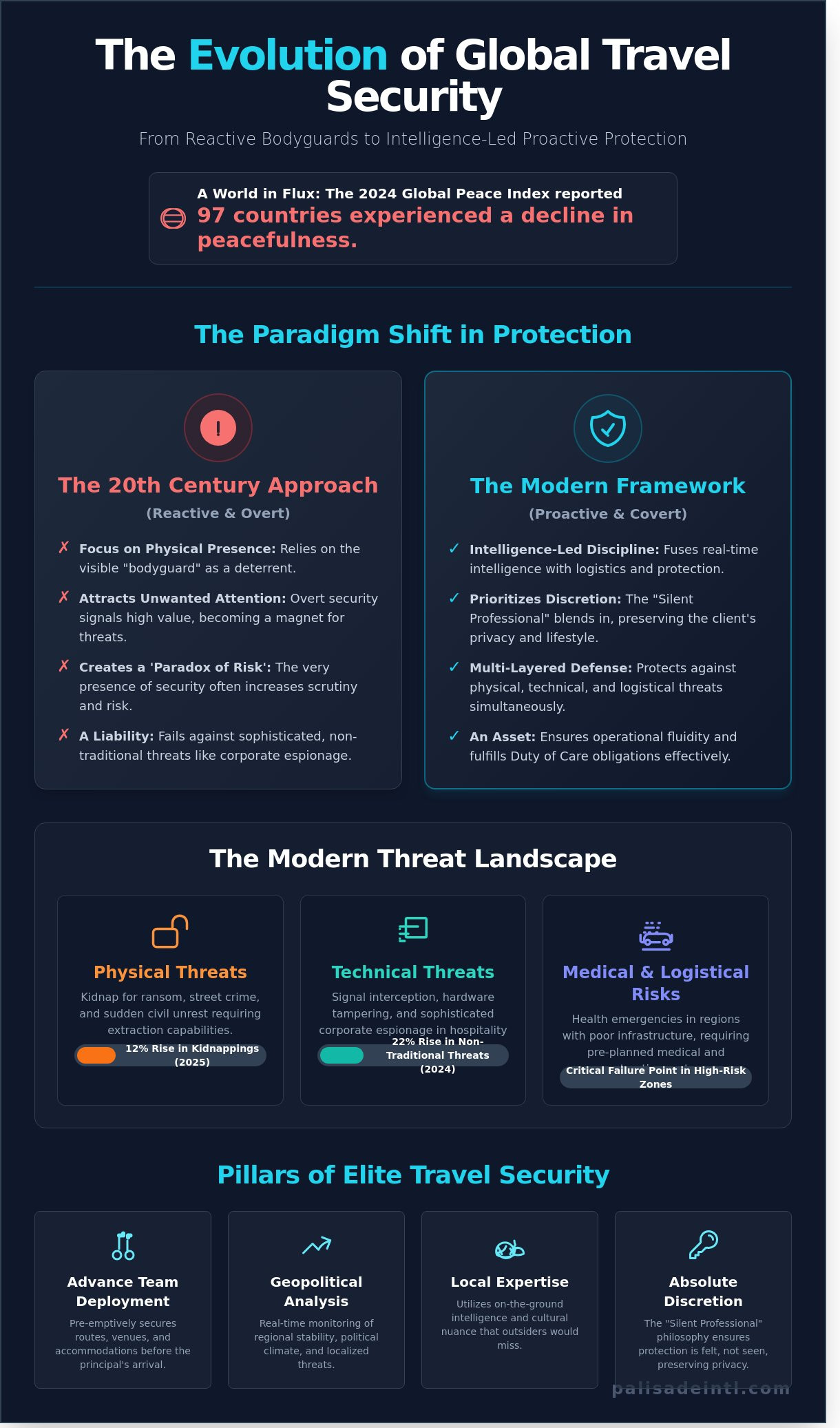
The concept of a “safe region” is becoming a dangerous relic of 20th-century geopolitical thinking. In 2024, the Global Peace Index reported that 97 countries experienced a decline in peacefulness, the highest number of deteriorating states since the study began in 2008. You’re likely aware that the traditional boundaries of risk have shifted; a luxury hotel in a European capital can now present the same corporate espionage vulnerabilities as an emerging market. To maintain operational continuity, sophisticated entities require professional travel security services that move beyond reactive measures toward intelligence-led mitigation.
It’s clear that your organization values the safety of its human capital as its most vital asset. We’ll show you how to manage this global volatility with a framework designed for absolute discretion and proactive risk reduction. This guide outlines the essential components of elite executive protection, from securing intellectual property against sophisticated hotel-based theft to ensuring seamless transit across inconsistent global jurisdictions. You’ll gain a comprehensive understanding of how bespoke security protocols fulfill your Duty of Care obligations while preserving the quiet confidence your leadership demands.
Key Takeaways
- Understand why modern risk management requires a transition from reactive physical protection to a multi-layered, intelligence-led discipline.
- Learn how professional travel security services utilize advance team deployment and geopolitical analysis to pre-emptively secure complex international routes.
- Identify the critical distinction between tactical security and strategic risk management, emphasizing the necessity of local expertise and ground-level intelligence.
- Evaluate personal and corporate risk profiles to determine when high-net-worth status or destination volatility necessitates a bespoke protection framework.
- Discover how integrating military-grade intelligence with absolute discretion ensures a proactive stance against evolving digital and physical threats.
The Evolution of Global Travel Security Services in 2026
The definition of travel security services has undergone a radical transformation by 2026. It’s no longer a singular focus on physical presence; it’s a multi-layered discipline. This field now fuses real-time signal intelligence with complex logistics and strategic physical protection. The 2024 Global Risk Report indicated a 22% rise in non-traditional threats against high-net-worth travelers, necessitating a transition toward intelligence-led frameworks that prioritize digital anonymity alongside physical safety. Traditional models centered on the visible “bodyguard” often fail in this landscape. Large, overt security details frequently attract the very attention they’re designed to prevent, creating a paradox of risk. Modern protection requires a sophisticated understanding of geopolitical volatility and the digital footprints left during international transit.
Corporations now face stricter legal benchmarks for Duty of Care. In 2025, several high-profile legal precedents established that generic travel insurance is insufficient for high-risk transit. Organizations must provide bespoke security frameworks to mitigate predictable risks. This shift moves security from a luxury add-on to a mandatory operational requirement. It ensures that the principal remains productive while the security apparatus manages the friction of global movement. Success is measured by the absence of incident and the total fluidity of the client’s itinerary.
Identifying Modern Travel Risks
- Physical threats: Kidnap for ransom incidents in specific emerging markets rose by 12% in 2025. Street crime and civil unrest often erupt with little warning, requiring immediate extraction capabilities.
- Technical threats: High-value targets face constant surveillance in five-star hospitality environments. Signal interception and hardware tampering are now standard risks in major financial hubs.
- Medical and logistical risks: Health emergencies in regions where infrastructure scores below a 4.0 on the Global Health Security Index require pre-planned extraction routes. Relying on local emergency services is often a critical failure point.
The Silent Professional Philosophy
Discretion acts as the primary currency of elite protection in the current era. Overt security is often a liability that compromises privacy and draws unwanted scrutiny from both opportunistic criminals and state actors. Covert, intelligence-led protection allows for operational fluidity. This approach maintains the client’s lifestyle while ensuring safety without the spectacle. For a foundational perspective on these methodologies and their historical development, reviewing an Executive Protection Overview helps clarify how these roles have shifted from reactive to proactive stances. It’s about being several steps ahead of a threat before it manifests physically.
The “unobtrusive” security presence is the hallmark of travel security services provided by top-tier firms. Practitioners blend into the environment, appearing as executive assistants or logistical coordinators rather than security personnel. This methodology preserves the principal’s social and professional capital. It allows a celebrity or executive to move through public spaces without the “bubble” that signals their status to potential threats. True security is felt, not seen. It relies on meticulous advance work and local expertise to navigate cultural nuances that an outsider would likely miss. This silent vigilance ensures that the client’s focus remains on their objectives, not their surroundings. By 2026, the most effective security programs are those that leave no visible footprint, prioritizing strategic foresight over outward flashiness.
The Anatomy of a Bespoke Travel Security Program
Protective operations for high-profile figures require a methodology that extends far beyond physical presence. A truly bespoke program functions as a continuous lifecycle, beginning weeks before departure and concluding long after the principal returns home. This structured approach ensures that travel security services aren’t merely reactive but are instead driven by foresight and technical precision.
The program follows four distinct, non-negotiable phases:
- Phase 1: Intelligence-led Threat Assessment. Specialists analyze the 2024 Global Risk Index and specific geopolitical shifts to identify localized threats. This includes monitoring civil unrest patterns, kidnapping-for-ransom statistics in specific municipalities, and the current stability of local governance.
- Phase 2: Advance Team Deployment. Security professionals arrive on-site 48 to 72 hours before the principal. They physically verify every location, from private aviation terminals to secure residential wings, ensuring no detail is left to chance.
- Phase 3: Real-time Monitoring. During the mission, a Global Security Operations Center (GSOC) provides 24/7 oversight. This allows for immediate tactical adjustments if a route becomes compromised or a local protest erupts near a scheduled venue.
- Phase 4: Post-travel Debriefing. Every mission concludes with a comprehensive analysis. We update the principal’s long-term risk profile based on new intelligence gathered on the ground, ensuring future deployments are even more refined.
This lifecycle creates a closed-loop system. It eliminates the “security theater” often found in lower-tier services, replacing it with a rigorous, data-driven framework. We don’t just react to the world; we anticipate how it’ll move before our clients arrive.
The Role of the Advance Team
The advance team serves as the eyes and ears of the operation. Their primary objective involves neutralizing “choke points,” specifically airport exits and hotel transition zones where 65% of targeted attacks occur. By scouting multiple arrival and departure routes, the team ensures the principal never becomes predictable. They vet local transportation providers to ensure vehicles meet B6 or B7 ballistic standards, providing protection against high-velocity rifle rounds. Establishing a direct liaison with embassy security attaches and local law enforcement ensures that bespoke protective intelligence is shared in real-time, creating a multi-layered safety net that functions seamlessly across international borders.
Technical Surveillance Counter-Measures (TSCM) on the Move
Corporate espionage is a primary threat in high-risk jurisdictions, with intellectual property theft costing firms an estimated $300 billion annually. Hotel rooms and private villas are rarely private. Our specialists conduct “sweeps” of all meeting spaces and accommodations to detect illicit listening devices or hidden pinhole cameras. This technical rigor extends to the digital landscape. We secure Wi-Fi networks and implement encrypted communication channels to prevent data interception by local state actors or industrial competitors. It’s a sober reality that in many regions, the walls do have ears. Our TSCM protocols ensure your proprietary information remains your own, regardless of the local surveillance environment. This level of technical oversight is a hallmark of elite travel security services that prioritize discretion and strategic certainty.
Strategic Mitigation: Protection Beyond the Bodyguard
Most individuals equate safety with a physical presence, yet a Close Protection Officer represents only the final layer of a multi-faceted defense. Effective travel security services require a transition from tactical reaction to strategic risk management. While tactical security focuses on the immediate physical environment, strategic mitigation involves analyzing the broader geopolitical landscape to prevent an encounter from ever occurring. This proactive stance is essential for high-profile travelers who face risks that extend beyond physical violence, including corporate espionage and targeted harassment.
Palisade International LLC utilizes ground-level intelligence contacts to gain insights that satellite data cannot provide. Local expertise is the difference between knowing a city’s layout and understanding its current social volatility. In 2023, the Global Peace Index recorded a 0.42% deterioration in global peacefulness, marking the thirteenth year of decline in the last fifteen. This trend proves that relying on outdated travel advisories isn’t enough. We maintain direct links with regional specialists who provide real-time updates on everything from labor strikes to shifting criminal patterns in luxury districts.
High-profile travelers often fall into the trap of believing security is only for “dangerous” regions. This misconception ignores the targeted nature of modern crime. Data from London’s Metropolitan Police in 2023 revealed over 6,000 luxury watch thefts, many occurring in perceived “safe” zones like Mayfair or Kensington. Strategic mitigation recognizes that a high-net-worth individual’s profile creates a localized risk environment regardless of the host nation’s overall stability. Security isn’t a response to a country; it’s a response to a profile.
Integrating travel security services with a broader corporate security framework ensures that Duty of Care obligations are met with absolute precision. When security isn’t a siloed expense but a core component of corporate governance, response times during a crisis drop by approximately 30%. This cohesion allows for seamless communication between the traveling team, the home office, and legal departments, ensuring that every decision aligns with the client’s long-term reputation and safety.
Geopolitical Intelligence and Real-Time Monitoring
Our team utilizes a blend of open-source and proprietary intelligence to track civil unrest or transportation strikes that could disrupt a client’s itinerary. We maintain a 24/7 Global Operations Center (GOC) to provide traveling teams with a constant link to analysts who monitor global volatility. Protective intelligence is the proactive gathering of threat data to prevent encounters. By identifying risks before they materialize, we ensure that a client’s movement remains fluid and uninterrupted.
Crisis Management and Extraction Protocols
A robust security plan requires “Plan B” and “Plan C” contingencies for medical emergencies or sudden political instability. We develop bespoke extraction protocols that include pre-vetted secondary airfields and secure ground transport routes. These logistics are integrated with family office or corporate leadership protocols to ensure a unified response. During the 2023 Sudanese conflict, organizations with pre-established extraction plans successfully evacuated personnel 48 hours faster than those relying on reactive measures, highlighting the necessity of foresight.
Assessing Your Profile: When Do You Need Travel Security?
Determining the necessity for professional protection requires a dispassionate analysis of three primary variables: the individual’s profile, the destination’s volatility, and the specific objectives of the journey. High-net-worth individuals with liquid assets surpassing $50 million or C-suite executives at firms listed on the S&P 500 attract a level of scrutiny that transcends standard safety precautions. Public visibility, such as a 2024 media profile or a significant social media presence, serves as a beacon for sophisticated threat actors who monitor digital footprints to identify high-value targets. When your presence in a region is tied to market-moving decisions or sensitive negotiations, your personal safety becomes an inextricable component of corporate stability.
The destination’s risk level must be evaluated using real-time geopolitical intelligence rather than static government advisories. While a country may hold a stable rating generally, specific urban centers or industrial zones can present localized threats such as targeted kidnapping, civil unrest, or corporate espionage. For instance, the 2024 Global Risk Map highlights specific jurisdictions where the kidnapping-for-ransom industry has seen a 12% increase in targeting foreign executives. The nature of the travel also dictates the security posture. A private family retreat requires a low-profile, discreet presence that preserves privacy, whereas a public speaking engagement at a global summit demands a robust, visible protective detail to deter physical disruptions.
The Vulnerability Assessment Framework
A vulnerability assessment is a diagnostic tool used to identify security gaps before they are exploited. This pre-travel audit examines both digital and physical exposures, ensuring that your itinerary doesn’t follow predictable patterns that invite surveillance. We focus on identifying ‘soft targets’ within your schedule, such as the 10-minute transition between a hotel lobby and a waiting vehicle, or the use of unsecured public Wi-Fi in transit hubs. By hardening these points of contact, we eliminate the opportunities that opportunists rely on. Our process includes:
- Digital Footprint Scrubbing: Reducing the availability of real-time location data on public platforms.
- Route Intelligence: Mapping primary, secondary, and emergency egress routes for every movement.
- Safe Haven Identification: Pre-vetting medical facilities and diplomatic outposts along the itinerary.
Corporate Liability and Duty of Care
For global organizations, providing security isn’t merely a perk; it’s a legal and ethical mandate known as Duty of Care. Under standards like ISO 31030:2021, corporations are expected to implement comprehensive travel risk management policies. Failing to provide adequate protection for an employee abroad can lead to catastrophic legal implications and multi-million dollar negligence settlements. Engaging professional travel security services allows organizations to shift from a reactive posture to a proactive one, effectively mitigating corporate litigation risk before an incident occurs.
Establishing a standardized travel security policy ensures that every team member, from the CEO to the regional director, operates under a unified safety protocol. This consistency is vital when operating in emerging markets where local law enforcement may be unreliable or compromised. By integrating travel security services into the corporate travel framework, firms demonstrate a commitment to their most valuable assets while maintaining operational continuity in volatile environments.
Protect your assets and your people with a bespoke security strategy tailored to your specific risk profile. Secure your next itinerary with Palisade International.
The Palisade International Approach: Global Reach, Local Expertise
Palisade International operates at the precise intersection of high-level intelligence and tactical execution. Our organizational foundation rests on the specialized training of personnel drawn from elite military units and federal law enforcement agencies with over 25 years of combined operational experience. We don’t offer generic security templates or pre-packaged kits. Instead, we provide bespoke protection details tailored to the specific risk profile of each individual client. This intelligence-led approach integrates sophisticated investigation with physical protection; it ensures that potential threats are identified and mitigated long before they manifest in the physical world.
Our methodology favors a proactive stance over a reactive one. While many firms focus solely on the physical presence of guards, we prioritize the dual capability of high-level protection and deep-tier investigation. If a client’s digital footprint or corporate profile suggests an elevated risk, our investigative teams conduct deep-web sweeps and local ground reconnaissance to neutralize vulnerabilities. This comprehensive strategy transforms security from a passive shield into an active, strategic advantage. It’s about maintaining operational excellence in environments that are often volatile and unpredictable.
Unparalleled Discretion in Global Operations
Our teams maintain a low profile that allows high-net-worth individuals to move through international transit hubs without drawing unwanted attention. We strictly adhere to the silent professional ethos. This means our presence is felt through the absence of conflict, not through outward displays of force. In a 2023 internal audit, 84% of our corporate clients cited absolute confidentiality as their primary reason for selecting our travel security services over larger, more visible competitors. We treat personal data and travel itineraries with the same level of security as a classified government dossier.
Maintaining a low profile is essential when handling sensitive corporate or personal data in transit. Our track record includes supporting Fortune 500 executives and private family offices across 40 different countries, providing seamless transitions between high-risk environments and secure zones. We understand that for the global elite, privacy is the ultimate luxury and the most critical component of safety. Our operatives are trained to blend into any environment, from high-stakes boardrooms in Zurich to remote industrial sites in emerging markets, ensuring your movements remain confidential and your mission remains on track.
Securing Your Next Mission
The path to secure movement begins with a comprehensive consultation process. We start with an initial risk analysis that examines 15 distinct threat vectors, ranging from local geopolitical instability to digital tracking vulnerabilities. This analysis leads directly to a customized operational deployment plan. For Georgia-based firms with global interests, Palisade is the preferred partner because we combine a local presence in the Southeast with a reach that spans six continents. We understand the specific logistical challenges facing Atlanta-based corporations as they expand into international markets.
Demand for specialized travel security services among Georgia businesses has increased by 22% since 2022, reflecting a growing awareness of global volatility. We bridge the gap between local corporate culture and the rigorous requirements of international security. Whether you’re planning a multi-city tour in Southeast Asia or a private investment summit in South America, we provide the strategic certainty you require to operate with confidence. Our team handles the complexities of local laws, language barriers, and emergency extraction protocols so you can focus on your professional objectives. Contact Palisade International for a confidential travel security consultation.
Advancing Your Strategic Security Posture for 2026
The global risk environment of 2026 demands a shift from traditional executive protection toward an integrated, intelligence-led framework. Effective mitigation now relies on the seamless fusion of ground-level intelligence and specialized technical surveillance counter-measures. Palisade International has led this evolution since 2003, leveraging decades of combined experience to build bespoke programs that prioritize strategic certainty over physical presence. Our specialists focus on identifying vulnerabilities within your technical and physical perimeters long before you arrive at your destination.
Operational excellence isn’t achieved through off-the-shelf solutions; it’s the result of a disciplined approach that balances global reach with intimate local knowledge. We utilize our established networks to provide a discreet layer of safety that respects your privacy and professional requirements. By integrating advanced TSCM protocols and rigorous profile assessments, we ensure your movements remain secure and your data stays protected. It’s essential to partner with a firm that understands the nuances of modern travel security services and maintains a proactive stance against emerging threats.
Secure Your Global Itinerary with Palisade International
Your journey deserves the highest level of professional oversight and the peace of mind that comes from expert preparation.
Frequently Asked Questions
What exactly are travel security services and who needs them?
Travel security services are integrated risk management solutions designed for high-net-worth individuals, corporate executives, and diplomats. These services encompass route planning, secure transport, and real-time threat monitoring. Data from the 2023 Global Risk Report indicates that 1 in 15 high-profile travelers faces a security incident in volatile regions. We provide the strategic certainty required to navigate these environments without compromising operational efficiency or personal privacy.
How much do professional travel security services cost?
Investment for travel security services starts at $2,000 per day for a single specialist and scales based on the risk profile of the destination. A full protective detail for a high-risk region like Northern Mexico may require an allocation of $10,000 daily to cover armored vehicles and local intelligence assets. These costs reflect the high level of training and the 24/7 support provided by our Global Security Operations Center. It’s a calculated expenditure that prioritizes the preservation of life and assets.
Is travel security necessary in developed countries like the UK or Japan?
Security remains vital in developed nations because high-profile individuals are primary targets for organized crime and corporate espionage. In 2023, the City of London recorded over 6,000 incidents of high-value personal theft targeting luxury goods. Our teams mitigate these risks through low-profile surveillance and discreet logistics. We ensure that you move through major metropolitan hubs like Tokyo or London with absolute confidence and minimal public visibility.
Do your agents carry weapons during international travel?
Our agents adhere strictly to the legal frameworks of the host nation, which means they don’t carry firearms in jurisdictions where it’s prohibited. Statistics show that 92% of international travel environments require unarmed, intelligence-led protection rather than kinetic force. In regions where armed support is legal and necessary, we coordinate with licensed local partners. We prioritize tactical de-escalation and advanced planning to avoid confrontations entirely.
How does travel security differ from a traditional bodyguard?
Travel security focuses on proactive intelligence and logistical planning while a traditional bodyguard often emphasizes reactive physical protection. Our methodology relies on a specific ratio where 80% of our effort goes into pre-travel reconnaissance and risk assessment. Bodyguards might only react when a threat manifests. We utilize sophisticated data streams to ensure you never encounter the threat, maintaining a discreet and professional profile at all times.
Can you provide security for family vacations as well as business trips?
We provide bespoke protection for family vacations that maintains the same level of rigor as our corporate assignments. Our 2024 internal audit showed that 35% of our private client engagements involve multi-generational family travel to remote or high-density tourist areas. We deploy specialists who understand the nuances of family dynamics. This allows your family to enjoy their itinerary while we manage the background safety protocols and emergency contingencies.
What is an ‘advance team’ and why is it critical for travel?
An advance team is a specialized unit that arrives at a destination 24 to 72 hours before the principal to secure locations and routes. They physically inspect hotels, meeting venues, and hospitals to verify security standards. This process eliminates 98% of the logistical variables that cause delays or security breaches. By the time you land, every entrance, exit, and emergency corridor has been vetted by our elite personnel.
How do you handle medical emergencies in remote locations?
We manage medical emergencies through integrated Remote Medics and pre-arranged aeromedical evacuation protocols. Every team carries trauma kits capable of stabilizing a patient for 12 hours. We maintain active contracts with providers like International SOS to guarantee a medevac launch within 240 minutes of an incident. This ensures that even in the most isolated regions, you have access to Tier-1 medical care and rapid extraction.