
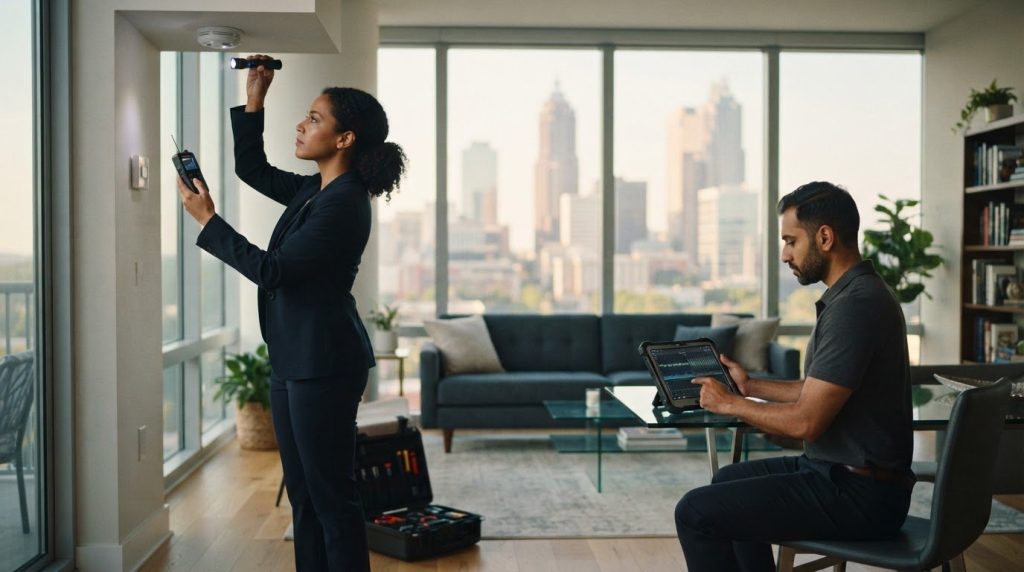
If you’re searching for “find hidden cameras atlanta,” the most useful first step may not be checking every corner. Start by establishing what prompted the concern and whether the space calls for a professional assessment. An unusual-looking object is not necessarily a camera, but uncertainty about privacy at home, work, or in a temporary space deserves a measured response.
A professional Technical Surveillance Counter-Measures (TSCM) sweep can help assess a concern and clarify what action, if any, is warranted. Palisade International LLC provides TSCM services as part of its security and investigative work for individual and business clients.
This guide explains when a professional camera-detection sweep may be appropriate, how a customized assessment is scoped, and how to prepare for it. It also explains what to consider when comparing a general visual check with a specialized TSCM response, so you can approach an Atlanta-area privacy concern with greater clarity.
Key Takeaways
- An unfamiliar object alone doesn’t establish that surveillance is present. A structured assessment helps put the concern in context.
- A professional sweep should be scoped to the space, authorized access, and specific concern, with technical findings interpreted by trained personnel.
- If you’re looking to find hidden cameras atlanta, compare assessment scope, discretion, relevant expertise, communication, and reporting.
- Prepare by confirming authorization and access, identifying the areas of concern, and recording factual observations without drawing conclusions.
- Palisade International provides TSCM services for Atlanta-area concerns, drawing on security and investigative expertise.
Suspect a Hidden Camera in Atlanta? Start with a Calm, Structured Assessment
A privacy concern deserves attention, but it doesn’t establish that a camera is present. Hidden-camera detection is a focused assessment of possible covert imaging devices in a defined space, such as a home, office, meeting room, or temporary accommodation. The aim is to examine the concern systematically and determine what the findings support, rather than treating every unfamiliar object as evidence of surveillance.
It’s also useful to distinguish concerns about private spaces from the public cameras people encounter every day. Georgia traffic-camera maps relate to public transportation infrastructure. A visible security camera at a building entrance is different from a suspected covert device in a space where people expect privacy. The setting and purpose matter: a general reference to “cameras in Atlanta” doesn’t show whether a particular private room needs an assessment.
A suspicion identifies a concern, an indicator gives a reason to examine it, and a professional assessment evaluates what the findings support.
What counts as a hidden-camera concern?
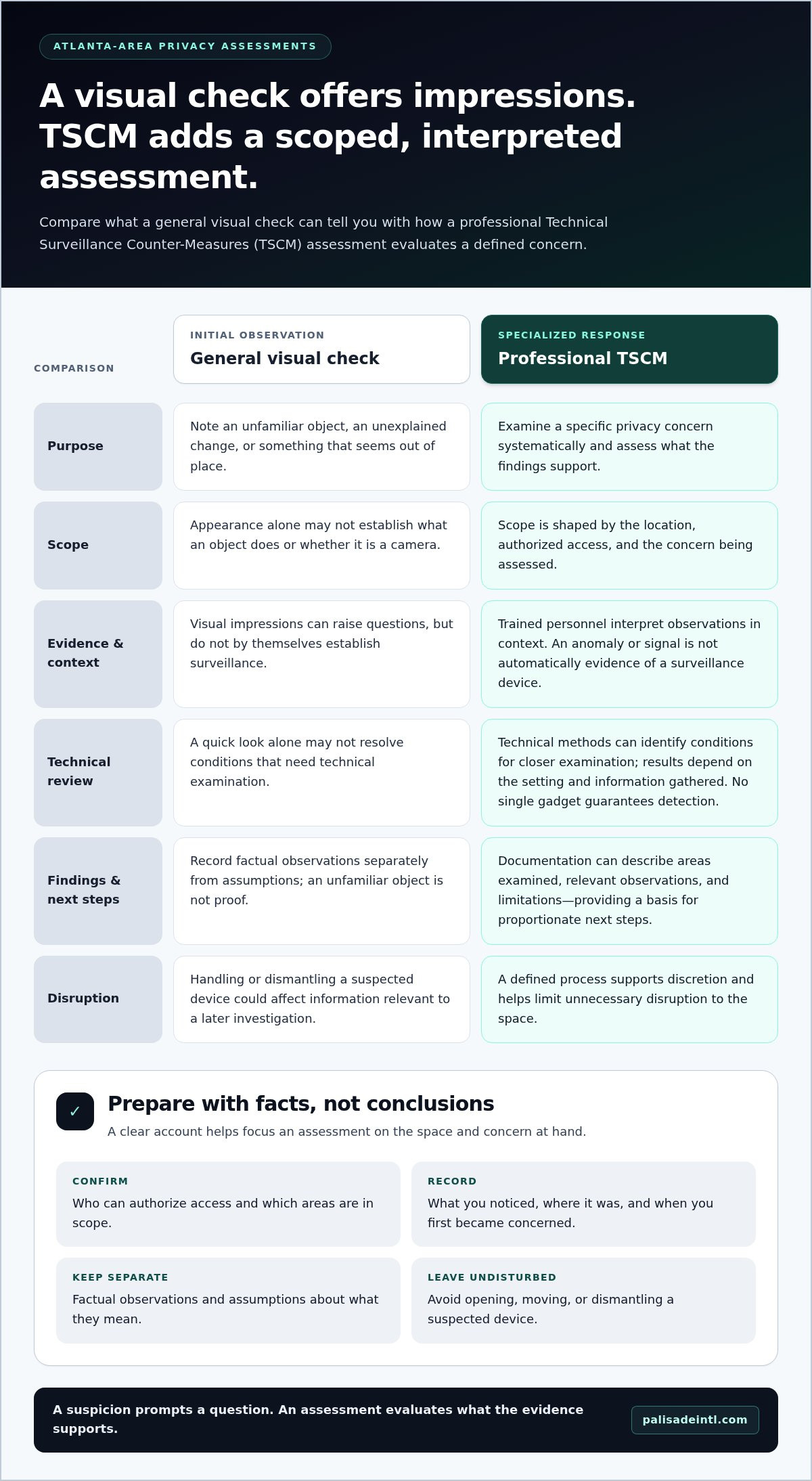
Concerns can arise in personal or professional spaces, including a bedroom, workspace, boardroom, or short-term accommodation. An unfamiliar object, an unexplained change to a room, or a device that seems out of place may prompt questions. These observations provide context, not proof. Everyday equipment can have a legitimate function, and appearance alone may not establish what an object does.
Record what you noticed, where it was, and when you first became concerned. Keep observations separate from assumptions. Avoid opening, moving, or dismantling an object. A factual account gives a specialist useful context and helps focus the assessment on the space and concern at hand.
When does an Atlanta-area concern call for professional help?
A scoped TSCM assessment may be appropriate when uncertainty persists, sensitive personal or business activity takes place in the space, or the potential consequences of a privacy breach warrant a more rigorous review. The scope should reflect the location, access, and concern, rather than assuming every situation calls for the same response. If you’re looking to find hidden cameras atlanta, consider whether a professional assessment would provide a more informed review than visual impressions alone.
If you suspect a device, leave it undisturbed. Moving or handling it could affect information relevant to a later investigation. Note its location and the surrounding circumstances, then share those observations during the assessment process. Palisade International’s professional TSCM guide explains how technical surveillance counter-measures relate to privacy concerns. The objective is not to amplify suspicion, but to establish a clear, discreet basis for practical next steps.
How Professional Hidden-Camera Detection Examines a Space
A professional hidden-camera assessment is not simply a generic room search or a demonstration of one device. It is a scoped TSCM process shaped by the location, authorized access, and specific concern. A residence, working office, and sensitive meeting space each have different layouts, equipment, privacy priorities, and operational needs. Defining the scope first helps keep the work relevant and proportionate.
What happens during a scoped TSCM assessment?
The process starts by establishing which spaces are in scope, who can authorize access, and what prompted the concern. The specialist can then plan an inspection suited to the environment and identify access limitations that may affect the work. A residence may call for attention to private living areas, while an office assessment may need to account for shared spaces and normal business operations. A sensitive meeting room may call for a narrower focus on its location and use.
During the assessment, trained personnel evaluate observations in context rather than treating one object or reading as conclusive. The client should understand the agreed scope and how updates and findings will be communicated. A defined process supports discretion, limits unnecessary disruption, and gives both parties a clear basis for discussing next steps.
How should technical findings be interpreted?
Technical methods can identify conditions that merit closer examination, but an anomaly or signal is not automatically evidence of a surveillance device. Ordinary electronics, building systems, nearby communications, and other environmental conditions can complicate interpretation. Results depend on the setting and information gathered, not simply on whether a tool registers something unusual. No single gadget guarantees detection.
Professional findings depend on the methods used, the context of the space, and documented observations considered together. A preliminary indicator calls for interpretation; a conclusion should reflect the assessment’s evidence and limitations. Clear documentation can describe the areas examined, relevant observations, and any limitations, then support practical next steps proportionate to the findings. It should not promise a particular result before the assessment takes place.
For anyone seeking to find hidden cameras atlanta, this is why a technical assessment involves more than a quick visual check. A careful scope helps focus the work on the actual concern, while informed interpretation helps explain what the findings do and do not establish. Palisade International provides Atlanta-area TSCM assessments tailored to the location and concern.
Choosing Hidden-Camera Detection in Atlanta: Compare Scope, Discretion, and Reporting
A useful comparison goes beyond whether someone will “check the room.” The quality of an assessment depends on how its scope fits the concern, how sensitive information is handled, what TSCM expertise informs the work, and how findings are explained. A general visual check can be a useful initial observation, but it is not equivalent to a properly scoped technical assessment.
| Consideration | General visual check | Scoped technical assessment |
|---|---|---|
| Scope | May focus on visible objects in a limited area. | Defines the locations, access, and specific concern to be assessed. |
| Discretion | Depends on who conducts the check and how information is handled. | Establishes expectations for discreet handling of the assignment and sensitive details. |
| Relevant expertise | May rely primarily on ordinary observation. | Applies specialized TSCM knowledge to interpret observations in context. |
| Communication | May offer an informal impression without a defined process. | Clarifies the assessment’s scope, limitations, and how findings will be communicated. |
| Findings | Can identify visible items but may not resolve uncertainty. | Can provide findings tied to the work performed and support proportionate next steps. |
What should a professional camera-detection engagement clarify?
The assignment should be shaped by the location, authorized access, timing, and the concern that prompted the request. A residence and an office may have different priorities; a sensitive meeting space may call for a clearly defined review. Setting these parameters helps avoid a generic approach and establishes what the assessment covers.
Palisade International tailors security work to the assignment. Discreet handling matters because the concern, the people involved, and details about a location can be sensitive. A clearly defined engagement also helps the client understand what was assessed and how to interpret the resulting information.
Why can consumer detectors and visual checks fall short?
Phone apps and inexpensive detectors vary in capability, and conditions in a particular environment can affect what they register. A consumer tool may identify an indication worth examining, but it cannot establish on its own that a camera is present. A negative result doesn’t prove that a space is clear, just as an unusual reading doesn’t confirm surveillance. Interpretation requires context.
People searching to find hidden cameras atlanta should treat consumer checks as inconclusive, not as a definitive clearance. Avoid confronting someone, tampering with suspected equipment, or making public accusations based on an unverified suspicion. A calm, documented assessment provides a more informed basis for deciding what to do next. Palisade International provides TSCM services for specific privacy concerns.
Before a Hidden-Camera Assessment in Atlanta: Prepare the Space and Preserve Information
A well-prepared assessment starts with clear authorization and a defined area of focus. Identify who can approve access, which rooms or spaces are included, and any practical limits on access. A residence, occupied office, and meeting room in active use may each require different coordination. Avoid searching, moving objects, or testing suspected equipment. Preserving the space as it is can help keep observations reliable.
What information helps define the assessment?
Share a concise, factual account of the concern. Identify the space, when you first noticed the issue, what you observed, and any relevant changes in access or room use. Separate direct observations from assumptions: “a device appeared in the room on Tuesday” is more useful than an unsupported conclusion about who placed it. This context helps focus the assessment without requiring you to conduct your own search.
Confirm that access is authorized and identify any areas outside the scope. If relevant, preserve dates, room schedules, or prior observations in a secure record. A short, neutral summary is often more useful than a long account that blends facts with speculation. If a suspected device is visible, note its location without touching or disturbing it.
How can organizations manage privacy and continuity?
In a workplace, coordinate access with the appropriate property representative or decision-maker and plan around the room’s normal use. Consider whether staff, visitors, or scheduled meetings could be affected, then limit disclosure to people with a legitimate need to know. This helps protect confidentiality while allowing the assessment to proceed within an agreed scope.
Organizations should also plan how to maintain essential work while the relevant space is being assessed. A team may need an alternate meeting location or a temporary adjustment to room access. Keep communications factual and restrained; broad announcements can expose sensitive information unnecessarily or encourage speculation.
Preparation does not require a legal conclusion. If legal questions arise, seek appropriate legal advice rather than relying on assumptions about what the law permits. For a privacy concern that intersects with broader fact-finding, the Atlanta private investigator guide offers related context on discreet investigative work.
If you’re preparing to find hidden cameras atlanta, clear authorization, access planning, and factual notes give a TSCM assessment a more precise starting point. Discuss a discreet TSCM assessment with Palisade International to develop a scope suited to the space and concern.
Palisade International’s Atlanta-Area TSCM Response: Discreet, Customized Next Steps
A suspected hidden camera calls for careful evaluation, not a predetermined conclusion. Palisade International LLC is a Georgia-based security and investigations agency that provides Technical Surveillance Counter-Measures (TSCM) for individual and business clients. Founded in 2003, the firm brings broader security and investigative expertise to Atlanta-area concerns. Its team includes professionals with military or law-enforcement backgrounds.
Detecting a possible device is only part of the assignment. Observations must be interpreted in context, with attention to the location, authorized access, and concern that prompted the assessment. A discreet, customized engagement can define the areas in scope, coordinate the work, and clarify how findings will be communicated. The objective is a measured understanding of the situation, followed by practical next steps based on the assessment.
What makes a specialist-led response relevant?
TSCM addresses technical surveillance concerns through a focused, professional assessment. Its value is not in implying that every concern will reveal a device, but in applying relevant expertise to examine the assignment and interpret available information. Palisade International tailors its security work to the situation, aligning the scope with the client’s privacy priorities, environment, and operational needs.
Discretion is central to sensitive work. Whether the concern involves a private residence, workplace, or meeting environment, communication and access can be considered as part of a customized engagement. Findings are specific to the work performed; no general statement can predetermine what an assessment will establish or what action will be appropriate.
How to take the next step
For an initial inquiry, describe the type of location, the areas that concern you, and the observations that led you to seek an assessment. Keep the account factual and concise. You don’t need to decide whether an object is a camera before speaking with a specialist. A tailored discussion helps clarify the concern and define an appropriate scope without assuming an outcome.
People searching to find hidden cameras atlanta can approach the issue more clearly by treating TSCM as a specialized assessment, not a guaranteed answer. Findings depend on the location, scope, access, and available observations. Palisade International’s Atlanta-area response is shaped around those specifics, with discreet coordination and practical communication guiding the engagement.
Discuss a discreet TSCM assessment with Palisade International to describe your concern and begin a tailored conversation about next steps.
Move Forward with a Clearer Basis for Action
Privacy concerns can create pressure to act before the facts are clear. A more deliberate next step is to seek an assessment suited to the situation, then make decisions based on what it establishes. This replaces open-ended uncertainty with a defined process, whether the concern involves a personal space or a business environment.
If you’re considering how to find hidden cameras atlanta, focus on clarity rather than assumptions. A discreet conversation can help frame the concern and identify a suitable way to proceed without presuming what an assessment will find.
Request a tailored TSCM discussion with Palisade International to describe your concern and take the next step with care.
Frequently Asked Questions
Can a professional find hidden cameras in a home or office?
Yes. A professional TSCM assessment can examine a defined area in a home, office, or other authorized space for possible covert imaging devices. Scope depends on the location, access, and concern, so a residence and a working office may require different priorities. Findings apply to the areas and conditions assessed; they are not a guarantee about every device or future change.
How do professionals detect hidden cameras?
Professionals use careful physical examination and technical methods selected for the setting. Depending on the assessment, TSCM methods may include tools that evaluate electronic signals or other indicators, but no single instrument establishes a finding on its own. Specialists interpret observations in context because ordinary devices and environmental conditions can produce misleading results. The process involves more than looking for a lens or an unusual object.
Are phone apps reliable for finding hidden cameras?
Phone apps aren’t a reliable way to clear a room. Their functions and capabilities vary, and a phone may not identify every type of device or distinguish a meaningful result from ordinary environmental activity. An app alert near common electronics, for example, doesn’t prove a camera is present. A negative result also can’t confirm that a space is free of surveillance. Treat app results as inconclusive, not as evidence.
What should I do if I find a device that may be a hidden camera?
Don’t touch, unplug, open, or remove it. Handling a suspected device could alter its condition or affect information that may matter later. If it’s safe, note where and when you noticed it, and restrict unnecessary access to the area. If you believe a crime may have occurred, consider notifying law enforcement before anyone disturbs the device. Avoid confronting someone based on an unverified conclusion.
Can a hidden-camera assessment be conducted discreetly in Atlanta?
Yes. A discreet assessment can be planned around the location, authorized access, and the client’s privacy and operational needs. In an office, coordination may account for room schedules and staff access; in a residence, the scope can focus on agreed areas. Limit sensitive details to people who need them, and provide factual information so the assessment can be coordinated appropriately.
What happens if a professional assessment finds no hidden camera?
A finding of no camera means none was identified within the assessment’s scope and conditions; it doesn’t establish that every possible space or device has been ruled out. Ask for a clear explanation of the areas examined, relevant limitations, and any observations that warrant follow-up. If circumstances change or a new concern arises, those details can inform a separate assessment. A measured finding can still help guide decisions.