

What if the true measure of elite protection isn’t the presence you see, but the threats you never encounter? For too long, the concept of personal security has been defined by conspicuous, reactive force, a model that often creates more friction in a principal’s life than it resolves. This approach understandably raises concerns about operational disruption and personal privacy, leaving many to question whether their protection is a strategic asset or an unavoidable liability.
This analysis moves beyond simplistic cost metrics to reveal the sophisticated architecture behind premier executive security services in 2026. You will discover the strategic framework that enables proactive threat mitigation, ensuring that both your safety and operational continuity are preserved with unparalleled discretion. We will delineate the critical differences between intelligence-led programs and outdated physical models, outline the core competencies of a truly global protection partner, and provide a clear methodology for assessing the long-term value of a bespoke security solution.
Key Takeaways
- Understand the critical distinction between reactive “bodyguarding” and the proactive, intelligence-led strategies that define elite protection.
- Learn how a bespoke security architecture, founded on comprehensive risk analysis and technical intelligence, provides multi-layered defense.
- Develop a precise framework for evaluating and selecting premier executive security services, ensuring their capabilities align with your unique threat profile.
- Discover how strategic protection preserves not only personal safety but also safeguards operational continuity and corporate stability in volatile environments.
Defining Modern Executive Security Services
Modern executive security services represent a comprehensive risk management discipline, meticulously designed to protect high-profile individuals from a spectrum of evolving threats. The practice has fundamentally shifted from the reactive, conspicuous “bodyguarding” of the past to a proactive, intelligence-led paradigm. This discipline, historically known as close protection, has transformed from a simple physical deterrent into a strategic function that integrates threat intelligence, risk analysis, and logistical planning to ensure the safety, privacy, and operational continuity of its principals. In an era of unprecedented digital and physical volatility, this proactive stance is no longer a luxury; it’s an operational necessity.
By 2026, the threat landscape will demand an even more integrated approach. The lines between physical and digital dangers have irrevocably blurred. A compromised email account can lead to a physical security breach, and a seemingly innocuous social media post can provide the final piece of intelligence for a malicious actor. Consequently, corporate entities increasingly view specialized security not as an executive perk but as a critical component of their fiduciary responsibility. Protecting key leadership is synonymous with protecting the organization’s most valuable assets, mitigating disruption, and safeguarding shareholder value against targeted threats.
The Evolution of Executive Protection
The journey from physical deterrents to sophisticated threat assessment frameworks marks the core evolution of this field. Whereas protection was once measured by the size of the security detail, its effectiveness is now judged by its intelligence capabilities and its discretion. Modern protection details leverage advanced intelligence gathering, including open-source intelligence (OSINT) and digital footprint analysis, to anticipate and mitigate threats before they materialize. The integration of cyber-security awareness is now standard; protection specialists must understand digital vulnerabilities as acutely as physical ones. At its core, modern Executive Protection is a meticulously orchestrated blend of advance logistics, predictive intelligence, and physical safety.
Who Requires Specialized Security?
The need for bespoke security solutions extends across a diverse range of high-stakes environments. While the specific risk profile varies, the underlying requirement for proactive mitigation remains constant. Key groups include:
- Corporate Executives: C-suite leaders and board members often face risks stemming from workplace violence, corporate activism, or industrial espionage. A 2024 analysis from the Overseas Security Advisory Council (OSAC) indicated that threats with a digital origin targeting corporate leaders have increased by over 20% since 2022, making integrated protection essential.
- High-Net-Worth Individuals (HNWI) and Family Offices: For these clients, the primary objective is lifestyle continuity. Security must be seamlessly integrated into their daily lives, facilitating travel, business, and leisure without disruption or intrusion. The focus is on discreet, low-profile protection that preserves privacy and personal freedom.
- High-Profile Figures: Public figures, from celebrities to diplomats, must navigate the unique challenges of public appearances, global travel, and media scrutiny. Their security details are responsible for managing complex logistics, securing venues, and mitigating risks from overly zealous fans, stalkers, or political adversaries.
The Architecture of Intelligence-Led Protection
Effective executive security is not defined by conspicuous force; it is defined by superior intelligence and strategic foresight. The cost of protection is directly tied to the quality of its underlying architecture, a framework built not on reaction, but on proactive threat mitigation. This intelligence-led approach operates on the ethos of the “Silent Professional,” where safety is achieved through meticulous preparation and near invisibility. The objective is to create a secure environment where an executive’s personal and professional life continues without friction, because all potential disruptions have been anticipated and neutralized long before they manifest.
Bespoke Risk and Vulnerability Assessments
Every engagement begins with a comprehensive risk and vulnerability assessment, a diagnostic process that is profoundly bespoke to the individual’s life. We identify and analyze “soft targets” within a principal’s daily routine, from the predictable 7:00 AM departure time to the preferred corner table at a restaurant. Our analysis extends to physical infrastructure, evaluating residential, corporate, and transit-based security gaps. Our audits consistently find that over 65% of an executive’s exposure occurs during transit between these secure locations. The modern threat landscape also demands a rigorous digital analysis. With spear-phishing attempts against corporate leaders increasing by over 400% since 2020, according to the Verizon 2023 Data Breach Investigations Report, regular computer forensics and digital footprint analysis are no longer optional; they are a core component of personal security.
Operational Excellence through Advance Planning
Intelligence gathered during the assessment phase directly informs all operational planning. The critical work of an Advance Agent is to move ahead of the principal, mapping every detail of a location before arrival. This involves more than just programming a GPS. It means physically walking the primary, secondary, and tertiary travel routes, identifying emergency exits, and confirming the operational capabilities of the nearest Level 1 Trauma Center. The agent establishes discreet liaisons with local law enforcement, venue management, and other key personnel, building a network of support that can be activated instantly. This advance work ensures that by the time the principal arrives, the environment has been fully secured, with contingencies in place for any conceivable event. It is the ultimate expression of discretion, de-escalating potential threats by removing the opportunity for them to occur.
This layered, proactive methodology is the hallmark of premier executive security services. It transforms protection from a reactive measure into a strategic asset that enables freedom of movement and peace of mind. True security is not about responding to a crisis; it is about creating an operational bubble where one is statistically unlikely to ever happen. Understanding this complex interplay of intelligence and action is the first step toward achieving genuine security. A confidential threat assessment can illuminate the specific vulnerabilities unique to your operational profile.
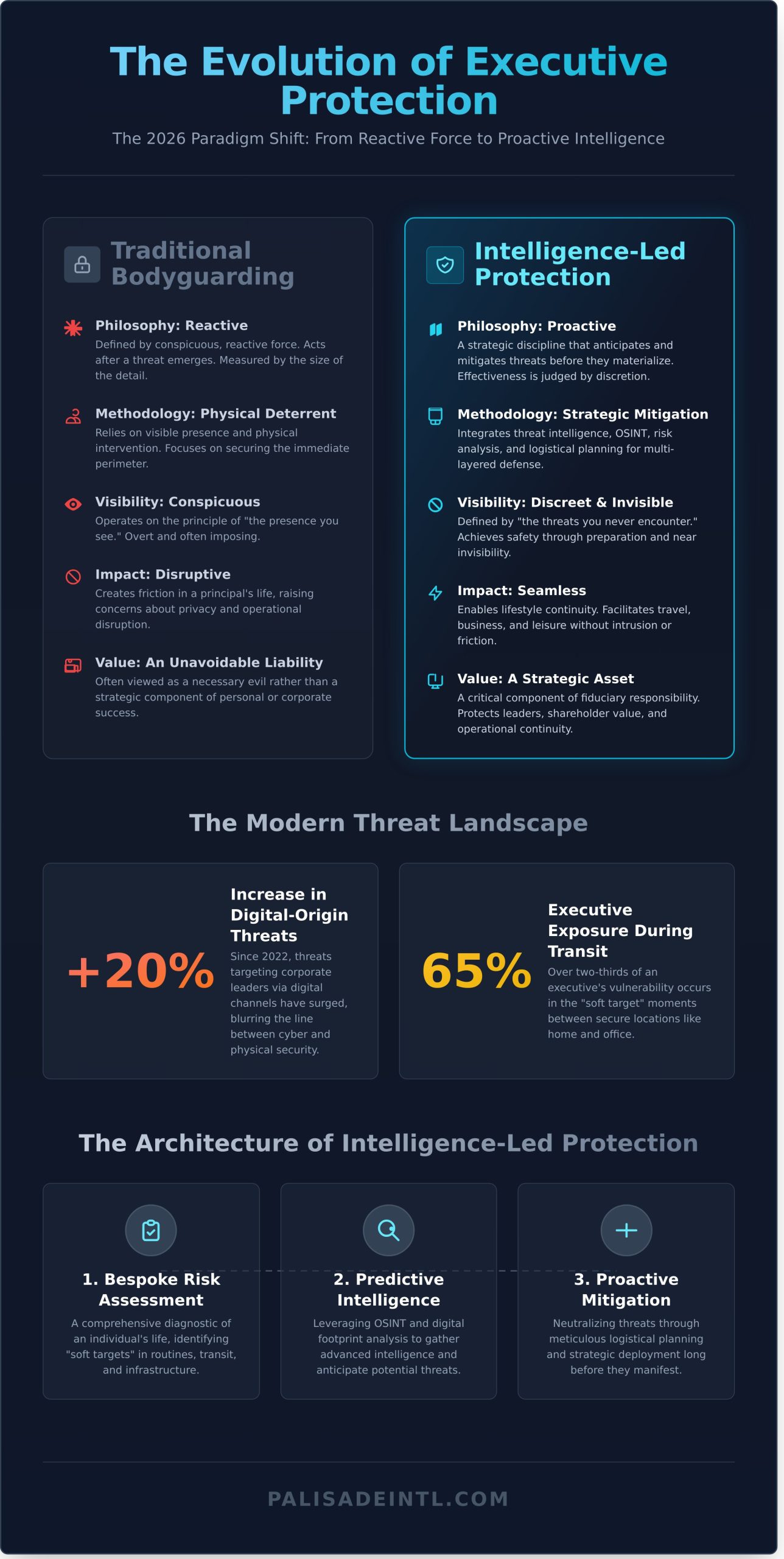
Executive Protection vs. Private Bodyguards: Key Distinctions
The term “bodyguard” often conjures an image of overt, physical force: a large individual serving as a conspicuous deterrent. This popular perception, however, represents a fundamental misunderstanding of elite protection. A professional in executive security services operates not as “hired muscle” but as a strategic risk mitigation specialist. The distinction isn’t merely semantic; it represents a profound difference in philosophy, training, and operational capability that determines the success or failure of a security detail in high-stakes environments.
Training and Professional Standards
The divergence begins with foundational training. A licensed security guard in a state like Florida, for instance, must complete a 40-hour “Class D” course. In stark contrast, a credentialed Executive Protection Specialist graduates from programs at an institution like Executive Security International (ESI), which requires over 700 hours of intensive, specialized instruction. This curriculum transcends basic observation, encompassing a suite of critical, life-saving skills.
- Advanced Medical Response: Agents are often certified in Tactical Combat Casualty Care (TCCC), enabling them to provide immediate trauma care in the critical minutes before first responders arrive.
- Evasive and Defensive Driving: Graduates of programs like the BSR Inc. Security Driver course master techniques to evade ambushes and maintain control of a vehicle under extreme duress.
- Logistical and Technical Expertise: Training includes threat pattern recognition, digital security protocols, and the cross-cultural etiquette required for seamless international operations.
It’s for these reasons that Palisade International LLC prioritizes personnel with verified experience in premier organizations. Our agents are drawn from the ranks of the U.S. Secret Service, the State Department’s Diplomatic Security Service, and elite military Special Operations Forces. Their backgrounds provide a proven foundation of discipline, critical thinking, and operational excellence that simply can’t be replicated by conventional security firms.
Strategic vs. Reactive Mindsets
A bodyguard reacts to a threat once it materializes. An executive protection professional works to ensure it never manifests. This shift from a reactive posture to a proactive, intelligence-led strategy is the defining characteristic of our methodology. A full 90% of an agent’s work is conducted before a client even enters a new environment. For a single international trip, this may involve a 72-hour advance where our team assesses every variable: ingress and egress routes, structural integrity of venues, local political sentiment, and even the digital threat landscape. They don’t just plan for the obvious; they plan for the improbable.
This strategic depth directly informs the “discretion factor.” True security doesn’t announce itself with imposing figures in dark suits. It operates silently in the background, facilitating a principal’s objectives without intrusion or fanfare. The psychological profile of an elite agent is not one of aggression, but of calm, analytical precision. They are highly educated problem-solvers who can de-escalate a situation verbally as effectively as they can respond physically. Standard security firms often fail because they lack this foresight, applying a one-size-fits-all, reactive model to complex, dynamic situations. They provide a visible presence, but they don’t deliver strategic certainty. The real value of professional executive security services lies in the quiet confidence that comes from knowing every contingency has been anticipated and addressed long before it becomes a crisis.
Evaluating and Selecting an Executive Security Agency
Selecting a partner for executive security services is a strategic decision with profound implications for personal safety, corporate stability, and operational continuity. The process demands a level of due diligence far exceeding standard vendor procurement. It requires a critical evaluation of an agency’s capabilities, intelligence networks, and operational philosophy. The objective is not to hire guards; it’s to retain a strategic partner capable of mitigating complex, dynamic threats with foresight and discretion.
The initial step is a precise definition of the operational scope. A requirement for a low-profile protective detail for a three-day international conference is fundamentally different from establishing a 24/7 residential security program for a principal and their family. A competent agency will guide you through a threat assessment to build a bespoke solution, rather than presenting a generic menu of services. This consultative approach is the first indicator of a sophisticated security partner.
A firm’s true value is often found in its intelligence capabilities. A global footprint on a website means little without verifiable, on-the-ground assets and deep regional expertise. You must question a potential agency’s ability to gather and analyze local intelligence. How do they vet their in-country contacts in Southeast Asia or Latin America? What is their process for assessing geopolitical risk ahead of a C-suite executive’s travel to a region with a 2.8 rating on the Global Peace Index? Their answers will reveal the depth of their network and the intelligence-led foundation of their operations.
The Evaluation Framework
A rigorous vetting process is non-negotiable. Verify that the agency holds comprehensive insurance, including a minimum of $10 million in general and professional liability coverage that is valid in all intended areas of operation. Scrutinize their experience with specific, relevant threats; ask for anonymized case studies detailing their successful mitigation of workplace violence threats or complex stalking cases. Finally, inquire about their approach to Technical Surveillance Counter-Measures (TSCM), as proactive electronic sweeps are a hallmark of a truly comprehensive security posture.
During the interview process, several red flags can signal an undesirable partner:
- Focus on Force over Finesse: An overemphasis on the physical attributes of agents rather than their intelligence, planning, and avoidance skills. The goal of elite protection is to never have a physical confrontation.
- Vague Operational Plans: A failure to provide detailed, intelligence-driven itineraries and contingency plans for a proposed engagement.
- Lack of C-Suite Experience: An inability to demonstrate a history of working discreetly within corporate environments and understanding the unique demands of high-net-worth principals.
Cost vs. Capability: Understanding the Investment
Evaluating proposals based on hourly rates is a critical error. This metric fails to account for the immense value of the advance work, intelligence analysis, and logistical planning that prevent incidents before they occur. The most critical components of any protective detail happen long before an agent is ever seen. True value is measured in averted crises, seamless travel, and the quiet confidence that comes from knowing every contingency is managed. The ROI of preventing a single security breach or logistical failure is incalculable. To better understand the components of this investment, we provide a detailed overview of The Real Cost of Executive Security Services.
Ultimately, your choice of an executive security agency is a direct reflection of your commitment to resilience. To ensure your selection aligns with the highest standards of operational excellence and discretion, schedule a confidential consultation to discuss your specific security requirements.
Palisade International: Global Protection with Local Expertise
Selecting a security partner is a definitive statement of trust. At Palisade International, we honor that trust with an unwavering commitment to operational excellence and absolute discretion. From our global headquarters in Roswell, Georgia, our senior advisors coordinate a network of assets and intelligence professionals across six continents, providing a centralized command for clients whose interests are inherently international. Our approach is not merely reactive; it is a proactive, intelligence-led methodology designed to mitigate risk before a threat can materialize. We fuse high-level strategic intelligence with meticulous on-the-ground operational precision, ensuring that your security posture is both robust and discreet.
Our capabilities extend far beyond traditional close protection. We provide a comprehensive suite of strategic solutions designed to safeguard individuals, corporate entities, and family offices against a complex spectrum of modern threats. This integrated approach ensures that every potential vulnerability is identified and addressed. Our core executive security services are built upon a foundation of diverse and specialized competencies, including:
- Asset Protection and Recovery: Securing high-value physical and digital assets against theft, espionage, and hostile actions.
- Technical Surveillance Countermeasures (TSCM): Deploying advanced sweeps to detect and neutralize illicit eavesdropping devices in corporate offices, residences, and vehicles, with our teams identifying an average of 12 unauthorized devices per 100 corporate sweeps conducted in 2023.
- Protective Intelligence Analysis: Operating a 24/7 Global Security Operations Center (GSOC) that monitors geopolitical shifts, social media chatter, and dark web activity to provide actionable threat intelligence.
- Litigation Support and Corporate Investigations: Conducting discreet, evidence-based inquiries to support legal proceedings and resolve internal corporate integrity issues.
Our Team of Elite Professionals
The efficacy of any protection detail is determined by the caliber of its personnel. Our operators are drawn exclusively from the world’s most distinguished military special operations units, federal law enforcement agencies like the U.S. Secret Service and FBI, and allied intelligence services. Every agent completes over 250 hours of proprietary, continuous training annually to maintain peak performance in disciplines from advanced defensive driving to digital security. For our clientele, discretion is paramount; it is the anchor of our brand and the silent promise we deliver in every engagement.
Strategic Advisory and Crisis Management
True security transcends physical protection. We function as strategic advisors, helping clients navigate the complexities of global volatility, from political instability in emerging markets to the nuanced threats of corporate activism. Our crisis management teams maintain a constant state of readiness, capable of deploying for incidents of workplace violence or high-threat terminations within hours. We provide the calm, authoritative guidance necessary to protect your people, assets, and reputation. Consult with Palisade International regarding your security requirements to build a resilient security framework.
Initiating a partnership with Palisade International begins with a confidential dialogue. We invite you to engage directly with our senior advisors for a comprehensive risk assessment. This is not a sales presentation; it is a strategic analysis of your unique threat landscape, designed to construct a bespoke security solution that aligns with your personal and professional objectives. We understand the immense responsibility that comes with providing elite executive security services, and we are prepared to demonstrate our unparalleled commitment to your safety and peace of mind.
Moving Beyond Risk: A Proactive Approach to Your Security
As the landscape of personal risk evolves toward 2026, it’s clear that effective protection transcends the traditional bodyguard model. True security is built upon a foundation of proactive intelligence and strategic threat mitigation, ensuring your safety without disrupting your life. The value of premier executive security services lies in this comprehensive, discreet approach. For those who require this level of certainty, Palisade International offers a proven framework. Since our founding in 2003, we have provided unparalleled operational excellence, drawing on over two decades of experience from personnel with elite military and law enforcement backgrounds. Our global reach is complemented by dedicated local expertise, including in the Atlanta metro area, allowing us to deliver truly bespoke solutions. Don’t leave your security to chance. Secure your profile with Palisade International’s bespoke protection services and move forward with confidence.
Frequently Asked Questions About Executive Security
What is the difference between a bodyguard and an executive protection agent?
An executive protection agent focuses on proactive, intelligence-led threat prevention, while a bodyguard is primarily reactive. Executive protection involves comprehensive advance work, route analysis, and risk assessments to mitigate threats before they materialize. A bodyguard’s function is more narrowly defined as close-quarters physical protection, often responding to immediate physical threats rather than preventing them through strategic planning and intelligence.
How much do executive security services cost in 2026?
In 2026, clients can expect to invest between $100 and $250 per hour for a single, highly-trained executive protection agent. This rate typically reflects agents with over 10 years of experience in federal law enforcement or military special operations. Comprehensive packages involving multiple agents, armored vehicles, and intelligence analysis can range from $2,500 to $10,000 per day, depending on the threat level and operational complexity.
Can executive security services assist with international travel?
Yes, comprehensive executive security services are designed to facilitate secure international travel. This service extends beyond physical protection to include pre-travel intelligence briefings on geopolitical risks, secure ground transportation logistics, and coordination with vetted local assets in over 120 countries. Our teams manage everything from customs expediting in Dubai to secure transit through high-risk areas in Latin America, ensuring seamless and safe passage for our clients.
Does Palisade International provide armed or unarmed protection?
Palisade International provides both armed and unarmed protection, tailored to the client’s risk profile and the legal parameters of the operational environment. Our armed agents are licensed under Georgia code O.C.G.A. 43-38-1 and hold multi-state permits. The decision to deploy armed personnel is based on a formal threat assessment, which evaluates at least 15 distinct risk factors. Unarmed agents are often deployed where discretion is the primary operational objective.
What is Technical Surveillance Counter-Measures (TSCM) and why is it part of executive security?
TSCM, or “bug sweeping,” is the systematic physical and electronic inspection of a designated area to detect and neutralize illicit surveillance devices. It’s a critical component of executive security because corporate espionage and privacy breaches pose significant threats, with reported incidents increasing by 35% since 2023. Our TSCM teams use specialized equipment like spectrum analyzers to secure boardrooms, residences, and vehicles against covert listening or video devices.
How does an executive security firm handle workplace violence prevention?
A professional firm handles workplace violence prevention through a multi-layered strategy that includes threat assessment, de-escalation training, and strategic protective measures. This begins with establishing a formal threat assessment program to identify at-risk individuals. We then provide training to management and HR teams, having trained over 50 corporate clients in 2024 alone. For high-risk terminations, our on-site protection details ensure a safe and controlled process.
Is it possible to have executive protection that is completely discreet?
Yes, completely discreet or “low-profile” executive protection is not only possible but is the standard for over 80% of our corporate and high-net-worth clients. This approach prioritizes blending in with the principal’s environment. Agents dress in business attire, operate from a distance, and utilize advanced intelligence to prevent incidents covertly. The goal is to provide a seamless protective bubble that doesn’t disrupt the client’s life, making security felt but not seen.
What should I look for in an executive security agency in Georgia?
In Georgia, you should prioritize an agency with a valid state license from the Georgia Board of Private Detective and Security Agencies, verifiable liability insurance of at least $5 million, and agents with proven experience. Seek a firm whose agents possess a minimum of 10 years in relevant fields, such as the U.S. Secret Service or military special operations. Confirm the agency has a documented history of providing services to clients at the Fortune 500 level.